
Portrait of Ria Munk III: The Face Klimt Finished, the Dress He Left in Charcoal
1917: The Last Year Klimt Spent Painting in Vienna
Gustav Klimt painted Portrait of Ria Munk III in 1917, during the last full year he spent working in his Vienna studio before his death in 1918.
By 1917 Klimt had spent decades as the painter Vienna’s wealthiest families called on when they wanted a portrait of a wife, mother or daughter for the drawing room. Industrialists, bankers and their relatives sat for him in turn, and each commission added to a reputation built across years of society portraits. He had also helped found the Vienna Secession, the exhibition society that broke Austrian art away from its conservative academy, and had stood as its best-known face for years before this canvas.
His style had moved on from the gold surfaces that made his early portraits famous. By the time he painted this canvas, gilding had mostly disappeared from his work, replaced by loose, saturated colour and the kind of ornament he studied in the Chinese and Japanese textiles, screens and prints he collected and kept around his studio. Figures in these late paintings tend to stand full length, wrapped in pattern that spreads into an equally patterned background, so the line between sitter and setting grows harder to find.
Flowers filled the space gold once occupied. In his final portraits Klimt packed the ground around a sitter with dense fields of blossom, laid in directly with the brush rather than built up in gold leaf, so the face sits against a wall of colour instead of a wall of metal. The same change showed in the garden and orchard paintings he made in these same years, built from the same small, dense strokes of saturated colour.
He was working on several such portraits of young Viennese women at the same time, this canvas among them, when his health failed. Early in 1918 he suffered a stroke, then caught the influenza moving through Vienna that winter, and died within weeks, still in his fifties.
A number of canvases stayed behind on his easels when he died. Their backgrounds were carried close to completion while their figures remained in charcoal outline, waiting for paint that never arrived. Portrait of Ria Munk III, begun the year before, was one of them, left exactly as his hand last touched it.
A Finished Face Set Against an Unfinished Gown
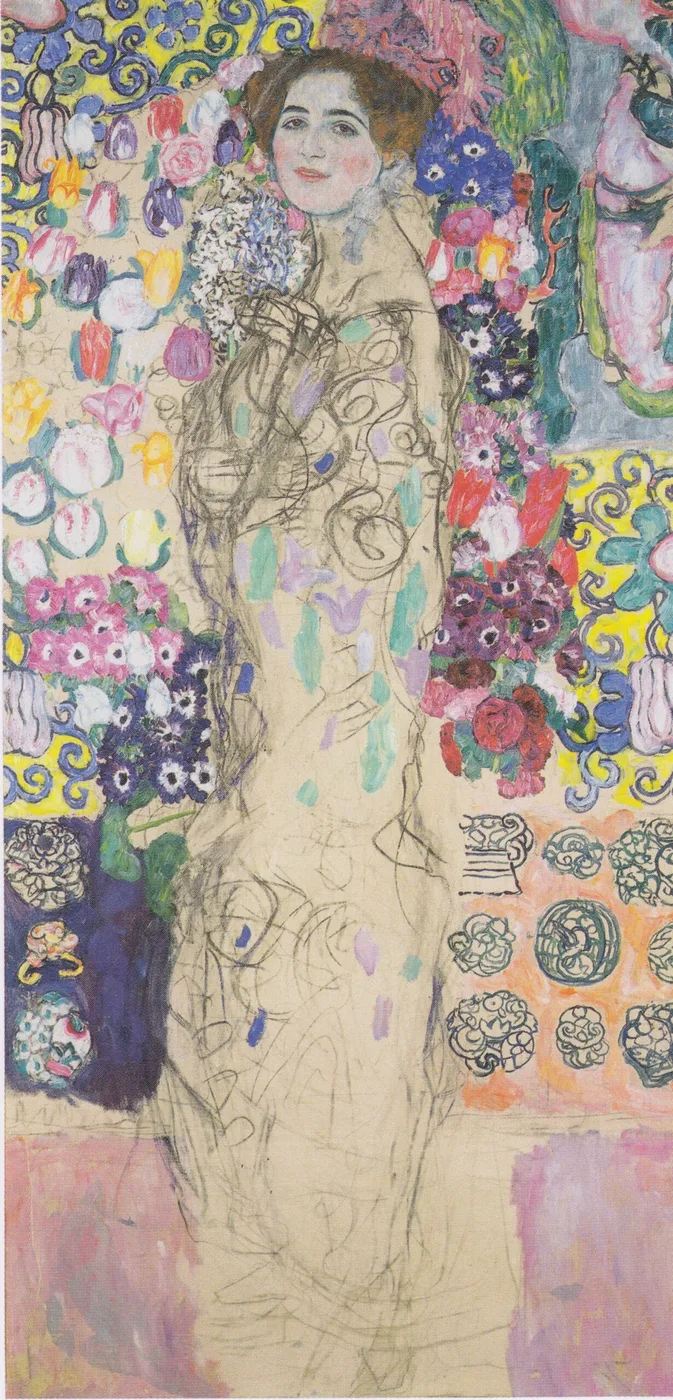
The canvas is tall and narrow, and the figure fills nearly its whole height. She stands left of centre, turned at an angle while her face meets the viewer directly, and the hem of her gown runs down into a plain stretch of pale pink floor at the bottom edge, broken only by a deeper rose-coloured block in the corner. The palette stays warm everywhere except the gown itself, which keeps the raw cream tone of the canvas underneath it.
Only the head, neck and a sliver of chest are fully painted. The skin is pale and flushed pink at the cheeks, the hair a dark auburn pinned close to the head with a small flower tucked into it, the mouth a small red shape, the eyes outlined in brown under dark brows. Set against the loose charcoal lines below it, the face reads as the one finished passage in the whole picture.
Below the collarbone the gown exists mostly as drawing. Long, spiralling charcoal lines loop and cross over the torso and down the legs, sketching the fall of the fabric, and only a few patches of colour sit inside them: lavender, pale jade green, and small dabs of blue scattered like buttons down the front. A spray of white and lilac blossom rests against her shoulder, held in a hand that is itself barely more than an outline.
Behind her left shoulder the wall turns into a mustard-yellow field scrolled with blue paisley curls, and tulips in pink, white, red and violet rise through it in loose dabs of paint. Lower down, a dark indigo vase holds a dense bunch of pink, white and magenta blossom, packed tightly enough to read as a single block of colour from a distance.
On the other side the wall changes again. An orange-salmon ground carries rows of grey-green medallions, each one a small coiled motif repeated in a grid. A small painted scroll, marked with a few strokes of blue, sits among them like a label pinned to the pattern, the only hint of text anywhere on the canvas. Above, a swathe of green and a mottled pink-grey passage close the composition at the top right corner.
No single light source models the figure the way a window or a candle would in an older portrait. Colour supplies the light instead: the yellow field and the orange panel push forward, the indigo square pulls back, and the charcoal-covered dress sits paler than everything around it. The eye moves between these zones rather than settling on one, since no passage carries more weight through shadow or highlight than any other.
The brushwork in the finished areas is thick and visible, short dabs for the petals and longer strokes for the flat colour fields. The dress carries none of that paint. It holds only the thin, dry line of the drawing underneath, with no layer of colour laid over most of it.
A Woman Held Inside a Field of Flowers
The painting shows, first of all, a young woman placed inside a decorative field as much as in front of it. Her face is the one clearly resolved form on the canvas. Everything else, from the gown to the flowers around her, is handled as pattern first and as object second.
Read this way, the dense background acts as a second subject competing for attention beside her. Klimt gave several of his late portraits of women this treatment, a figure held inside a field of ornament so thick that the eye has to search for where she begins. A bolt of patterned silk or a wall of blossom could carry as much weight in these pictures as the sitter herself.
The unfinished dress invites another reading, one about time rather than meaning. Seen beside the finished face and the finished background, the charcoal lines and half-filled patches of colour read as a portrait stopped partway between drawing and paint by the interruption of 1918.
The bouquet she holds sits inside the same field of flowers that fills the wall behind her, almost indistinguishable from the blossoms painted into the background. The line between a woman and her setting blurs often in Klimt’s late work, and this canvas pushes that blur further than most, since half of the figure is still only a drawing.
Where This Portrait Sits Among Klimt’s Last Women
Portrait of Ria Munk III belongs with a small group of female portraits Klimt worked on in his final years, pictures that share the same loosened, flower-packed style and the same move away from gold. Amalie Zuckerkandl, another portrait from this stretch of his career, was left in a similarly unfinished state when he died, its figure still partly in sketch while its setting carries more finish.
The same density of pattern and flower runs through other late works. Lady with a Fan, painted in the same late period, carries a similar weight of ornament around its sitter, and it too was still unfinished at his death.
Earlier in his career, portraits such as Fritza Riedler relied on gold ground and geometric ornament, with none of the flowers or loose colour of this later canvas, a measure of how far Klimt’s portrait style had travelled by 1917.
Choosing an Oil or a Print of This Portrait
Every reproduction of Portrait of Ria Munk III sold in this shop starts from the same photograph of the original painting. Both editions, the hand-painted oil and the archival canvas print, are made from that image, so choosing between them is a question of method and feel rather than a different version of the picture.
The hand-painted oil edition is painted from scratch by an artist working in oil on canvas, building the large fields of colour first, then the flowers and medallions, then the fine detail of the face. Because a person paints it by hand, no two canvases come out identical, and the brushwork catches light as you walk past it, which suits the thick petals and scrollwork of this background well. Painting the oil by hand takes 2 to 4 weeks.
The archival canvas print is a high-resolution giclee print of the same image on canvas, with colour and detail that stay consistent from one print to the next. It suits a dependable result or a smaller budget, and the difference between the two editions is set out in the shop’s comparison guide. Printing takes 2 to 4 business days.
Every size keeps the tall, narrow proportion of this canvas, so the figure is never cropped or stretched to fit a standard rectangle. Because the painting is dense with flowers and ornament from edge to edge, a larger size reads better than a small one, letting the pattern separate into tulips, medallions and blossom instead of blurring into a single field of colour from across the room. Check the available sizes and frames on the product page before you choose.
Before a hand-painted piece leaves the studio, it is photographed so you can see and approve the finished canvas before it ships. Delivery then takes 5 to 7 business days.
Questions Readers Ask About This Portrait
What does Portrait of Ria Munk III show?
A young woman in a full-length gown, her face and neck fully painted and her dress still in loose charcoal drawing, set against a background of flowers, scrollwork and patterned medallions finished in oil.
Why does part of the painting look unfinished?
Klimt died in 1918, the year after he began this canvas, and left several late portraits with their backgrounds carried further than their figures.
Is the sketch-like dress a deliberate effect?
No. Klimt’s death in 1918 interrupted work on the canvas before the dress reached the same finish as the face and the background.
Which editions and sizes are available?
The piece comes as a hand-painted oil or an archival canvas print, in sizes that keep the original’s tall, narrow proportions, shown on the product page.
How long does a hand-painted reproduction take to arrive?
Painting the oil by hand takes 2 to 4 weeks. Delivery after that takes 5 to 7 business days.
More from this collection
Bring this painting home
Choose a hand-painted oil reproduction for real brushwork, or an archival canvas print for a crisp museum-image edition. Every size preserves the original proportions.
View this work & options
Further reading
Verify the original in the collection record and continue through related works in the catalogue.