
Klimt and Vienna Secession
To every age its art
The motto over the door of the Secession building reads: to every age its art, to art its freedom. Klimt helped write that argument in paint. Flat gold grounds he had seen in the mosaics of Ravenna, ornament borrowed from Japanese prints, and figures that sit inside the pattern rather than in front of it: the Vienna Secession treated decoration as serious art, and Klimt took the idea further than most.
Browse the collectionVienna Secession was a break from the official art world of its day, and Gustav Klimt stood at the centre of it. This page explains what the movement changed, what Klimt did within it, and what that means when one of his paintings hangs on your wall.
What the movement changed
Vienna Secession began as a group of artists who left the established exhibiting body of the city because they felt it was conservative and closed to new European currents. They wanted their own exhibitions, their own building and their own journal, and they wanted art to be seen as part of everyday life rather than a separate, formal activity.
Three ideas followed. First, painting, architecture, graphic design and decorative arts were treated as equals, so a poster, a frieze and a picture frame could carry the same ambition. Second, foreign artists were invited to show in Vienna, which opened the city to symbolism and to the wider modern movement. Third, the exhibition itself was designed as a whole, with the hanging, the lighting and the walls planned alongside the works. The group’s motto, as it is widely recorded, argued that each age should have its own art and each art its freedom.
What Klimt did within it
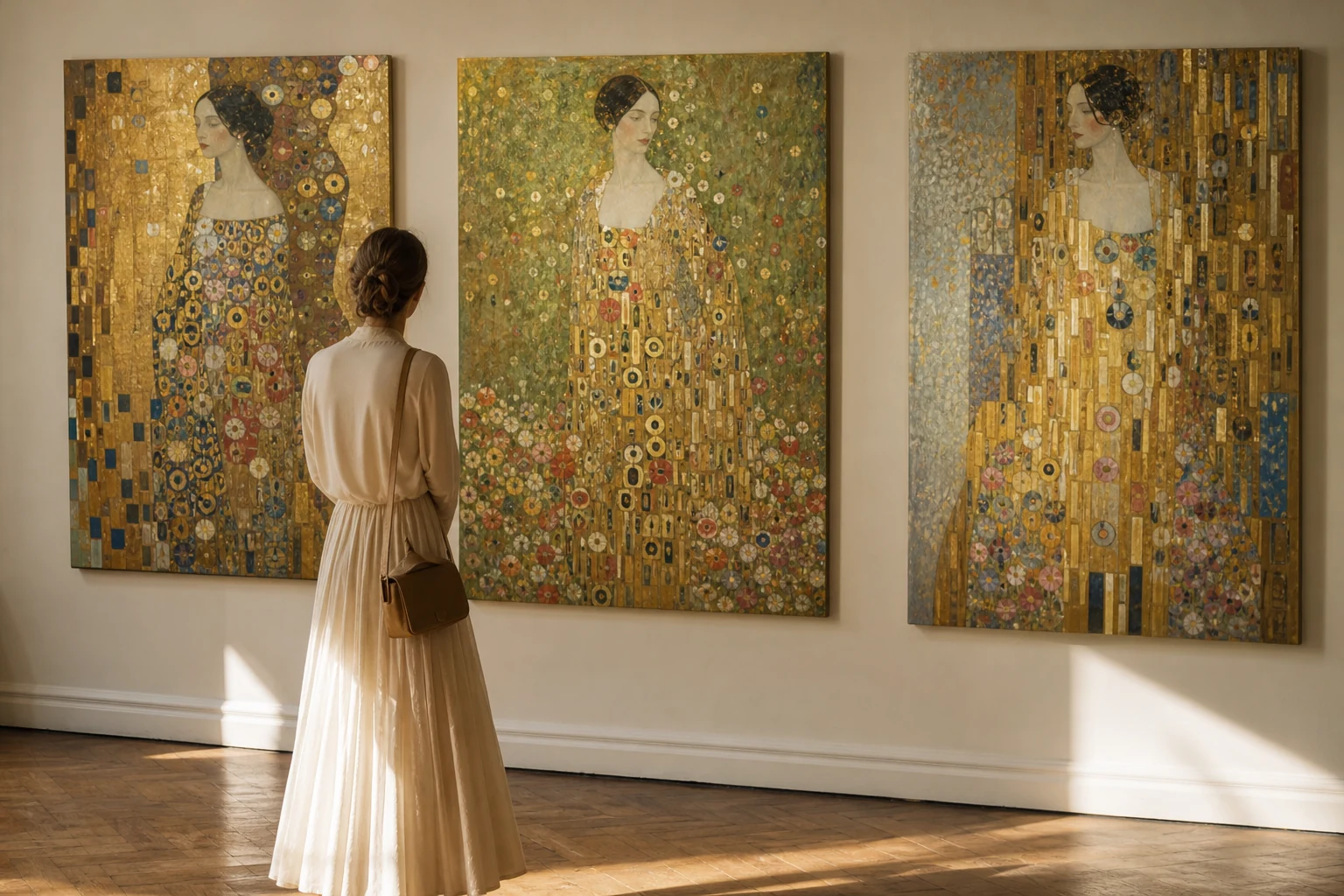
Klimt was the first president of the group, and he gave it a public face. Many painters of the period moved towards abstraction or towards stark realism. Klimt kept the human figure at the centre and surrounded it with pattern. Faces and hands are painted with soft, close observation, while dress, background and ornament flatten into decorative fields.
That contrast is his signature. A naturalistic head can sit inside a surface of gold, mosaic-like shapes, spirals and geometric motifs. He drew on Byzantine mosaics, Egyptian and Greek art, and Japanese prints, and he combined them into something recognisably his own. He also treated allegory and desire openly, which made him controversial, and it set him apart from colleagues who preferred safer subjects.
Others in the group were gifted designers and architects. Klimt’s particular contribution was to make painting behave like decoration without losing psychological depth, so that ornament became part of the meaning rather than a border around it.
How the work developed over the career
Klimt, born in 1862, trained in a thoroughly academic tradition and began with large, polished decorative commissions for public buildings, working in a conventional historical manner. The early paintings are controlled and naturalistic.
Around the time of the Secession his handling changed. Surfaces became flatter, outlines more deliberate and ornament more prominent. This is the period most people call his golden phase, when gold leaf and dense patterning enter the work and portraits of Viennese women take on an almost icon-like presence.
Later the gold recedes. Colour becomes freer and brighter, patterns turn into looser, more painterly flowers and textiles, and the brushwork is more visible. Alongside the figure paintings he painted square landscapes of gardens, orchards and lakeside villages, which show the same sense of pattern applied to leaves, grass and water. He died in 1918, and the late work points towards a more expressive handling than the early golden pictures.
How that shows in a painting on a wall
Klimt’s pictures work at two distances. Across a room you see the large shapes: the silhouette of a figure, the balance of warm and cool areas, the rhythm of pattern. Close up you find small touches, layered marks and the edge where a soft face meets a hard ornamental surface.
Light matters because of that second reading. Strong, direct light flattens texture and can make metallic areas glare, while soft side light brings out brushwork and keeps the warm tones calm. A hand-painted oil reproduction shows real surface variation, so a gentle raking light suits it. A print stays consistent from every angle, which helps in a room with changing daylight.
Allow enough viewing distance for the ornament to resolve into pattern. Large figure paintings need space to step back, while the square landscapes sit comfortably on a shorter wall. To learn more about the store, read about us, or browse the full range in the shop.
Follow the life
The National Gallery biography of Gustav Klimt covers the life in brief: the son of a gold engraver who decorated Vienna's theatres, then broke with the official art world to lead the Secession. The catalogue below follows the same road, painting by painting.
See the movement
The Secession's own history tells how a group of young artists left the Künstlerhaus in 1897, chose Klimt as their first president and built an exhibition hall of their own.
Shop by period
Golden-phase portraits, the square Attersee landscapes and the crowded, brightly coloured late canvases bring very different light into a room.