
Amalie Zuckerkandl: Klimt’s unfinished square portrait of a Viennese sitter
A portrait begun in 1913, broken off when Klimt died in 1918
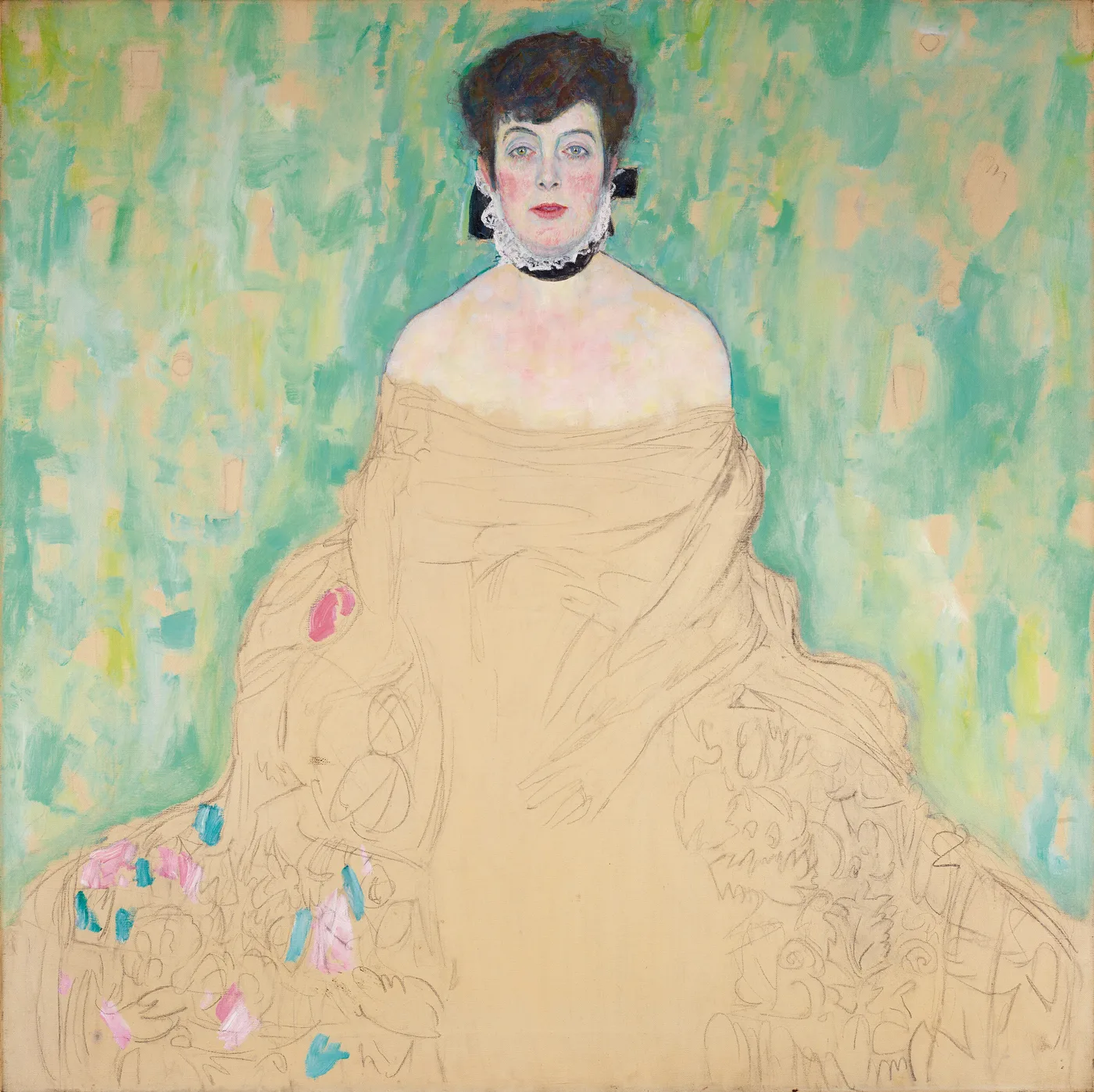
Amalie Zuckerkandl is a square portrait that Gustav Klimt began in 1913/14, took up again in 1917 and left unfinished at his death in 1918, now held by the Belvedere in Vienna at 128 × 128 cm. It shows a Viennese woman, her face and shoulders carefully painted, the rest of the canvas left far more open than a finished commission usually allows.
Klimt was born in 1862, and by the years he worked on this canvas he had moved well past the gold-covered surfaces that made his earlier portraits famous. His palette had turned toward greens, pinks and blues applied in loose, visible strokes, and his backgrounds had traded flat metal leaf for fields of mixed colour that read closer to a garden than to an ornament.
These were still years of steady portrait commissions from Vienna’s wealthier families. Klimt painted women from that circle through these years, among them the sitter of Portrait of Eugenia Primavesi, a work close to this one in date and in its bright, ungilded colour.
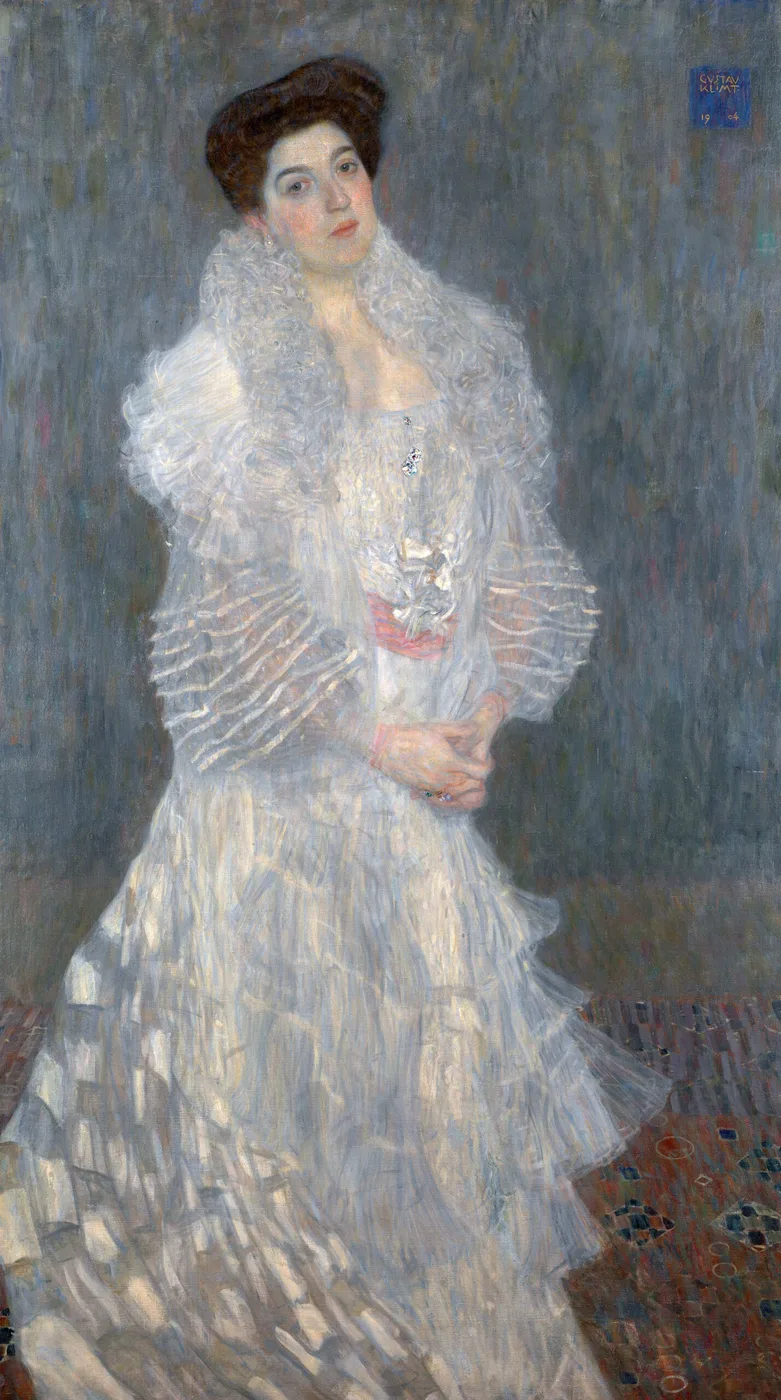
He kept working on portraits of younger women from the same Viennese households in these years too, including the one now known as Portrait of Elisabeth Lederer. Amalie Zuckerkandl belongs with that group of late sittings, painted in oil on a square canvas rather than the tall, narrow format he had used for women a decade earlier.
Klimt died in 1918, and this canvas was one of several still standing in his studio at the time. Work on it had stopped with the face, neck and shoulders resolved in paint and the lower two thirds of the dress left as pencil drawing with only a handful of brushed patches of colour.
Nothing was added to the canvas after that point. The Belvedere keeps it in the state Klimt left it; the dress and the floral motifs sketched into the skirt were never completed.
What the brush finished, and what stayed pencil
Klimt places the sitter dead centre on the square canvas, facing the viewer with her shoulders square to the picture plane. The pose widens as it drops, from the narrow point of her upswept hair to the broad spread of fabric filling the bottom third of the picture, so the composition reads as a wide triangle set inside a square frame.
Her face carries the most finished paint in the picture. The skin is pale with pink worked into the cheeks and a touch of red at the lips, the eyes pale blue-grey under dark, defined brows. Dark brown hair is piled up loosely, with a black bow pinned at one side and a few loose strands left free at the temple.
A ruffled white collar sits high on her neck, closed with a black ribbon tied at the throat. The white of the lace and the black of the ribbon are the two sharpest points of contrast on the whole canvas, set against the warm pink of her skin.
Below the collar her shoulders and chest are bare, painted in pale flesh tones with soft pink and grey shading to mark the collarbone and the turn of the arm. The brushwork here is smoother than anywhere else on the canvas, built up in thin, blended layers with none of the loose, visible strokes used elsewhere.
A loose sand-coloured wrap is draped across both shoulders and down over the arms, painted in flat, pale ochre with only a few darker lines marking the folds. Through the thin paint the pencil underdrawing is still visible, tracing curves the brush never filled in.
Past the wrap the canvas turns almost entirely to drawing. The skirt is sketched in pencil, an elaborate pattern of circles, scrolls and flower shapes that covers the raw canvas without a layer of paint over most of it. In the lower left corner a cluster of brushed patches, pink, turquoise and pale blue, marks where Klimt began to lay colour into that pattern before he stopped.
Behind her the ground is a mottled field of green and teal, brushed on in short, loaded strokes with no horizon or object to read. Pale ochre patches sit among the green, scattered rather than massed, closer to a loose pattern of light than to any single element.
What the gap between face and gown can say
Amalie Zuckerkandl faces the viewer with a steady, open expression. Because the dress around her stays mostly undrawn in colour, that face carries almost the whole weight of the picture.
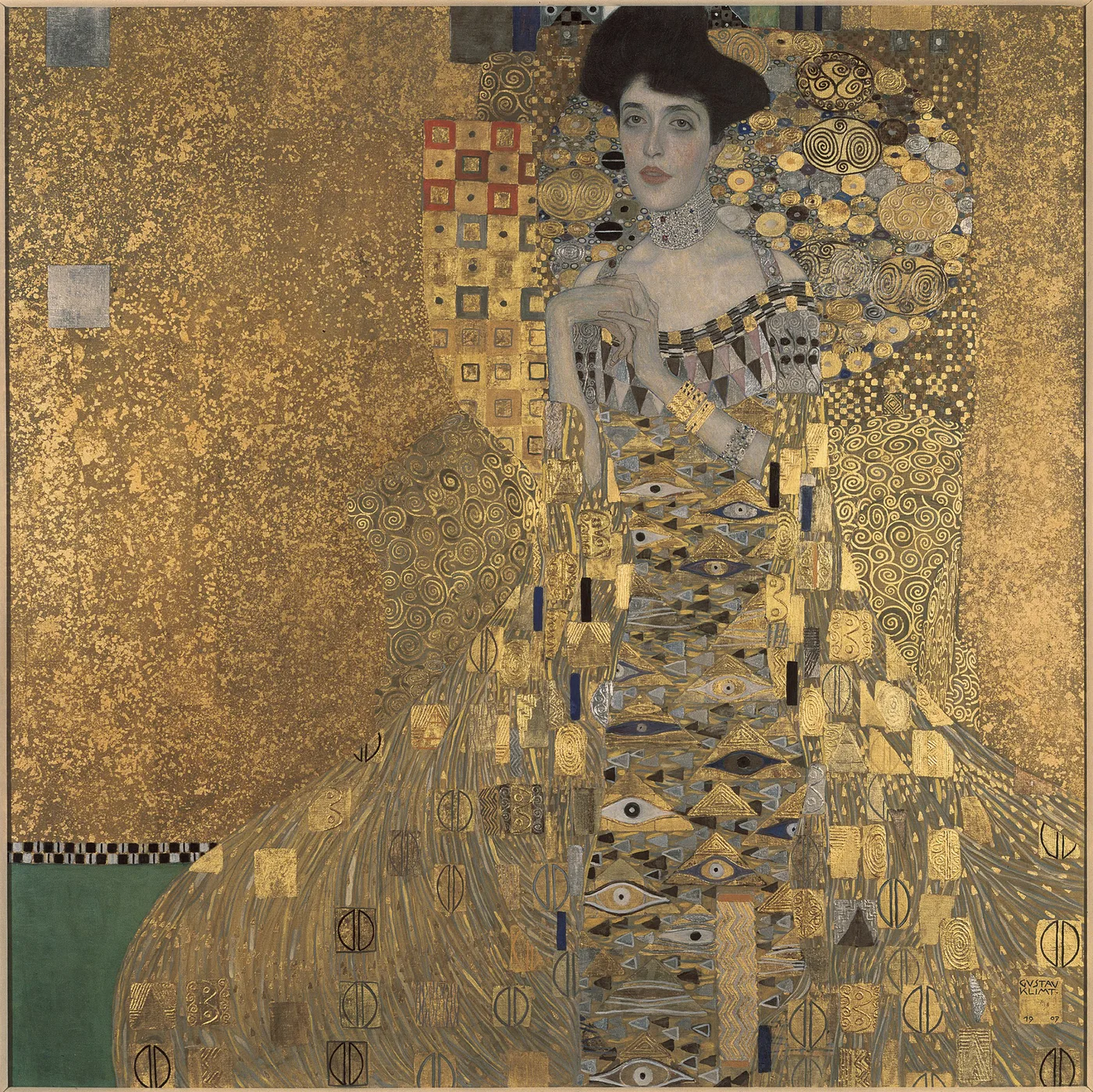
Klimt’s earlier society portraits, among them Fritza Riedler, build their decoration from flat gold leaf and tight ornament around the sitter. Here colour carries the decoration instead of gold, a field of green and a sketched pattern of flowers in place of a disc of metal, and that shift can be read as part of how his late portraits moved away from the earlier style.
Reading the finished face against the drawn skirt gives a view into how the portrait was built, layer by layer, with the parts a sitter would notice first given the most attention. It leaves visible what a finished commission would normally hide, the pencil lines a painter lays down before colour goes on.
Pink and turquoise patches started in the skirt read as flowers, a departure from the geometric motifs of Klimt’s gold period. Read against the greens of the background, they point toward a floral, almost garden-like scheme for the finished dress, one the painting never reached.
The canvas shows a resolved portrait of a woman’s face and shoulders set above a pattern that stops at the pencil stage.
The painting at the Belvedere
The original hangs in the Belvedere, the Vienna museum that holds it as Amalie Zuckerkandl, begun in 1913/14, taken up again in 1917 and unfinished at Klimt’s death in 1918. The canvas measures 128 × 128 cm, square in both directions, a proportion Klimt used for only a small number of his late portraits.
Standing in front of it, the unfinished lower section is as plain to see as the painted face above it. The pencil pattern in the skirt and the raw canvas around it are visible at normal viewing distance, not only on close inspection, because Klimt never covered them with paint.
A museum visit is the only way to see the brush and pencil work together at full scale. For a version to live on a wall at home, the Amalie Zuckerkandl page sets out the sizes and formats made from the same painting.
Choosing a square reproduction of this portrait
Every reproduction in this shop starts from the original painting held by the Belvedere. Both the hand-painted oil and the archival print on the Amalie Zuckerkandl product page come from that same painting. The picture does not change between the two editions, only the method used to make it.
A hand-painted oil is built by an artist working in oil on canvas, brush by brush, which suits a picture that already mixes tight modelling in the face with loose, open paint in the background and wrap. Painting the oil by hand takes 2 to 4 weeks.
An archival canvas print is a high-resolution giclee on canvas, which gives a consistent, repeatable result at a friendlier budget and is the practical choice for a dependable match across more than one piece. Printing takes 2 to 4 business days.
The original is square, so every size on the product page keeps that square proportion. None of them stretch it into a standard rectangle or crop it to fit a stock frame. A larger size suits this picture well, since the pencil pattern in the skirt and the patches of colour within it need enough canvas to stay legible.
Before a hand-painted piece ships, the finished canvas is shown to you so you can check the colour and the balance between painted and drawn areas before it leaves the studio. Delivery then takes 5 to 7 business days. Frame and stretcher choices for this square format are set out next to the sizes on the product page.
Questions about this portrait and its reproductions
Is the Amalie Zuckerkandl portrait finished?
No. Klimt completed the face, neck and shoulders in paint, but the dress stays mostly as pencil drawing on raw canvas, with only a few brushed patches of colour. The Belvedere displays the canvas in that unfinished state.
Where is the original painting kept?
The original is held by the Belvedere in Vienna, measuring 128 × 128 cm. Klimt began it in 1913/14, took it up again in 1917 and left it unfinished at his death in 1918.
Can I order a reproduction in the same square proportions?
Yes. Every size on the product page keeps the original’s square format and is never cropped to a standard rectangle.
What is the difference between the hand-painted oil and the print?
The oil is painted by hand on canvas from the original painting, with real brush texture and natural variation between canvases. The print is a giclee on canvas from the same painting, giving a more consistent, repeatable result.
Will I see my reproduction before it ships?
For the hand-painted oil, yes. The finished canvas is shown to you for approval before it leaves the studio. Delivery then takes 5 to 7 business days.
More from this collection
Bring this painting home
Choose a hand-painted oil reproduction for real brushwork, or an archival canvas print for a crisp museum-image edition. Every size preserves the original proportions.
View this work & options
Further reading
Verify the original in the Belvedere collection record and continue through related works in the catalogue.