
Portrait of Eugenia Primavesi: Klimt Trades Gold for a Painted Dress, 1913-1914
How a Viennese Patron’s Wife Became a Late Klimt Portrait
Gustav Klimt painted Portrait of Eugenia Primavesi in 1913 and 1914, near the end of his career, as a tall portrait on an upright canvas.
By these years Klimt had largely left behind the gold grounds of his earlier portraits. His later work favours broad fields of plain or patterned colour, closer in spirit to folk textile and Japanese prints than to the Byzantine mosaics he had studied for his gold period. Portraits from this stretch of his career trade metal leaf for thick, separate strokes of paint, laid side by side, each stroke kept distinct.
Klimt painted more than one member of the Primavesi family during these years.
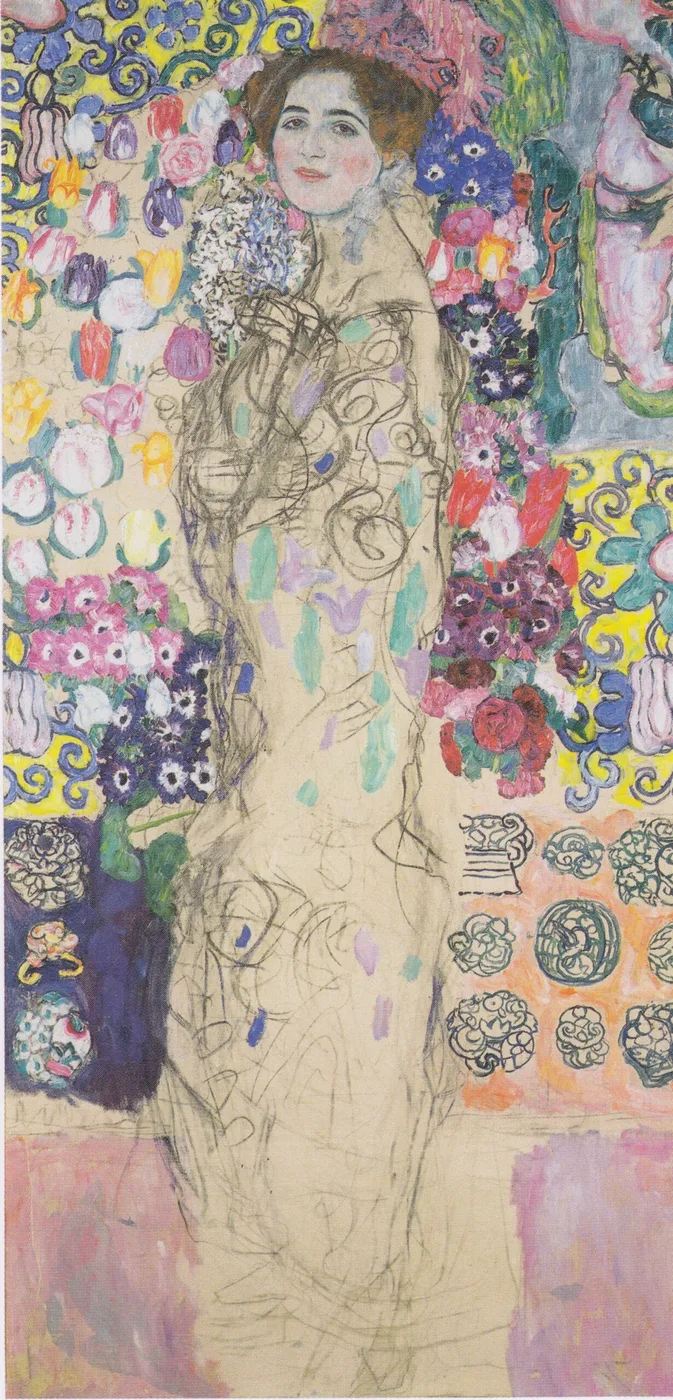
This picture belongs with a run of portraits Klimt painted of Viennese women in his last active years, among them Lady with a Fan and Portrait of Elisabeth Lederer, made for women from a similar circle of wealth and taste. Amalie Zuckerkandl, left unfinished at his death, shows how far that same circle of commissions still ran by the time he died.
Klimt was born in Baumgarten, near Vienna, in 1862, and trained at the city’s School of Arts and Crafts before he co-founded the Vienna Secession, the group that set the direction of his career.
He died in Vienna in 1918, a few years after finishing this portrait, during the last phase of a career spent mostly on commissioned portraits of women.
A Gold Field, a Flowering Arch and a Dress Built from Colour Patches
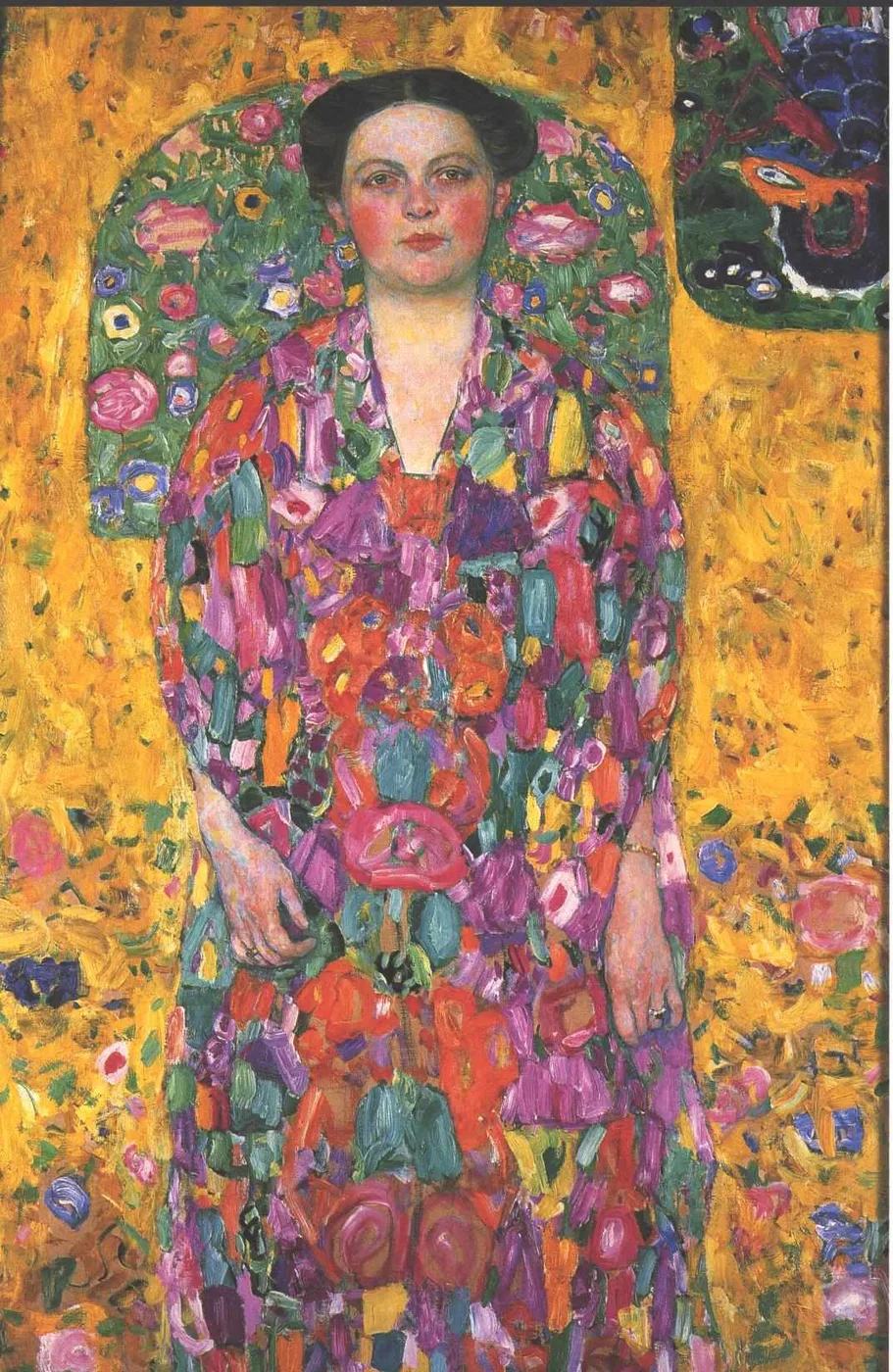
Eugenia Primavesi stands facing forward in the centre of the canvas, shown from the head down to the thighs, with both arms hanging straight at her sides. The pose is frontal and still, with no turn of the shoulders and no object in the hands. A broad field of mustard and ochre yellow fills the space around her on both sides and continues below her at the bottom edge of the canvas.
Behind her head and shoulders, a rounded green arch rises like a trellis, filled with small flowers in pink, red, blue and white set against dark green leaves. It frames the face the way a niche frames a figure in a wall, separating the head from the gold field that surrounds the rest of the canvas and giving the eye a fixed point to return to.
The gold ground itself is not flat. Short, loaded strokes of ochre and mustard sit next to each other across the surface, and small dark flecks and dabs of other colour are scattered through it, breaking up what would otherwise read as a single block of yellow. Patches of pink and pale blue appear low on the left and right edges of the canvas, echoing the colours of the dress.
From neck to wrist, the dress is covered in a dense, all-over pattern of colour. Blocks of orange-red, magenta, teal-green and yellow sit edge to edge, built up as separate, unblended patches that read from a distance as loose flowers and leaves, closer to garden blooms than to a printed textile design. Near the hem, large pink rounded forms stand out against the darker red and purple around them.
In the upper right corner, set apart from the rest of the composition, sits a small dark panel on a near-black blue ground. An orange and red curling shape, close to a bird or a stylised creature, sits inside it with a scatter of pale blue dots. It reads as a separate decorative insert, apart from the room or the dress.
Against all this pattern, the face is painted smoothly. Pale skin, rose-pink cheeks, dark arched eyebrows and a direct, level gaze are modelled with soft, blended transitions, and the dark hair is gathered into a low, tidy knot. The hands, visible at her sides, are loosely but clearly drawn, with individual fingers.
Nowhere on the canvas is there gold leaf or a raised metal surface of the kind Klimt used in his earlier portraits. Every colour here, including the yellow ground, is paint applied directly with a brush.
What the Flowers, the Dress and the Corner Panel Might Say
The painting is a formal portrait of a named woman, posed to be recognised. Her direct, level gaze and her still, frontal pose are typical of a sitter meant to be seen clearly, in the manner of a commissioned likeness. The face carries the individual likeness; everything around her is decoration built up by the painter.
Flowers and leaves, built from colour patches of paint, cover almost the whole dress, a motif that runs through much of Klimt’s work in these years, from his garden paintings to his portraits of other women. Worn this way, the pattern covers the body almost completely, leaving only the face, neck and hands as areas of plain skin.
A small dark panel in the upper corner, with its bird-like orange and red shape, sits apart from the main figure and the gold field around her. It reads as an ornamental aside, separate from the room, close to the kind of decorative inserts and borrowed motifs Klimt drew from folk art and East Asian sources in his later portraits.
Seeing the Original at the Toyota Municipal Museum of Art
The original Portrait of Eugenia Primavesi is held by the Toyota Municipal Museum of Art. Up close, the canvas Klimt painted in 1913 and 1914 shows the separate loaded strokes that build the dress and the gold ground as distinct ridges of paint, with brush texture no photograph reproduces.
At 140 × 85 cm, the canvas is tall enough that the figure, shown from the head to the thighs, is close to life size. At that scale the separate, unblended strokes that build the dress and the gold ground are easy to see from a short distance, while the smoother handling of the face only shows its full effect from a few steps back.
Up close, the canvas breaks into individual patches of colour and visible brushwork. Stepping back, those patches settle into the dress, the flowering arch and the gold field as a single, readable image. The scale of the original, taller than most domestic portraits, is part of what a reproduction has to match to keep the same effect.
Choosing a Reproduction of This Portrait
Every reproduction of Portrait of Eugenia Primavesi sold here starts from the museum photograph of the original, and the same image is used for both editions on offer. The choice between a hand-painted oil and an archival canvas print on the product page is a choice of method, not of a different version of the picture.
A hand-painted oil reproduction is painted from scratch, in oil on canvas, by an artist working from that photograph. Given how much of this picture depends on separate, visible strokes of colour in the dress and the gold ground, a painted surface carries that texture in a way a flat print cannot, and no two painted copies come out quite the same.
The archival canvas print is a high-resolution giclee print of the same image, on canvas, with consistent colour from one order to the next. It suits a tighter budget or a set of pieces that need to match each other exactly, and it keeps the same proportions as the original at every size offered on the product page.
Because the original is upright, every size keeps that same tall, narrow ratio, never forced into a square or landscape shape. In a room, the format suits a hallway, a stairwell wall or the space beside a tall window, where a wide piece would not fit. A plain, slim frame in a dark tone lets the gold ground carry the wall on its own, and the available sizes and frames can be seen on the product page.
Painting the oil by hand takes 2 to 4 weeks. Printing the canvas takes 2 to 4 business days. Delivery then takes 5 to 7 business days. Before a hand-painted piece leaves the studio, it is photographed so you can see and approve it.
Questions About This Klimt Portrait
What does the Portrait of Eugenia Primavesi show?
A portrait of Eugenia Primavesi, painted by Gustav Klimt in 1913 and 1914, shown from the head to the thighs. She stands facing forward against a gold field, wearing a dress built from patches of orange-red, purple and teal-green, with a flowering green arch behind her head.
Where is the original painting kept?
The Toyota Municipal Museum of Art holds the original, a canvas measuring 140 × 85 cm.
What is the difference between the hand-painted oil and the print?
The hand-painted oil is painted by hand in oil on canvas and carries real brushwork and texture. The archival print is a giclee print on canvas from the same image, with consistent colour across copies. Both keep the proportions of the original.
Which size and frame suit this portrait?
Because the original is tall and narrow, every size offered keeps that same upright ratio. A slim, dark frame suits the gold field best, and the format fits a hallway, a stairwell or a wall beside a tall window.
Will I see the painting before it ships?
Yes, for the hand-painted oil. Before it leaves the studio, the finished canvas is photographed so you can check colour and detail and approve it before delivery.
More from this collection
Bring this painting home
Choose a hand-painted oil reproduction for real brushwork, or an archival canvas print for a crisp museum-image edition. Every size preserves the original proportions.
View this work & options
Further reading
Verify the original in the Toyota Municipal Museum of Art collection record and continue through related works in the catalogue.