
Lady with a Fan: Klimt’s final square portrait, painted among birds and blossom
A square portrait from the last year of Klimt’s career
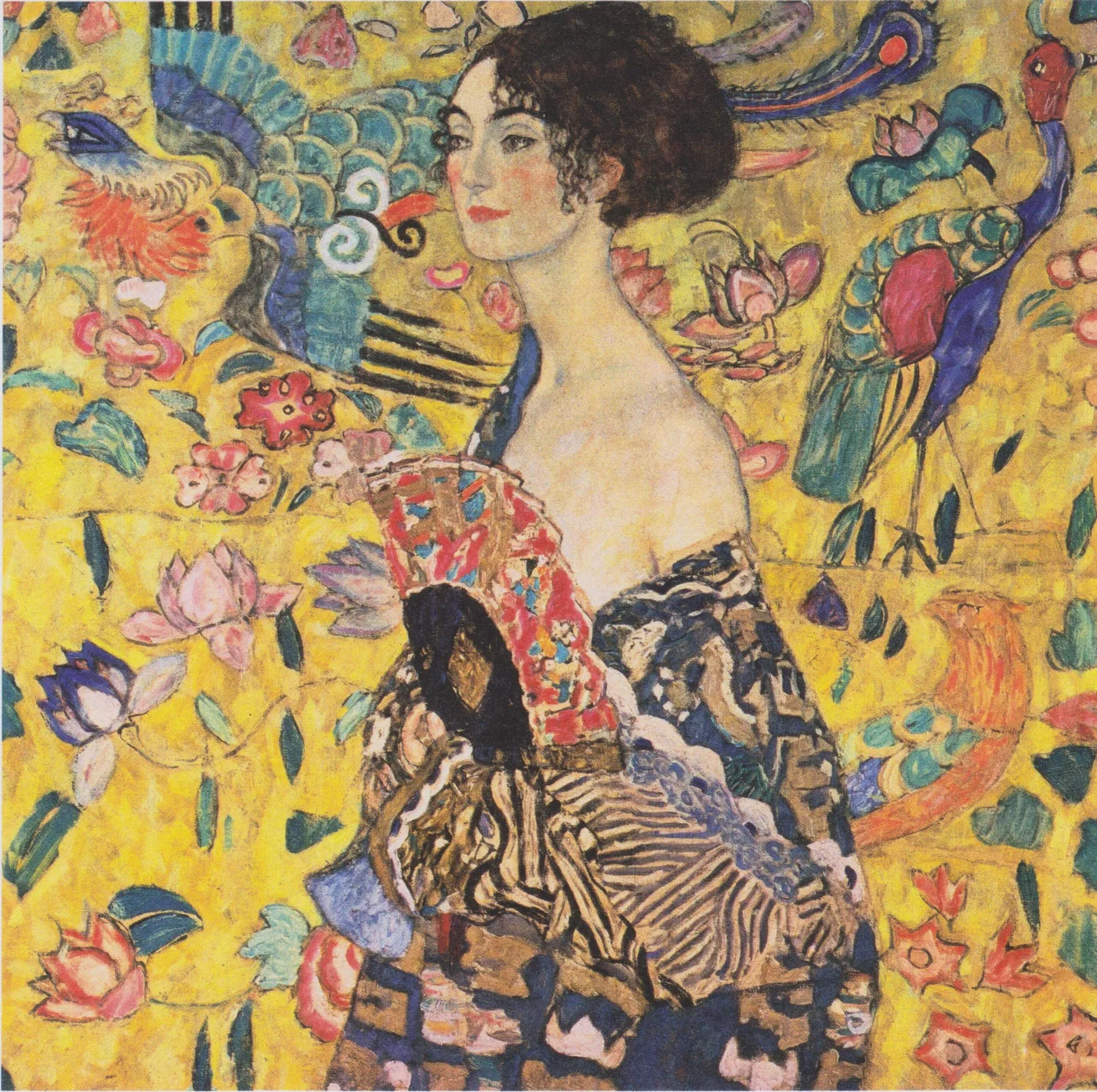
Lady with a Fan is a square canvas, 100.2 × 100.2 cm, that Gustav Klimt painted in 1917 and 1918, the final year of his working life. A woman in half profile holds a folded fan close to her chest, set against a dense field of painted birds and flowers.
Klimt was born in 1862 near Vienna, the son of a gold engraver. He trained in the decorative arts before taking on mural and ceiling commissions for the city’s public buildings, work that gave him a precise hand and a lasting taste for pattern and gold ground.
He went on to lead a generation of Viennese artists who broke from the conservative academy and pushed painting toward ornament and flattened space. He helped found the Vienna Secession, the group that gave this decorative style its public stage, and gold leaf became one of his signatures.
By the time he painted Lady with a Fan, Klimt had largely set aside gold leaf for a denser, more saturated use of colour, drawn from textiles, folk costume and the East Asian art objects he collected throughout his career. Japanese screens and Chinese robes filled his studio, and their flat, patterned surfaces shaped how he built a background.
In these last years Klimt kept working on portraits of Viennese women, commissioned chiefly by the city’s wealthier families, and such portraits made up the larger part of his output in this period. Several were painted, like this one, on a square canvas that gives the sitter no horizon to anchor her and lets the background pattern carry equal weight. He painted other late portraits of Viennese women in this same period, among them Portrait of Ria Munk III.
Early in 1918 Klimt suffered a stroke and died a few weeks later, still at work. Lady with a Fan, begun the previous year, was still unfinished on his easel at his death, and its dating to 1917 and 1918 places it with the last works he made.
The title Lady with a Fan is not unique to this canvas: other paintings and studies carry the same name. This square portrait is fixed in time by its date, 1917 to 1918, and by its dimensions, 100.2 × 100.2 cm, and its pattern of birds and flowers, which separate it from any other picture sharing the title.
How the face, the fan and the birds around her are painted
Klimt set the woman slightly right of centre, turned in half profile, her head tilted and her gaze turned to one side, away from the viewer. Her bare shoulder and upper chest fill the lower middle of the square, and from there the fan she holds spreads toward the bottom edge of the canvas. Little empty space remains: pattern, fabric and fan reach almost to all four edges of the square.
Her face and bare shoulder carry the only soft, blended modelling on the canvas: pale skin shaded toward the jaw, pink colour worked into the cheeks, the mouth painted in a clear red. Her dark hair, pulled up and cut short around the face, is laid in with loose, curling strokes that let some of the canvas show through.
The fan takes up the lower third of the picture. Its upper section is red, scattered with small white, black and ochre shapes, and a line of pale blue lace runs along its curved edge. Below it, a dark blue garment patterned with pale squares and stripes wraps around her arm and shoulder.
Behind her, a flat field of mustard yellow covers the canvas edge to edge, filled with stylised birds and flowers. At the upper left a teal-blue bird’s head faces outward, crowned with a spray of orange plumage. At the upper right a taller bird stands with a red head, jade-green and blue feathers and a pink breast, and a smaller orange bird appears at the lower right. Pink lotus blossoms, small blue flowers and star-shaped red flowers are scattered across the yellow ground between them.
Every shape in the background is painted flat and outlined in black, the way a printed textile or a lacquer screen is built, with no shading to suggest depth. That flatness meets the rounded, shaded painting of the face and shoulder directly along the edge of her skin.
There is no gold leaf anywhere on the canvas. The colour comes from saturated paint instead: the yellow ground, the red of the fan, the jade and cobalt of the birds’ feathers, set close together with little blending between them. The palette is more intense and more varied than the gold surfaces Klimt had used earlier in his career.
Because the background pattern runs behind her shoulder and under the fan at the same scale throughout, the woman seems folded into the pattern itself. The square format adds to this effect: there is no floor, no wall and no horizon line to separate the figure from the ornament around her.
Reading the fan and the pattern behind her
The picture shows a single woman holding a fan, seen from the chest up. No story is attached to her within the painting itself: there is no setting, no book or instrument, to suggest where she is or what she is doing. She wears no visible jewellery, only the patterned fabric wrapped around her shoulder.
The background invites a reading tied to Klimt’s long interest in East Asian decorative art. He collected Japanese and Chinese screens, robes and porcelain through much of his career, and the flat birds and blossoms behind her draw on the same sources, folded into a Western portrait.
The contrast between her softly modelled face and the flat, repeating pattern around it carries its own reading: a living presence set against a surface that behaves like wallpaper or woven cloth, a device Klimt used across many of his portraits of women.
The fan supports a further reading. Held close to the body, not open and raised, it works as much as a screen as an accessory, an attribute that can carry associations of concealment or fashion depending on how a viewer takes it.
Her eyes are turned to one side, past the edge of the canvas, and her expression stays even and does not invite the viewer in.
Where this portrait sits among Klimt’s final canvases
Lady with a Fan belongs with a small group of canvases from Klimt’s final working year. Among them is Portrait of Ria Munk III, another portrait of a Viennese woman that Klimt was still working on when he died in 1918.
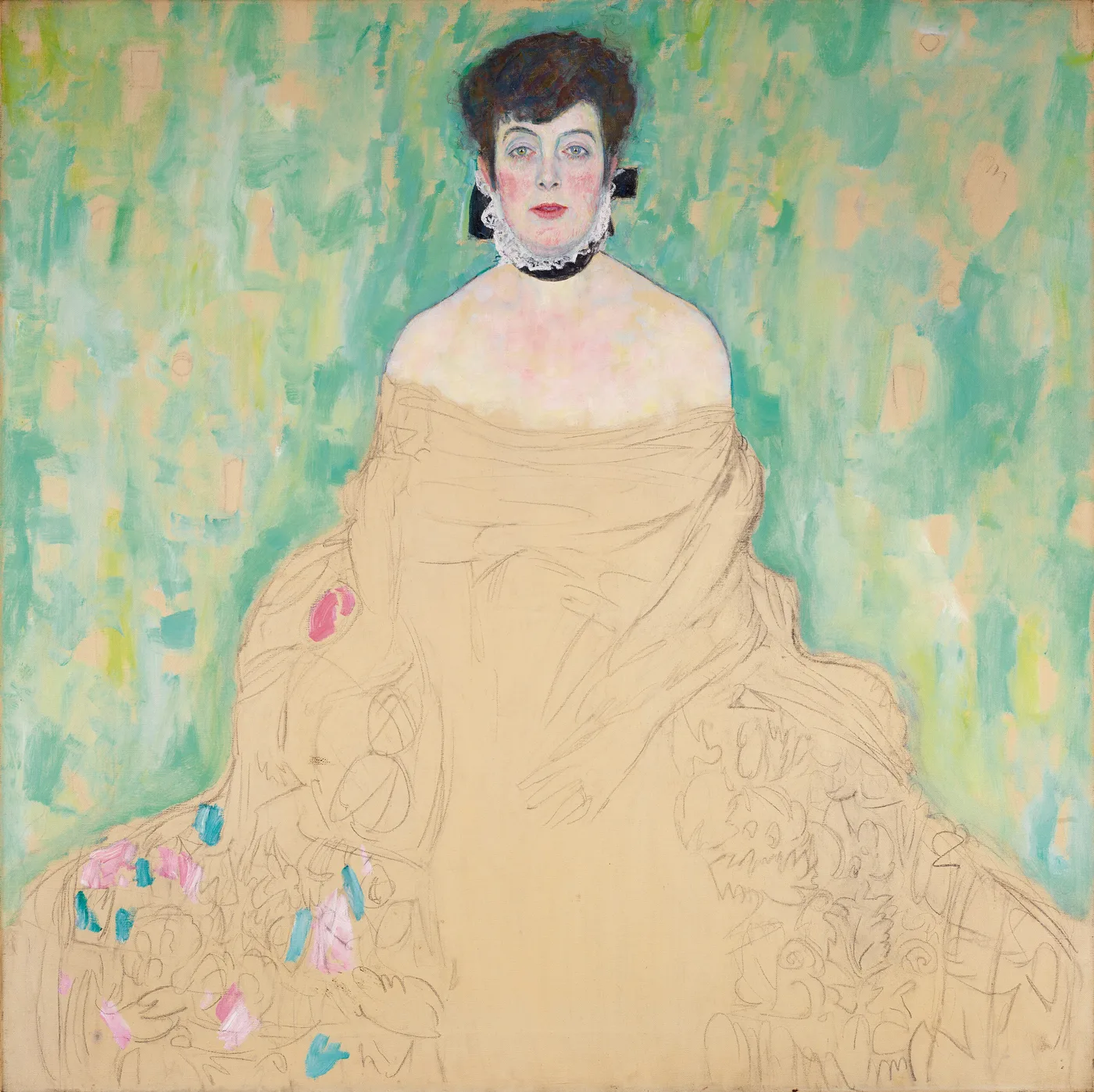
Several of these late canvases, among them Amalie Zuckerkandl, stayed in his studio at his death and reached the market only afterward. Lady with a Fan is dated to that same late period of his career.
The same final years also produced Adam and Eve, a large allegorical canvas left unfinished at his death.
Choosing a hand-painted oil or print of Lady with a Fan
Every reproduction of Lady with a Fan sold here starts from a photograph of the painting. Both editions on offer, the hand-painted oil and the archival canvas print, are made from that same image, so the choice is about method and feel: the colours and the proportions stay the same across both.
Each hand-painted oil reproduction is painted by hand in oil on canvas, using that photograph as reference. Nothing is printed underneath, so the surface carries real brushwork. Before it ships, the finished painting is photographed so you can see and approve it. Painting the oil by hand takes 2 to 4 weeks.
The archival canvas print is a giclee print of the same image on canvas, in pigment inks, and it keeps the colours and the pattern consistent from one print to the next. It suits a smaller budget or a pair of pieces that need to match closely. Printing takes 2 to 4 business days.
Because the original is square, every size of this reproduction keeps that same proportion: it is never cropped into a standard rectangle or stretched to fit a stock frame. A dense field of pattern like the birds and flowers behind her holds up well at a larger size, where the detail stays legible instead of blurring into the yellow ground. The available sizes are listed on the page for Lady with a Fan.
A plain, narrow frame in a dark tone or in a warm gold tone suits this canvas, since neither competes with the yellow ground or the red of the fan. Framing choices are set out in the framing guide. Delivery then takes 5 to 7 business days. The hand-painted version of Lady with a Fan keeps the change of touch between the modelled face and the flat pattern around it, while the print gives the same image in a steadier, even finish.
Questions about Lady with a Fan
What does Lady with a Fan show?
A woman in half profile holds a folded fan close to her chest, painted against a dense yellow background filled with stylised birds, lotus blossoms and smaller flowers. The canvas is square, 100.2 × 100.2 cm, and dates from 1917 and 1918.
Why is the background so full of birds and flowers?
Klimt collected Japanese and Chinese decorative art for much of his career, and this late painting folds that flat, patterned style into a Viennese portrait.
What is the difference between the hand-painted oil and the archival print?
The oil is painted by hand on canvas from a photograph of the painting, so it carries real brushwork and small natural variation. The print is a giclee reproduction on canvas, consistent from one copy to the next and the steadier choice for a tighter budget.
Which size and frame suit this painting?
Every size keeps the original square proportion, and a larger size lets the birds and flowers in the background stay legible rather than blur together. A plain, narrow frame in dark wood or warm gold works well, since either lets the yellow ground and the red fan carry the wall.
How long does a hand-painted reproduction take?
Painting takes 2 to 4 weeks. Printing takes 2 to 4 business days. Delivery takes 5 to 7 business days.
More from this collection

Bring this painting home
Choose a hand-painted oil reproduction for real brushwork, or an archival canvas print for a crisp museum-image edition. Every size preserves the original proportions.
View this work & options
Further reading
Verify the original in the collection record and continue through related works in the catalogue.