
Adam and Eve: The Last Nude Klimt Left Unfinished
Begun in 1916, Left Unfinished at Klimt’s Death in 1918
Gustav Klimt began Adam and Eve in 1916, and the canvas was still on his easel in 1918, the year he died in Vienna, leaving the painting unfinished in his studio.
By 1916 Klimt had spent decades as one of Vienna’s most prominent painters, a founder of the Vienna Secession and the artist the city’s wealthiest families hired for portraits of their wives and daughters.
Klimt kept working through the war, moving between his studio at Feldmühlgasse 11 in Hietzing and the gardens and lakeside villages where he painted landscapes in the warmer months.
He had been born in 1862 in Baumgarten, near Vienna, the son of a gold engraver, and trained at the city’s School of Arts and Crafts. His early reputation rested on decorative, gold-ground paintings; by his last years that gold had largely disappeared, replaced by looser brushwork and plainer colour.
For Adam and Eve he turned to the Book of Genesis, much as he had turned earlier to the stories of Judith, Salome and Danaë for other women to paint, a habit visible too in the story of Danaë on this site. The biblical names gave him an occasion for the nude figure, more than a scene he set out to illustrate.
Adam and Eve was one of several large canvases still in progress in his studio at the time of his death, each left at a different stage of completion.
Klimt died in Vienna in February 1918, after a stroke left him unable to work in his final weeks. The painting stayed exactly as he had left it, Eve’s figure carried close to finished, Adam’s barely begun.
A Finished Eve Beside an Unfinished Adam
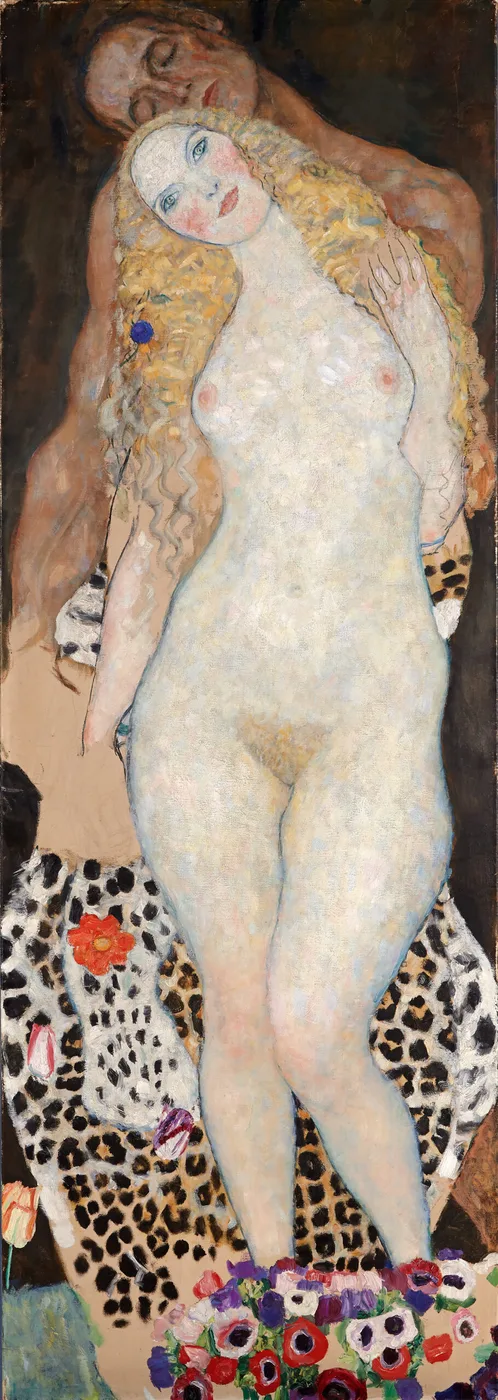
The canvas is tall and narrow, a single upright band that holds Eve’s figure nearly full length, her legs extending well past the knee toward the feet she plants among the flower band at the very bottom edge. Eve stands facing the viewer in the lower two-thirds of the composition; Adam stands close behind her, his head tilted down against the top of her hair.
Eve’s hair draws the eye first, a mass of golden-blonde ringlets that falls past her shoulders in dense, overlapping curls of honey yellow, ochre and pale gold. Her skin is an even, pale ivory, warmed with soft pink at her cheeks, lips, nipples and fingertips.
Her eyes are lowered, nearly closed, and her mouth holds a faint, closed smile. One arm hangs loosely at her side; the other bends upward, her hand resting near her own collarbone, just below where Adam’s head leans against her hair.
Adam’s face is turned down and half in shadow, painted in a deep terracotta brown that sits in plain contrast to Eve’s pale skin. His body is far less resolved than hers, the brown paint thinning into loose, unblended patches that dissolve into the dark ground behind him, without the modelled light that shapes Eve’s figure.
Behind the two figures the background carries none of the gold leaf or dense pattern of Klimt’s earlier work. A near-black ground sits around Adam’s head at the upper left; to the right, a length of fabric in ochre and brown, marked with a lozenge pattern, hangs behind his shoulder.
Lower down, a length of cream cloth printed with black leopard spots drapes across the space behind and beside Eve’s legs. A dense band of flowers crosses the bottom edge of the canvas: red poppies with dark centres, white and violet anemones, and a pair of red and magenta tulips at the lower left, with a sliver of pale blue-green showing in the corner.
The paint handling marks the gap between the two states of finish. Eve’s flesh is built in smooth, blended layers that let light move gradually across her shoulders, chest and stomach. The flowers beneath her feet are laid on thickly, in separate dabs of colour, while Adam’s body stays a flat, unworked passage of brown paint.
Genesis as a Pretext for Two Nude Bodies
The title names Genesis’s first couple, though the canvas shows two nude bodies standing close together against a plain, patterned ground, without the apple, serpent or garden scenery that usually mark the scene.
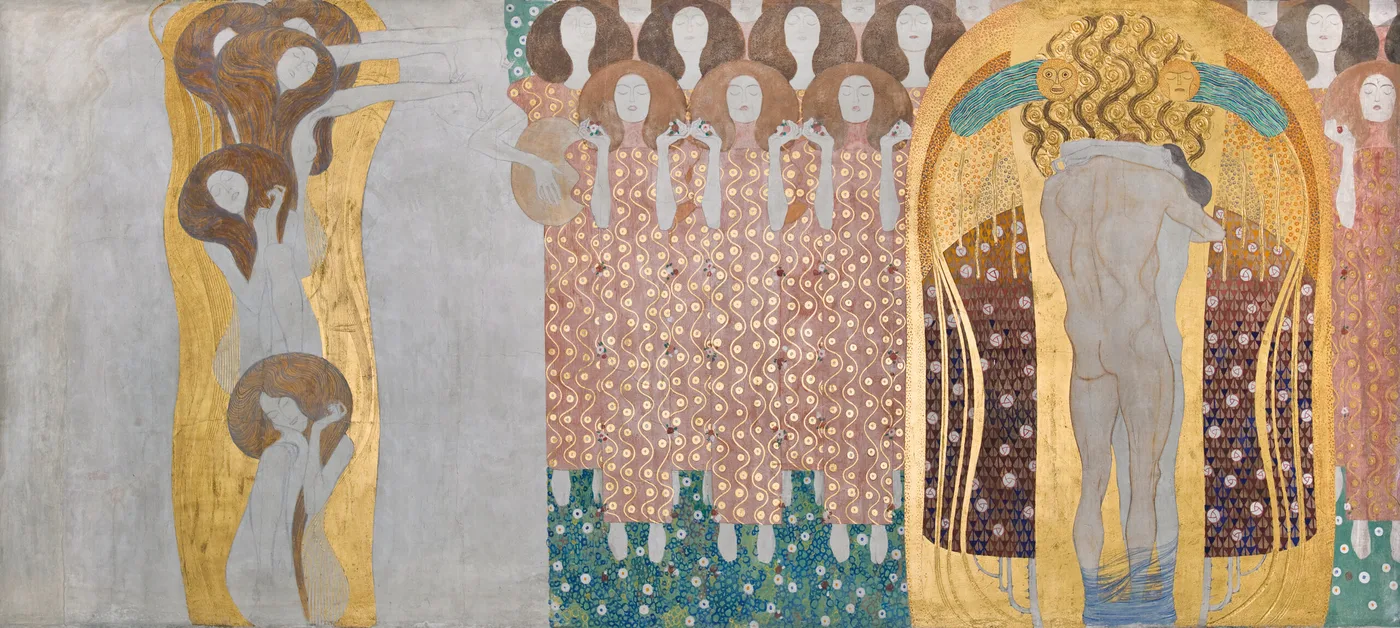
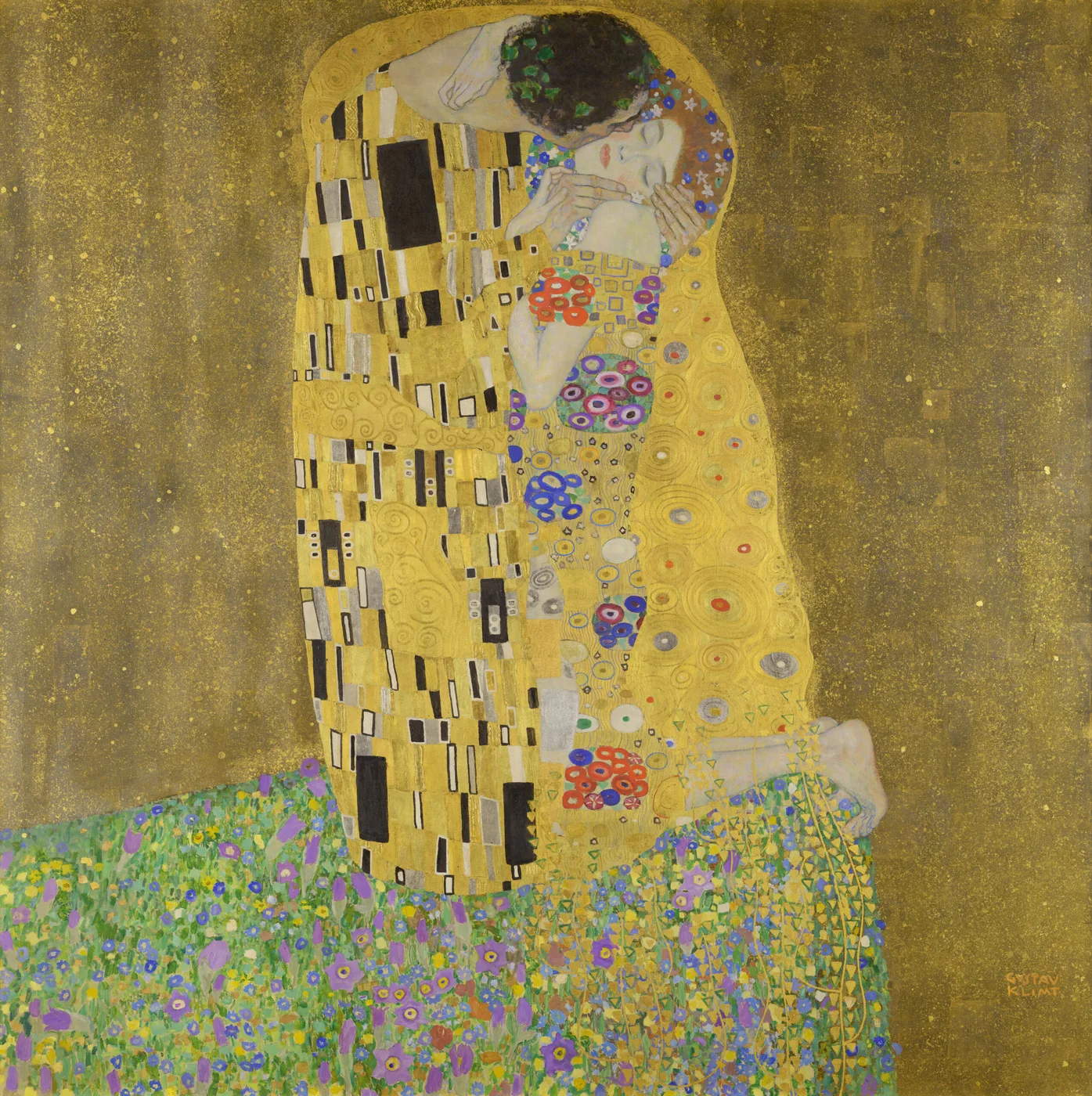
Eve carries almost all of the attention. She is lit, finished and set at the front of the canvas, while Adam stands behind her in shadow, his body barely resolved. The arrangement repeats a pattern in Klimt’s late work: a woman placed at the centre, a man reduced to a supporting presence, close to the embracing pair in The Kiss (Lovers).
The painting reads as two bodies resting against each other, without a scene of temptation or any narrative incident. Adam’s head rests against Eve’s hair, and her raised hand sits close beside him, a quiet gesture of contact.
The flowers at her feet, poppies, anemones and tulips in red, white and violet, belong to the same world as the gardens Klimt painted throughout his career, among them the blossoming tree of Apple Tree II (Green Apple Tree). Set beneath a standing nude, the flowers suggest growth, a garden standing in for the opening chapters of Genesis without showing it directly.
The leopard-spotted cloth and the patterned fabric behind Adam keep the decorative surfaces that run through Klimt’s work, even with the gold leaf of his earlier paintings gone. Adam and Eve sits between two habits of his career: the flat pattern of his decorative years and the plainer, more direct brushwork of his last ones.
Seeing the Original at the Belvedere
The original Adam and Eve hangs in the Belvedere, in Vienna, the museum that holds the largest public collection of Klimt’s paintings. It is shown there among works from across his career, from the decorative gold-ground paintings to the plainer pictures of his final years, including this one, left in his studio at the time of his death.
At 173 × 60 cm, the canvas is tall and narrow, close to the height of a standing adult, and that proportion is part of how the painting works: a single upright column of bodies rather than a wide, settled scene. Standing in front of it puts Eve and Adam close to life size.
Seeing the original also means seeing its unfinished passages at full scale. The loose brown paint of Adam’s body sits beside the fully worked skin and hair of Eve, a contrast that is harder to read in a photograph than it is in front of the canvas.
Choosing a Reproduction of a Tall, Narrow Canvas
A reproduction of Adam and Eve is made one of two ways: hand-painted in oil on canvas, or printed as a high-resolution giclee on canvas. Both start from the same museum photograph of the original, so the choice is about method and finish, not a different version of the image. The product page for Adam and Eve lists both options with every available size.
In the hand-painted version, an artist builds Eve’s pale skin and golden curls with a brush, in layers that let light move across the canvas the way it does on the original, and the artist copies the looser paint of Adam’s figure the same way. Painting the oil by hand takes 2 to 4 weeks.
The archival print reproduces the same photograph with consistent colour and detail from one order to the next, a practical choice on a tighter budget or when several pieces need to match. Printing takes 2 to 4 business days.
Every size keeps the original’s narrow, upright proportions, so the composition is never cropped or stretched to fit a standard frame. That tall, narrow shape suits a slim stretch of wall, the space beside a door or window, or a stairwell, better than it suits a wide, open wall. The sizes and frame options for this painting are worth checking against the wall before ordering, and a size close to the original height keeps the figures close to life size.
A dark wood or narrow black frame holds the contrast between Eve’s pale skin and Adam’s brown shadow without competing with it, while a plain or white frame suits a lighter room. Before a hand-painted piece ships, it is photographed so you can see and approve it. Delivery then takes 5 to 7 business days.
Common Questions About This Painting
What does Adam and Eve by Klimt show?
Two nude figures: Eve stands at the front with golden ringlet hair and pale skin, and Adam stands behind her, his head resting against her hair and his body left in loose, unfinished brown paint. Flowers in red, white and violet lie at her feet.
Why is the painting unfinished?
Klimt died in February 1918 with Adam and Eve still on his easel in his Vienna studio, and the canvas was never completed. Eve’s figure is close to finished; Adam’s is not.
Where is the original Adam and Eve kept?
The Belvedere, in Vienna, holds the original, which measures 173 × 60 cm.
What is the difference between the hand-painted and printed reproduction?
The hand-painted oil is built with a brush by an artist, in layers, and no two canvases are identical. The archival print is a giclee print of the same museum photograph, with consistent colour and detail from one order to the next.
Which size and frame suit this painting?
A size close to the original’s tall, narrow proportions keeps the figures close to life size and fits a slim wall or the space beside a door or window. A dark or narrow frame holds the contrast between Eve’s pale skin and Adam’s shadowed figure well.
More from this collection
Bring this painting home
Choose a hand-painted oil reproduction for real brushwork, or an archival canvas print for a crisp museum-image edition. Every size preserves the original proportions.
View this work & options
Further reading
Verify the original in the Belvedere collection record and continue through related works in the catalogue.