
A Couple Fused in Gold on a Flowered Ledge: The Kiss (Lovers)
Painting The Kiss (Lovers) at the Height of Klimt’s Golden Phase
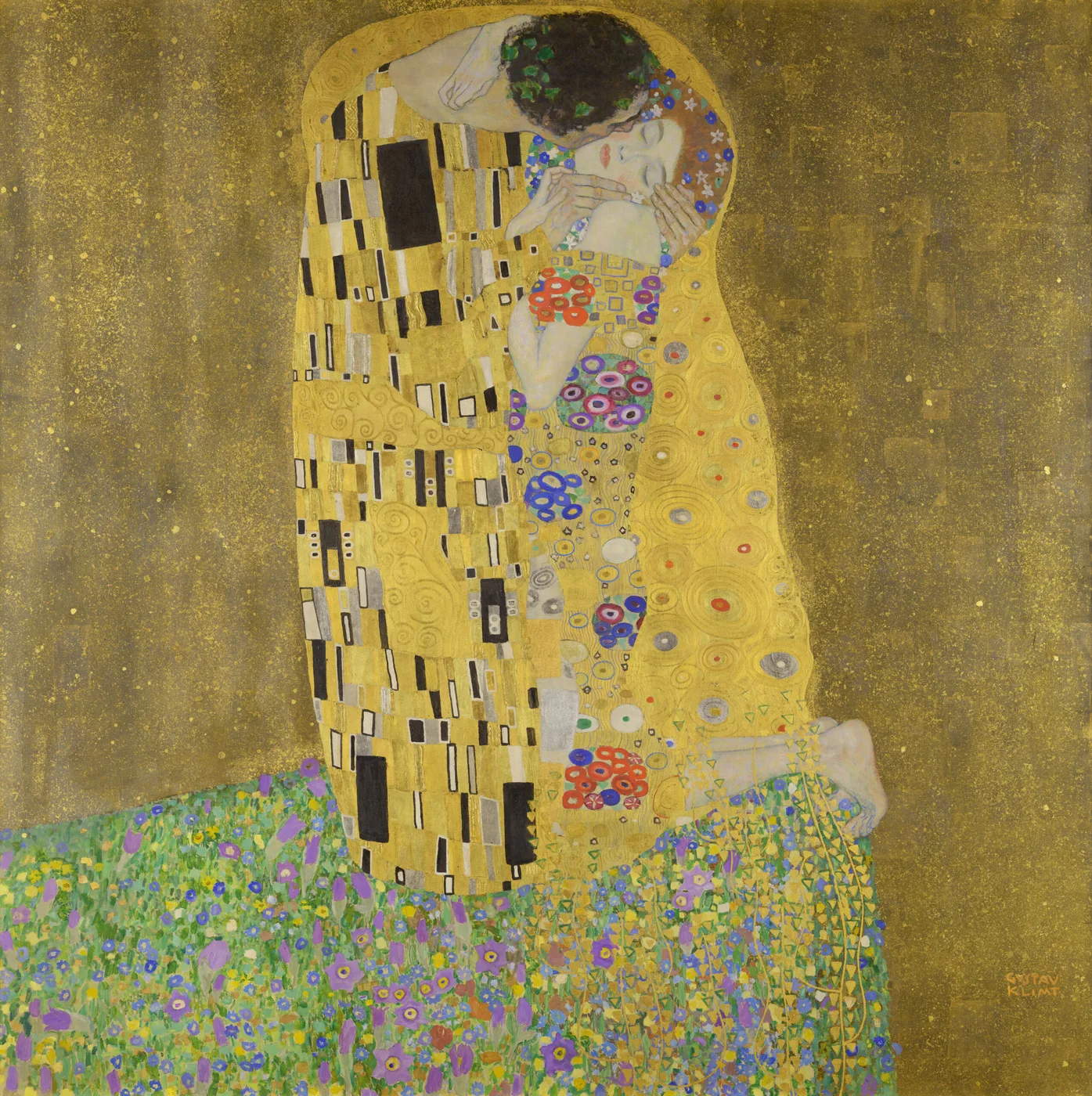
Gustav Klimt (1862-1918) painted The Kiss (Lovers) between 1907 and 1909, on a square canvas measuring 180 × 180 cm that the Belvedere now holds. He worked on it in Vienna during the strongest years of his career, when gold leaf and flat ornament had taken over his painting. The canvas shows two kneeling figures locked together, set against a field of beaten gold.
Vienna’s official art establishment had already lost Klimt years earlier, when he helped found the Secession and became its first president. By 1907 he was deep into what is usually called his Golden Phase, a run of paintings that lay real gold leaf onto the canvas next to the oil paint. The Kiss (Lovers) sits near the end of that run and remains the best known picture to come out of it.
Years earlier, his ceiling paintings for the University of Vienna had drawn public attacks over their nudity and their pessimism, and the dispute pushed him away from further state commissions. He turned to private patrons instead, painting from then on for his own exhibitions. The Kiss (Lovers) belongs to that later, more private body of work.
A trip to Ravenna had also shaped how Klimt used gold. He had studied the Byzantine mosaics inside its churches, and the flat, light-catching surfaces of those walls stayed with him. Those same qualities, flatness, pattern and a surface that behaves like metal, carry through everything else he made in this stretch of his career.
In these same years he painted several other gold-ground canvases, among them the Portrait of Adele Bloch-Bauer I and Danaë. Together with The Kiss (Lovers), these pictures share one technique: sheets of gold leaf applied directly onto the paint, across both his portraits and his allegorical subjects.
Klimt kept his private life mostly closed off from outsiders. He never married, and for most of his adult life his closest companion was Emilie Flöge, who ran a Vienna fashion house with her sisters and appears, under different guises, in several of his portraits. Their companionship lasted the rest of his life.
He died in Vienna in 1918.
Pattern, Gold Leaf and Brushwork in The Kiss (Lovers)
The canvas is square, 180 × 180 cm, and nearly all of it is given to one tall, narrow shape: the two figures fused into a single column that rises from the bottom edge to just below the top. Klimt gives them no room, no horizon and no furniture. A mottled field of gold and bronze fills every inch around them, broken only by faint darker rectangles in the upper corners that read as the suggestion of a wall.
At the top, the man bends his head down and to the side, so that his face almost disappears against the woman’s cheek. His dark hair is bound with a thin wreath of pale green leaves. The woman tilts her face up and back, her eyes closed, her cheeks and chin flushed with pink, her mouth meeting his.
His hands do the work of holding the embrace together. They cup her jaw and the side of her face, the fingers long and pale against her skin. Her own hands answer his: one closes over his wrist, the other curls around the back of his neck, the fingers loose against the gold, two or three rings visible on them.
Rectangles and bars fill the man’s robe, in black, white, grey and dull gold, set in vertical bands down his back and shoulders, like the tesserae of a mosaic floor. Few of the blocks repeat exactly, so the eye keeps moving down the pattern.
Circles answer that geometry on the woman’s side: ovals and concentric rings in teal, violet, scarlet and cobalt, clustered over her shoulder and down her side. Small red and orange discs gather near her chest, a ring of blue dots sits lower, and pale pink round flowers mark the edge of the fabric near her knees. The geometry of his robe and the circles of her dress keep the two figures visually apart even as their outlines merge into one shape.
At the bottom edge the gold gives way to a patch of green ground scattered with small flowers in purple, blue, yellow and red, painted as dense, separate flecks of colour. The woman kneels here, and her bare feet and toes curl over the front edge of this flowered patch, which drops away into plain gold beneath her, as if the ground runs out.
Paint handling shifts from one zone to the next. Faces, necks and hands are smoothly modelled in soft, naturalistic shading, while the gold passages are flatter and more raised where leaf sits on top of the paint, catching light differently from the surrounding oil. Klimt signs the canvas in orange lettering, GUSTAV KLIMT, low in the right-hand corner, set directly into the gold.
What the Embrace in The Kiss (Lovers) Can Mean
The subject is a kiss, or an embrace about to become one. Klimt gives no names, no setting and no story beyond the gesture: a man curves around a kneeling woman, cups her face, and she leans into his hands with her eyes closed. The reading below is one way to see the picture. The Belvedere does not identify who these two people are.
Gold surrounds them on every side, removing the couple from any particular place or moment. There is no room and no landscape beyond the flowered patch at their feet, nothing to date the scene or locate it. Gold removes any single moment from the scene, so the embrace reads as two people absorbed in each other rather than one dated event.
Pattern keeps the two bodies distinct even as their outlines merge. Rectangles mark the man’s side and circles and ovals mark the woman’s, so male and female stay legible inside one fused gold shape. The distinction holds through the whole canvas, geometry on one side of the embrace, curves on the other.
Her bare feet, curled at the front edge of the flowered ground, add a note of risk to the tenderness. She kneels at what looks like the brink of a drop, held up by the man’s grip and her own balance, an embrace that could tip further into itself or over the edge.
A wreath of green leaves on the man and small flowers threaded through the woman’s hair borrow from a long tradition of garlands worn in scenes of love and ritual in earlier European painting. Klimt keeps the gesture and strips away the myth that would usually come with it, so the garland reads as ornament, with nothing in it to say who the two figures are.
Seeing The Kiss (Lovers) at the Belvedere
The original hangs in the Belvedere, the Vienna museum that holds it in its permanent collection.
At 180 × 180 cm, the canvas is a true square, as wide as it is tall. Standing in front of it, the gold ground fills most of a visitor’s view, and the mottled texture of the leaf becomes visible only a few steps away, a detail a photograph or a screen flattens out.
Its reproduction, sold on this painting’s own page, follows the same square proportions at every size, so the relationship between the gold ground and the two figures stays the one visitors see in Vienna, scaled down to fit a wall at home.
Choosing a Hand-Painted Oil or Print of The Kiss (Lovers)
Every reproduction starts from the museum’s open-access photograph of the original, the same image behind both editions sold in this shop. Museums that hold Klimt’s paintings publish high-resolution photographs of them for this kind of use, which gives a faithful record of the composition, the colour and the proportions of the canvas. The choice between the hand-painted oil and the archival print is a choice of method and feel: both start from that photograph and keep the same composition.
Each hand-painted oil reproduction is painted from scratch in oil, working from that photograph: the gold ground goes in first, then the rectangular and circular patterns, then the faces and hands last. The brushwork stays visible in the finished surface, which suits a painting built from this much texture and pattern. Painting the oil by hand takes 2 to 4 weeks.
The archival canvas print is a high-resolution giclee print of the same image, made with pigment inks on canvas. It gives a steadier, more even result from one print to the next, useful for a tighter budget or for matching several pieces in one room. Printing takes 2 to 4 business days.
Every size keeps the original’s square proportions, so the sizes listed on this painting’s page never crop the figures or stretch the gold ground into a rectangle. A square canvas this size suits a wall with open space around it, above a low sideboard or between two windows, somewhere the shape is not squeezed between taller or wider pieces nearby.
Before a hand-painted piece ships, the finished canvas is photographed so you can see and approve it. Delivery then takes 5 to 7 business days. For a composition this dense with pattern, a plain, fairly narrow frame tends to keep the attention on the gold ground and the ornament.
Questions Buyers Ask About The Kiss (Lovers)
What does The Kiss (Lovers) show?
Two figures kneel together on a patch of flowering ground, wrapped into one gold-covered shape. The man bends his head over the woman’s face, which tilts up with her eyes closed, while his hands cup her jaw and her hands hold his wrist and neck.
Where is the original painting kept?
The Belvedere holds the original, a square canvas Klimt painted between 1907 and 1909.
What is the difference between the hand-painted oil and the print?
The oil is painted by hand on canvas from the museum photograph, so the surface carries real brushwork and slight variation between canvases. The print is a giclee on canvas from the same image, with steadier, more even colour from one piece to the next.
Does the reproduction keep the square shape at every size?
Yes. Every size keeps the proportions of the original, so the square format is never cropped into a rectangle or stretched to fit a different shape.
Who are the two people in the painting?
Klimt does not name them, and the Belvedere does not identify the couple. The painting leaves out any detail, such as clothing or setting, that would tie the embrace to a specific place or a specific pair of people.
More from this collection
Bring this painting home
Choose a hand-painted oil reproduction for real brushwork, or an archival canvas print for a crisp museum-image edition. Every size preserves the original proportions.
View this work & options
Further reading
Verify the original in the Belvedere collection record and continue through related works in the catalogue.