
Curled Beneath a Shower of Gold: Klimt’s Danaë, 1907
A Mythological Nude from Klimt’s Gold-Leaf Years, 1907
Danaë, painted in 1907, is a small canvas measuring 77 × 83 cm, now in a private collection. Gustav Klimt (1862-1918) made it during the years historians call his Golden Phase, when gold leaf and dense pattern dominated his paintings of women.
By 1907 Klimt was the best known painter working in Vienna. He had helped found the Vienna Secession, the association of artists who broke away from the city’s official exhibition society, and had served as its president before stepping back from its daily running. Younger Austrian painters looked to him by then as the senior figure of the city’s modern art scene.
Klimt grew up the son of a gold and silver engraver, and the trade left its mark on his later work. In paintings from this decade he laid real gold leaf directly onto the canvas, a technique he sharpened after studying Byzantine mosaics on his travels through Italy. Danaë belongs fully to that practice, its shower of gold laid on in the same manner as the gilded passages in his other paintings of the time.
The subject comes from Greek myth. Danaë’s father, King Acrisius, locked her in a bronze chamber after an oracle warned him that her son would one day kill him. Zeus reached her anyway, arriving as a shower of gold, and she conceived Perseus from that visit. Klimt paints the moment as a closed, private scene, with no other figures present.
He returned often in these years to women drawn from myth and allegory, each one painted close to the picture plane and wrapped in ornament. The pregnant figure in Hope II (Vision) comes from the same run of work, built on the same contrast between modelled flesh and flat decorative pattern.
Official commissions had mostly dried up for Klimt by 1907. His ceiling paintings for the University of Vienna, representing Philosophy, Medicine and Jurisprudence, had been attacked years earlier as indecent, and the dispute pushed him away from state projects for good. His income came instead from private patrons among Vienna’s banking and industrial families, and from paintings made on his own terms, Danaë among them.
Klimt never married. He lived with his mother and sisters and kept a separate studio where models worked for him through the day. He went on painting until a stroke, followed by pneumonia, ended his life in 1918, eleven years after he finished this canvas.
Inside the Canvas: A Curled Body, a Gold Shower, a Patterned Drape
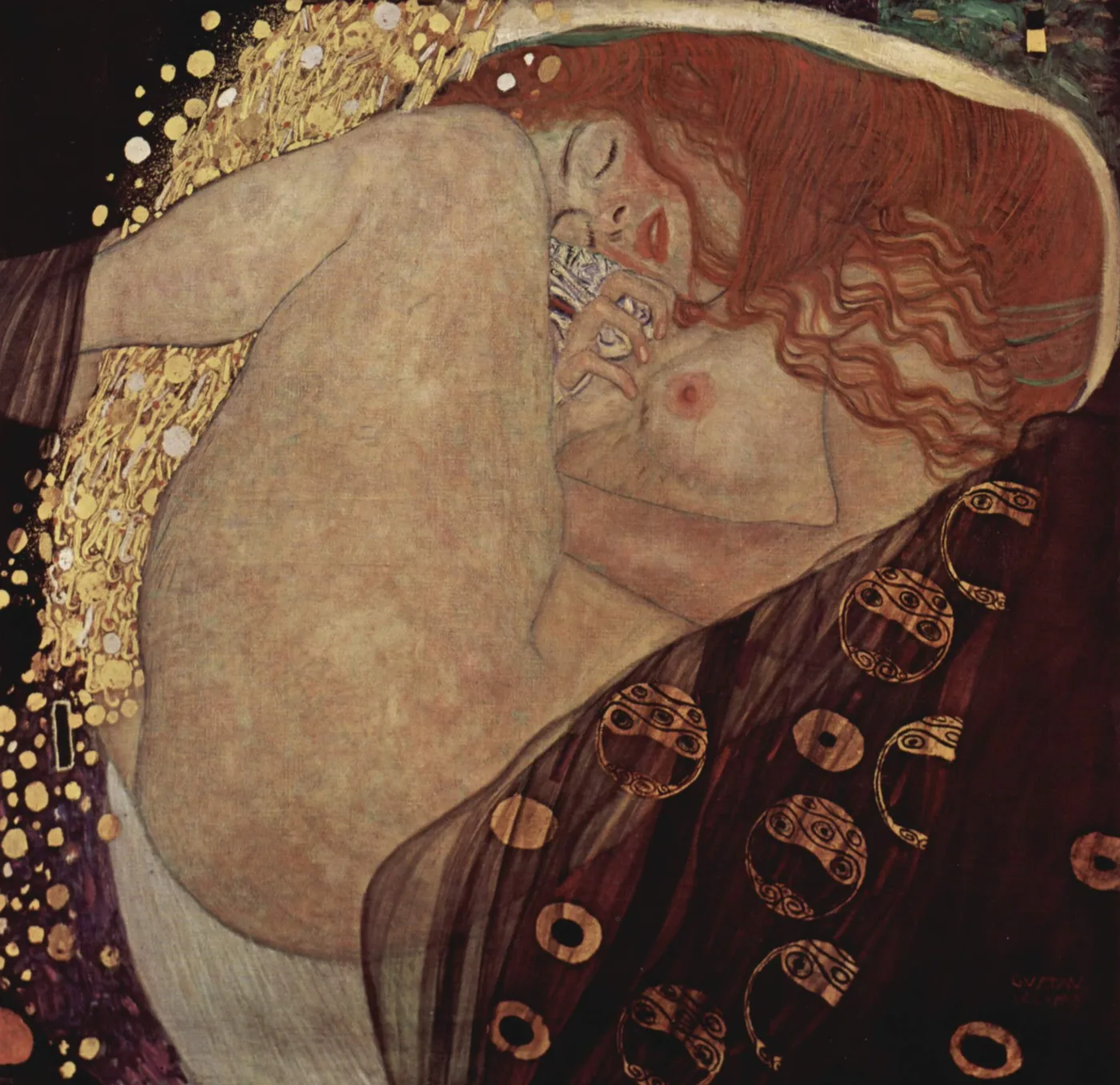
The canvas is close to square, and Klimt crops the figure so tightly that no setting survives around her. The woman’s curled body runs on a diagonal from the gold shower at upper left down to the dark drapery at lower right, and that diagonal carries the whole composition.
Her head rests at the top right, tipped back against a pale, curved border that reads like the edge of a cushion. Copper-red hair spreads from it in loose waves, covering her shoulder and running past the edge of the canvas. Her eyes are shut, her lips are parted and painted a deep red, and her face turns slightly away from the viewer.
One arm bends up and back over her head, the hand resting loosely near the hair. The other hand is drawn up under her chin, fingers curled around a strip of blue and white striped fabric. Between the two arms, one breast is left bare, its skin shaded in soft pink against the paler ivory tone of the rest of the body.
Across her hip and upper thigh, a cascade of small gold ovals and circles falls in a diagonal band, Klimt’s rendering of the shower of gold from the myth. Loose gold dots scatter further up, into the black ground at the top left corner, as though still falling through the dark.
A dark maroon drape wraps her lower body, patterned with large gold roundels, each one a ring or a spiral set inside a circle, with smaller solid dots scattered between them. The pattern is flat and graphic, painted without the shading Klimt gives the skin, so it reads as decoration printed onto a flat cloth rather than folded fabric.
The ground is plain black in the upper left corner, broken only by the scattered gold dots. The lower left corner is pale grayish-white instead. At the top right, past her hair, a small patch of pale green and cream squares breaks the black, a fragment of pattern close in spirit to the decorative grounds Klimt built around the figures in Goldfish. Klimt signs the canvas in small gold letters, low on the right, inside the maroon drapery.
The skin is built from smooth gradations of ivory and pink, giving the body a rounded, fleshy weight. The hair is painted with looser, curling strokes, and the gold shower and the drapery pattern are laid in as flat shapes with firm outlines. That contrast between modelled flesh and flat ornament runs through most of Klimt’s paintings from this decade.
A Private Reading of an Old Myth
Danaë shows the moment Zeus visits the imprisoned princess as a shower of gold, but Klimt leaves out the prison, the father, and the god himself, so no other figure or setting appears in the canvas. A woman alone remains, curled in on herself, eyes closed, holding a private sensation the picture does not explain.
The gold crossing her body is both myth and material. It is Zeus’s visit, and it is also actual gold leaf sitting on the canvas, so the picture folds its subject and its own making into one surface.
Klimt painted several women from myth and scripture in these years with a similar closeness and a similar refusal to meet the viewer’s eye, among them the title figure of Judith II (Salome). In each painting the story narrows to one body, shown at close range, with the ornament around her doing much of the telling. The myth gives Klimt a reason for painting a nude without calling it simply that.
Because her eyes stay shut and her face turns away, the viewer stays outside whatever she is experiencing. The mood is private and personal, closed off from anyone looking in, with nothing in her posture addressed to an audience.
The Original, Now in a Private Collection
The original Danaë is in a private collection.
The canvas is close to square and smaller than many of Klimt’s best known portraits. A visitor takes in the whole curled figure at a glance, then needs to step closer to follow the outline inside each gold roundel and the texture built into the hair.
Gold leaf catches gallery light differently depending on where you stand, so the shower crossing her hip can flare bright or settle flat and dark as you move past the canvas. A reproduction cannot shift with the room in quite that way, though the colour and the drawing carry across; sizes and framing for a reproduction are shown on the Danaë page.
Choosing a Danaë for Your Own Wall
This shop offers Danaë as a hand-painted oil reproduction or as an archival canvas print, both made from the museum photograph of the original. The available sizes and both editions are shown on the Danaë page.
The hand-painted version is painted from scratch in oil on canvas, using that photograph as the reference, with the large skin tones laid in first, then the gold shower and the drapery pattern, then the detail of the face and hands. Painting the oil by hand takes 2 to 4 weeks. No two canvases come out identical, and the slight variation in brushwork is part of what you are buying, which suits a picture built from such a sharp contrast between smooth skin and flat gold pattern.
The archival print is a giclee reproduction of the same image, printed on canvas with pigment inks, and it gives even, consistent colour from one print to the next. Printing takes 2 to 4 business days. It suits a quicker order, a tighter budget, or several pieces that need to match each other closely.
Because the original is close to square, every size of Danaë keeps that same proportion, square in feeling at each size offered. In a bedroom or a quiet reading corner, a mid-sized framed version lets you stand close enough to follow the line from her raised hand down to the gold shower. A dark or narrow frame keeps attention on the maroon drapery and the gold, with no wide pale border competing for the eye.
Delivery then takes 5 to 7 business days.
Questions Buyers Ask About This Painting
What does Danaë show?
Danaë shows the Greek myth of Zeus visiting the imprisoned princess Danaë as a shower of gold. Klimt paints only her, curled in sleep or reverie, with the gold falling across her hip and thigh.
Where is the original kept?
The original is in a private collection.
How big is the original painting?
The original measures 77 × 83 cm, close to a square format. Every reproduction keeps that same proportion at every size offered.
What is the difference between the hand-painted oil and the print?
The hand-painted oil is painted by hand in oil on canvas and carries real brushwork, while the archival print is a giclee reproduction on canvas with even, consistent colour. Both are made from the same museum photograph.
How long does a hand-painted order take to arrive?
Painting the oil by hand takes 2 to 4 weeks. Delivery then takes 5 to 7 business days.
More from this collection
Bring this painting home
Choose a hand-painted oil reproduction for real brushwork, or an archival canvas print for a crisp museum-image edition. Every size preserves the original proportions.
View this work & options
Further reading
Verify the original in the collection record and continue through related works in the catalogue.