
Hope II (Vision): A Pregnant Figure Wrapped in Gold Circles and Bowed Heads
Why Klimt Returned to the Subject of Hope in 1907
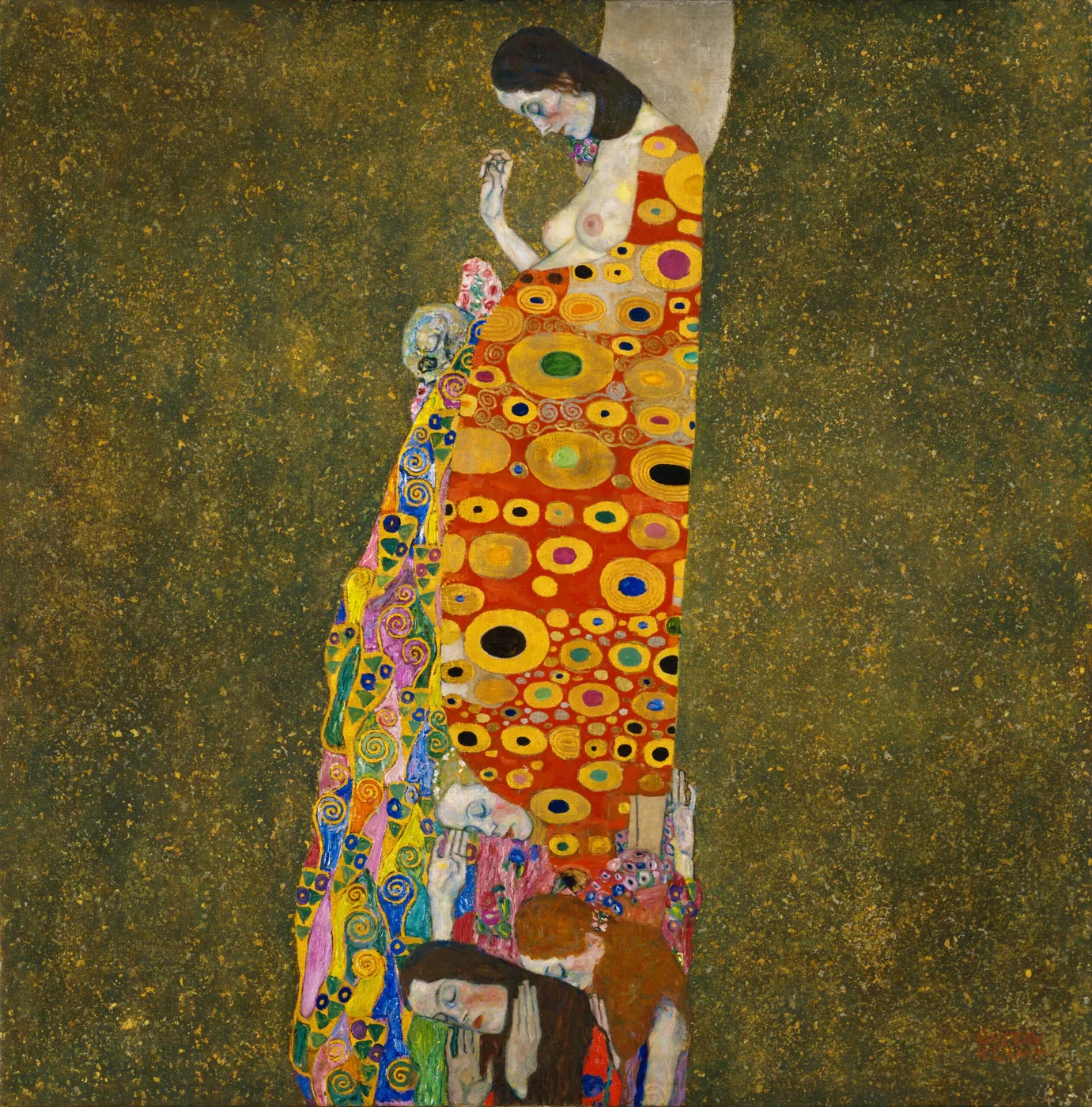
Gustav Klimt painted Hope II (Vision) in 1907-1908, a square canvas of 110.5 × 110.5 cm now held by the Museum of Modern Art. It shows a standing woman, pregnant, wrapped below the chest in a robe covered with gold and coloured roundels, her head bowed and her eyes closed.
Klimt was born in 1862 in Baumgarten, a village near Vienna, the son of a gold engraver. He trained at the city’s School of Arts and Crafts and built his early career on mural and ceiling painting for public buildings, work that brought him prestige and official commissions. He later broke from Vienna’s conservative art establishment to help found the Vienna Secession, a group of painters who pushed for a more decorative, modern style over academic convention.
By 1907 Klimt was working at the height of what is now called his golden phase, the years in which gold leaf, flat ornamental pattern and the female figure dominate his painting. That same year he completed Portrait of Adele Bloch-Bauer I, commissioned by one of Vienna’s wealthiest industrial families and built from gold leaf laid directly onto the canvas.
Pregnancy was not a subject other Viennese painters of his generation addressed directly. Klimt had already treated it once, in an earlier painting that showed the body more plainly and drew criticism when it was exhibited. In Hope II (Vision) the robe of circles covers the figure from below the chest down, so the subject reaches the viewer through pattern as much as through the body itself.
Klimt never married. His closest companion for most of his adult life was Emilie Flöge, who ran a fashion salon in Vienna with her sisters, and his name appears in the birth records of several children born outside marriage. A painting built around pregnancy, from a painter with that private history, sits close to his own life.
Klimt died in 1918, after a stroke left him partly paralysed, with pneumonia following during the influenza epidemic that swept Europe that year. He kept working until shortly before his death, leaving a number of paintings unfinished in his studio.
Women are the central subject of almost everything Klimt painted in this period, from society portraits of Vienna’s wealthiest wives to allegorical figures built from gold and pattern. Hope II (Vision) belongs to that run of work, though it stands apart for making the female body carry the specific experience of pregnancy rather than romance or status.
A Robe Built from Circles, a Face Turned Inward
The canvas is square, 110.5 × 110.5 cm, and Klimt uses that shape to push the figure toward one side rather than centre her inside it. She stands right of centre, tall and narrow, rising almost the full height of the canvas, so that close to half the picture on the left stays open ground. The format gives the gown room to run uninterrupted from below her chest to the bottom edge, with no architecture or horizon to break it.
That open ground is a dark olive green, flecked all over with small marks of gold, like dust settled across a dark field. The colour sits flat behind the figure with no other object anywhere in it, so nothing in the background competes with the woman and her robe. The speckled texture keeps that green from reading as empty space.
Her head tilts down and to the side, eyes closed, dark hair falling loose past her shoulders. Behind her head, in the upper right corner, a pale grey-white oval sits like a halo or a rising moon against the green ground, the one cool, quiet shape in a picture otherwise built from warm colour and pattern.
Her hands are clasped together under her chin, fingers interlaced, a gesture closer to worry than to ease. The chest is bare, the skin painted in soft pink and cream with gentle shading that gives it real weight against the flat gold around it. A necklace of small coloured beads, pink and blue, circles her throat, the only jewellery in the painting.
From below her chest the robe turns into a dense field of circles over a deep red-orange ground. Large discs in gold and mustard yellow, some ringed in black, carry smaller dots of blue, pink and green inside or beside them, scattered at different sizes like coins pressed into the fabric. The pattern covers the whole central panel of the dress, left bare of any other decoration.
Along the left edge of the gown runs a narrower band with a different pattern entirely: diagonal stripes of green, magenta and blue crossed with small spirals and triangles in yellow and black. It reads as a separate length of cloth laid beside the main robe, and it breaks the red field’s rhythm with a busier, more varied design.
Near the bottom edge, three pale faces with closed eyes emerge from the folds of the gown, heads tilted together, almost hidden in the cloth around them. The paint itself alternates between thin, flat colour in the pattern and thicker, built-up touches where the gold catches light, so the surface changes depending on where you stand.
What the Bowed Heads at Her Feet Might Mean
The title joins two words, hope and vision, and the painting reads as an interior state more than an event. The woman does not look outward at anything, not at the viewer and not at any object in the picture; her closed eyes and bowed head turn the whole figure inward, toward a thought or a feeling that stays private and unexplained.
Pregnancy in Vienna at the start of the twentieth century carried real risk for both mother and child, and a closed, lowered gaze can be read as apprehension as much as peace. The clasped hands support that reading: they sit close to the chin in a gesture nearer to prayer or worry than to rest.
The three pale faces bowed at the foot of the gown complicate the title further. Set against a figure who carries new life, they can be read as a reminder of death, of children lost, or simply of the fear that accompanies hope. The painting holds both without resolving them, and it offers no single key to which reading is correct.
The gold and pattern covering her body can be read as a kind of protection, an ornament built up like armour, set against the one patch of bare, modelled skin at her chest and face. Klimt repeats this pairing of flat decoration against a naturalistic body through much of his work from this period, including the reclining figure of Danaë, where a shower of gold also falls across a woman’s body.
Read this way, Hope II (Vision) sits close to other paintings from Klimt’s work that put a woman’s life stages at the centre, among them The Three Ages of Woman, where infancy, motherhood and old age share one canvas. Here the stages stay implicit, folded into a single pregnant figure caught between expectation and its opposite.
Seeing the Original at the Museum of Modern Art
Hope II (Vision) is held by the Museum of Modern Art, where it remains part of the permanent collection. Seeing the original means standing in front of a canvas just over a metre square, 110.5 × 110.5 cm, smaller than life-size for the standing figure it shows, so the painting meets the viewer almost at eye level rather than towering overhead.
At that size the gold circles across the gown are large enough to read individually from across the room, each one a few centimetres wide, while the bowed faces at the base reward a closer look that a reproduction on a screen cannot give. The speckled green background also changes with the angle of the museum’s lighting, brightening and dulling as you move past it, in a way a flat photograph flattens out.
For anyone who cannot make the trip, a reproduction kept to the same square proportions is the closest way to live with the composition day to day. The editions and sizes offered for Hope II (Vision) follow those original proportions exactly, so the figure is never cropped or stretched to fit a standard rectangle.
Choosing a Hope II (Vision) Reproduction for Your Wall
Every reproduction in this shop starts from a museum photograph of the original, which is how the colour relationships in Hope II (Vision), the red-orange ground, the gold discs, the olive green behind the figure, carry across into a copy made in a different medium. Both the hand-painted oil and the archival print are made from that same image.
The hand-painted oil version is built by an artist working in oil on canvas from that photograph, laying in the red and green fields first, then the pattern, then the face and hands. No two canvases come out identical, and the brush texture across the gold discs and the speckled background is part of what you are buying. Painting the oil by hand takes 2 to 4 weeks.
The archival canvas print reproduces the same image with pigment inks for a more even, consistent finish, a practical choice when you want the colours to match closely across more than one piece or want a friendlier budget. Printing takes 2 to 4 business days.
Because the original is square, every size of Hope II (Vision) stays square too, with the figure running the full height of the canvas as it does in the original. The square format and the gold discs of the gown stand out well against a dark wall, without the constraints of a rectangular frame, and a plain dark or gold-toned frame keeps the attention on the red and gold pattern rather than competing with it.
The studio photographs a hand-painted piece before it leaves, so you can see and approve the finished canvas. Delivery then takes 5 to 7 business days. You can review the available sizes and frame options on the page for Hope II (Vision).
Questions Buyers Ask About This Painting
What does Hope II (Vision) show?
A pregnant woman stands with her head bowed and her eyes closed, hands clasped under her chin, her body covered below the chest in a gold and red robe patterned with circles. A pale halo-like shape sits behind her head, and three pale faces bow at the foot of the gown.
Where is the original kept?
The Museum of Modern Art holds the original, a square canvas measuring 110.5 × 110.5 cm, painted by Gustav Klimt in 1907-1908.
What is the difference between the hand-painted oil and the print?
The hand-painted oil is painted from scratch in oil on canvas by an artist and carries real brushwork, so no two canvases match exactly. The archival print is a giclee print of the same image on canvas, more consistent from one copy to the next.
Which size works best for a square composition like this one?
Every size keeps the original’s square proportions, so the standing figure is never cropped. A medium or large size suits a narrow wall or a space between two windows, where the height of the gown has room to read.
Will I see the painting before it ships?
Yes. A hand-painted order is photographed once finished so you can check the colour and detail before it leaves the studio.
More from this collection
Bring this painting home
Choose a hand-painted oil reproduction for real brushwork, or an archival canvas print for a crisp museum-image edition. Every size preserves the original proportions.
View this work & options
Further reading
Verify the original in the Museum of Modern Art collection record and continue through related works in the catalogue.