
Three Generations, One Square Canvas: Klimt’s The Three Ages of Woman From 1905
A Square Canvas From the Year Klimt Broke With the Secession
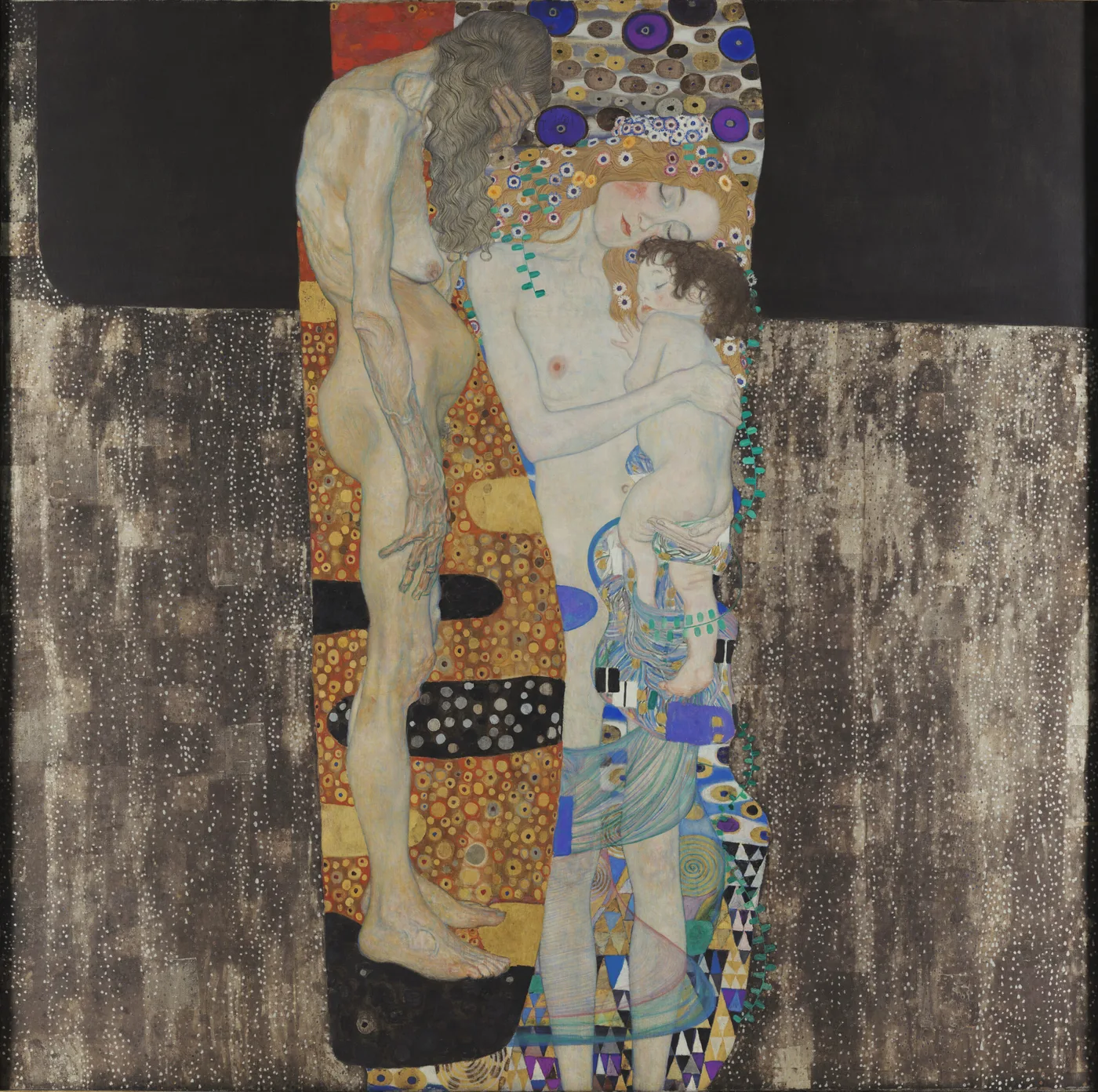
Gustav Klimt painted The Three Ages of Woman in 1905, a square canvas 180 × 180 cm now held by the Galleria Nazionale d’Arte Moderna e Contemporanea di Roma. It groups an old woman, a young mother and a sleeping child inside one composition, with nothing in the picture to confirm which generation is which.
Born in 1862 in Baumgarten, on the edge of Vienna, the son of a gold engraver, Klimt trained at the city’s School of Arts and Crafts and built his early career on public decoration, ceiling paintings for grand buildings and portraits for the Viennese elite. By the early years of the new century he led the Vienna Secession, the exhibition society formed to show work outside the official academy.
In 1905 that leadership ended. Klimt and a group of like-minded painters broke away from the Secession over a dispute about direction: Klimt’s faction pushed to unite fine art with applied arts and architecture, while others wanted independent, non-decorative painting sold through dealers. The split cost Klimt the exhibition platform he had spent years building.
The same year brought a second break. The University of Vienna commissioned Klimt to paint ceiling panels, named Philosophy, Medicine and Jurisprudence, and members of the faculty objected to their dark, erotically charged imagery. In 1905 Klimt withdrew from the commission and repaid the fee rather than alter the paintings to meet their objections.
The Three Ages of Woman belongs to that same year, made outside any public commission. It returns to ground Klimt had already explored in allegorical form, the female body standing for a stage of life, but compresses the idea into three figures sharing a single canvas rather than a frieze running the length of a wall.
Flat, patterned fields of colour had begun to spread across Klimt’s canvases by now, pressed directly against passages of closely observed flesh and face. This painting sits at that turning point in his manner.
He returned to the square format more than once in these years, a shape that holds a composition still, without a line pulling the eye to one side. By the time Klimt died in 1918, the painting had already left Austria for an Italian public collection, the Galleria Nazionale d’Arte Moderna e Contemporanea di Roma, where it remains today.
How the Paint Changes Across the Three Bodies
The canvas divides roughly into two halves. On the left stands the old woman, alone, with a margin of weathered background between her body and the canvas edge. On the right, the young mother holds the sleeping child against her shoulder.
At the top of the canvas, two solid black shapes frame the corners like cut drapery, and a flat red rectangle sits above the old woman’s head. Between them, a band of circles in purple, gold, grey and white looks like patterned fabric, set directly behind the two women’s heads.
The old woman is nude, her grey hair falling loose down her back. Her head bends forward and one hand covers part of her face, hiding her eyes from view. Klimt draws her in thin, exact contour lines that trace her collarbone, ribs and hip bones without softening them, the same attention he gives the reclining body in Danaë, though here the line stays drier and the body stands upright instead of reclining.
Behind her, a tall panel of ornament fills the space beside her body: dense orange and gold discs, like coins or beads, broken by two black bands scattered with white dots at knee and ankle height. Her feet rest on a dark, rounded shape that resembles a shadow or plinth rather than solid ground.
The mother’s skin takes a different handling, rounder and pinker, with a flush at the cheek and a red mouth. Her eyes are closed, her head tilted down toward the child, and small flower-shaped medallions dot her red hair under a gold band at the crown. The child’s brown curls rest against her shoulder, eyes shut, its body pressed into the curve of her arm.
Below their joined bodies the paint turns fully decorative. Jade-green drop shapes hang in vertical rows, a length of fabric in pale pink and blue-grey stripes wraps the mother’s legs, and at the bottom edge a field of gold, purple and white triangles meets a border of blue and purple eye-shaped motifs.
The lower half of the canvas, left and right of the figures, is given over to a speckled grey-brown-and-gold surface, streaked vertically and dotted with cream flecks, closer to a weathered wall than a drawn setting. Against it, the smooth modelling of the two faces and the flat geometry of the ornament sit on the same canvas without blending into each other.
Why the Old Woman Stands Apart From the Pair
The painting groups three bodies that read as one life seen in sequence: a sleeping infant, a young mother in her prime, and an old woman bowed by age. Nothing in the picture names them as mother, daughter and grandmother, and the three could as easily stand for one woman seen at three distances from birth.
She stands apart from the pair in the composition. She shares the same ornamental panel as the mother and child, yet no touch connects her to them, while the mother and child share one continuous outline, curved into each other. One group is closed and warm; the other stays open and cool.
Read this way, the picture sets closeness against isolation: the young pair touch and curve into each other, the old woman stands alone, her hand covering her face instead of meeting the viewer’s eye. Klimt had painted mothers and children with a similar closeness before, in the pregnant figure of Hope I, treating the female body as a vessel for a life still to come.
The gold and pattern around the young pair, set against the old woman’s bare body, suggests another reading: a culture that dresses youth in ornament and leaves age bare. Nothing in the painting’s title or composition settles which reading fits.
Klimt’s refusal to soften the old woman’s body the way he softens the mother’s stays constant across these readings. He draws her sagging flesh and visible bones with the same care he gives the child’s curls, so the contrast between the two halves of the canvas carries as much weight as either figure alone.
Finding the Original in Rome’s Modern Art Collection
The Three Ages of Woman hangs in the Galleria Nazionale d’Arte Moderna e Contemporanea di Roma, part of the Italian national collection of modern art. Seeing this particular canvas in person means a visit to Rome.
At 180 × 180 cm, the painting meets a viewer close to life size. The old woman’s body runs nearly the full height of the canvas, so standing in front of the work puts her bowed head and raised hand at roughly eye level.
The gallery holds other nineteenth and twentieth century European works around it, so the painting is seen inside a modern art collection rather than a room devoted to Klimt alone. Its square shape and dense ornament stand out against most of what hangs nearby.
Matching This Square Composition to a Wall at Home
Every reproduction of The Three Ages of Woman sold here starts from a museum photograph of the original, so the composition, the colours and the proportions match the painting described above. From that image, the workshop offers two routes to a finished piece, a hand-painted oil on canvas or an archival canvas print.
Choose the hand-painted oil version of The Three Ages of Woman and an artist builds the image with a brush, laying in the large fields of pattern first, then the smooth modelling of the two faces and the fine lines of the old woman’s body. Painting the oil by hand takes 2 to 4 weeks. Because a person paints it, no two canvases come out identical, and the surface carries real brushwork you can see change as you move past it.
The archival canvas print reproduces the same image with even, consistent colour and detail from one print to the next. It suits anyone who wants a dependable result or needs the piece to match others on the same wall.
Every size on the product page for The Three Ages of Woman keeps the original’s square proportions, so a small version stays as square as a large one. A large size suits a stair landing or a wide bedroom wall where the composition reads from a distance, while a smaller size works closer to eye level, in a hallway or beside a desk, where a viewer stands nearer the detail in the old woman’s body and the mother’s robe.
A plain or narrow frame keeps attention on the gold and the pattern rather than competing with it; frame options for The Three Ages of Woman are set out alongside the sizes. Before a hand-painted piece ships, the studio photographs the finished canvas so you can check the colour and detail yourself. Delivery then takes 5 to 7 business days.
Questions Buyers Ask About This Painting
What does The Three Ages of Woman show?
An old woman, a young mother and a sleeping child, grouped together on a single square canvas that Klimt painted in 1905.
Why is the old woman kept apart from the mother and child?
They share the same ornamental panel; no touch connects her to the pair, a gap read here as distance between youth and old age.
Where is the original painting kept?
In the Galleria Nazionale d’Arte Moderna e Contemporanea di Roma, where it hangs as part of the Italian national collection of modern art.
Can I get this painting as a square reproduction in a smaller size?
Yes. Every size keeps the square proportions of the original, scaled from a small piece down to a large one for a stair landing or bedroom wall.
What is the difference between the hand-painted oil and the archival print?
The oil is painted by hand in oil on canvas, so the surface carries real brushwork and small natural variation. The print is an archival canvas print with even, consistent colour from one copy to the next.
More from this collection
Bring this painting home
Choose a hand-painted oil reproduction for real brushwork, or an archival canvas print for a crisp museum-image edition. Every size preserves the original proportions.
View this work & options
Further reading
Verify the original in the Galleria Nazionale d'Arte Moderna e Contemporanea di Roma collection record and continue through related works in the catalogue.