
Fritza Riedler, painted behind a wall of gold leaf and mosaic
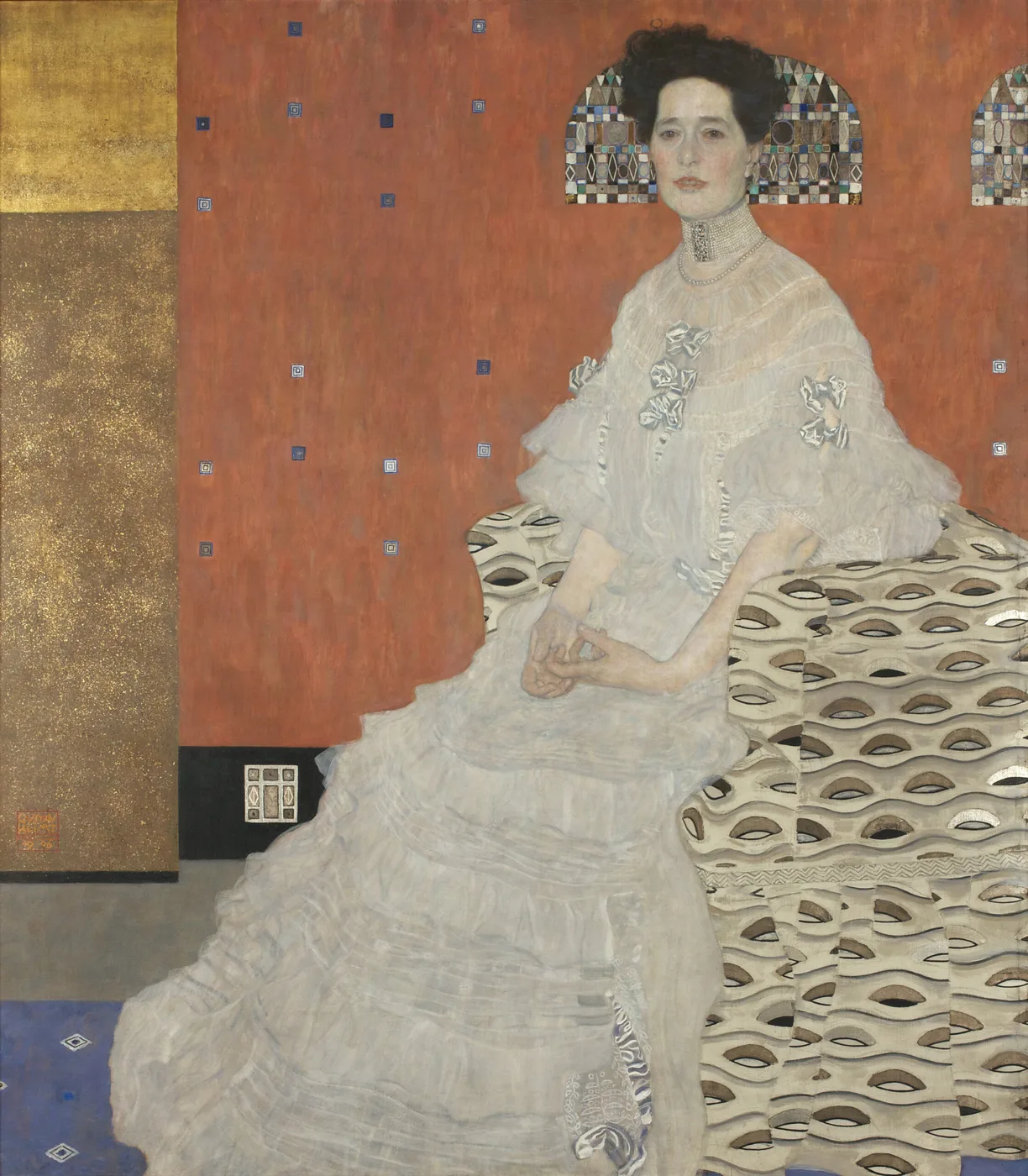
Painted in 1906, after Klimt left the Secession
Gustav Klimt painted Fritza Riedler in 1906, a seated portrait of a Viennese woman set against a wall of gold leaf, mosaic pattern and dense red ornament, now held by the Belvedere.
Klimt was born in 1862. By 1906 he was the portraitist every wealthy Viennese family wanted, painting the wives and daughters of industrialists, bankers and civil servants, and private commissions were his main income.
The year before, Klimt and the closest members of his circle had broken away from the Vienna Secession, the exhibition society he had helped found and had led for years. Free of its committees and its shared exhibitions, he spent his working year moving between private commissions, portraits of the women who sat at the centre of Vienna’s wealthiest households.
Behind this new direction in his portraits lay an earlier trip to Ravenna, where Klimt had studied the gold and silver tesserae of the city’s Byzantine church mosaics. He carried that memory of flat, glittering surfaces back to his Vienna studio and began setting his sitters’ faces against fields of pattern instead of ordinary depth and furniture.
Fritza Riedler belongs to this run of society portraits, alongside the picture of Margaret Stonborough-Wittgenstein from the same years and, soon after, Portrait of Adele Bloch-Bauer I. Each woman sat for Klimt in formal dress, in a chair or against a wall built from a different arrangement of gold, silver and geometric pattern, and no two of these backgrounds repeat the same motifs.
Summers took Klimt away from Vienna’s portrait commissions entirely. He spent them at the Attersee, painting gardens and flowers, among them Cottage Garden with Sunflowers. The two bodies of work rarely overlap on canvas, though both share his attention to pattern built from small, repeated marks.
Fritza Riedler stands among the most elaborate backgrounds he built for any sitter, with two distinct ornamental systems, the mosaic arches and the patterned chair, meeting behind her. Historians group this run of portraits under the label Golden Phase, pictures where gold leaf and applied pattern replace a conventional interior.
Gold leaf, mosaic and a face painted from life
The canvas is a tall rectangle, the sitter turned in three-quarter view and pushed close to the picture plane. She leans against the arm of a chair that fills the lower right corner, her body taking up most of the lower half of the canvas while her head sits just right of centre, near the top edge, with little space left above her for sky or ceiling.
Behind her, the wall is painted a deep terracotta red, scattered with small navy-blue squares set in a loose, irregular grid, each one no larger than a coin. To the left, a flat panel of gold leaf runs the height of the canvas, and below it a second, mottled gold-brown panel catches less light. A small black square patterned in white sits at the point where the gold panels meet the red wall.
Two fan-shaped forms rise behind her head and shoulder, built from a checkerboard of silver, black, white and pale blue tesserae, close to the Byzantine mosaics that had struck Klimt in Ravenna. They sit behind her like a halo of pattern, with no architecture in the room to explain where they come from.
Her dress is pale grey-white, built from tier after tier of fine pleats that fall from the waist and pool around the chair and floor. A striped silver-and-black ribbon crosses the bodice and gathers into two soft bows at the chest, and a high collar closes under her chin with a beaded choker. Her bare forearms and clasped hands carry the only warm, modelled flesh in the lower half of the canvas.
The chair she leans against is covered in a woven pattern of almond-shaped eyes, cream and black with touches of silver, set in wavy horizontal bands. It takes up the entire right side of the composition, meeting the red wall with no visible edge of carved wood or upholstery seam.
At the lower left corner, a strip of floor shows through in deep blue, dotted with small white diamond shapes, the one cool note of colour at the base of the canvas. It grounds the composition for a moment before the eye returns to the pale dress and the red wall above it.
Klimt paints the face, throat and hands with thin, smooth layers that model real light across bone and skin. Everywhere else, Klimt replaces the brush with pattern laid on in flat, repeated units, gold leaf, mosaic tesserae, the eye motifs on the chair, each one built up as a separate, hard-edged shape instead of blended into its neighbours.
A likeness set inside a field of pattern
Fritza Riedler sits for her portrait the way most of Klimt’s society clients did, composed, dressed for the occasion, her hands folded and empty of any object or task. Nothing in the picture identifies her beyond her face and her clothing. The setting around her carries the information a viewer might otherwise look for in a room, a possession or a view through a window, since none of those appear anywhere in the canvas.
The gold leaf and the mosaic forms behind her can be read as a sign of standing, the kind of surface Klimt reserved for sitters whose families could afford it. Read this way, the portrait states her position in Vienna through materials alone.
A different reading finds tension in the same surface. The face stays sharply individual, modelled with care, while the body below it dissolves into pattern that could belong to any sitter in this run of portraits. The woman and the decoration pull against each other instead of sitting comfortably side by side.
The fan-shaped mosaic above her head, close to Klimt’s memory of Ravenna’s church interiors, can also be read as borrowing the setting of a religious image for a portrait with no religious subject at all. The eye motifs across the chair add to the sense of a figure watched from several directions at once.
The gap between her face, the one passage that is a likeness, and the rest of the picture, built from pattern that repeats regardless of who sits in front of it, stays constant across the canvas. Klimt painted several women this way in the same years, each held still inside a different arrangement of the same gold and silver materials.
Seeing Fritza Riedler at the Belvedere
The original Fritza Riedler hangs in the Belvedere, in Vienna. The canvas measures 153 × 133 cm, close to life size for the seated figure it holds and large enough that her head sits roughly level with the eyes of an adult standing in front of it, with room on the canvas for the full reach of the mosaic and gold panels around her.
Gold leaf and mosaic tesserae change with the light falling on them in a way no photograph fully carries. Standing in front of the canvas, the gold panel on the left and the silver mosaic above her head catch the room’s light at different angles, so the surface shifts in brightness as a visitor moves past it.
The Belvedere holds the largest public collection of Klimt’s paintings, so a visit built around Fritza Riedler usually takes in several other portraits and landscapes from the same years, in the same rooms. The scale of the canvas rewards looking from across the room for the overall pattern, then stepping close for the brushwork of the face and hands.
Choosing an oil or a print of Fritza Riedler
Every reproduction in the shop starts from the museum’s open-access photograph of Fritza Riedler, which keeps the colours, the proportions and the small ornamental detail of the original canvas. From that same image, two different methods produce two different objects, a hand-painted oil and an archival canvas print.
The hand-painted oil is built up in layers by an artist on blank canvas, with nothing printed underneath. For a picture built from smooth flesh, gold leaf and mosaic pattern, a painted surface lets light move differently across each kind of passage, closer to how the original behaves on a wall. Painting the oil by hand takes 2 to 4 weeks. The hand-painted edition of Fritza Riedler is listed alongside its sizes.
An archival canvas print reproduces the same image with consistent colour and detail from one copy to the next, a steadier and more affordable route to the same composition. Printing takes 2 to 4 business days. It suits a buyer who wants several matching pieces, or a straightforward alternative to the painted edition, in the same sizes.
Every size keeps the proportions of the original, so the tall, near-square format of Fritza Riedler stays the same shape whether the canvas is small or large. A narrow wall between two windows, a hallway, or the space above a console suits this shape well, since the portrait reads as one dense block of colour from across the room before the gold and mosaic separate out up close. Frame options for this piece are shown on the product page.
Before a hand-painted canvas ships, the studio photographs the finished piece so you can check the colour and the detail before it leaves. Delivery then takes 5 to 7 business days. A dark or antique gold frame keeps the colour of the original wall instead of competing with it.
Questions about the Fritza Riedler reproduction
What does the painting show?
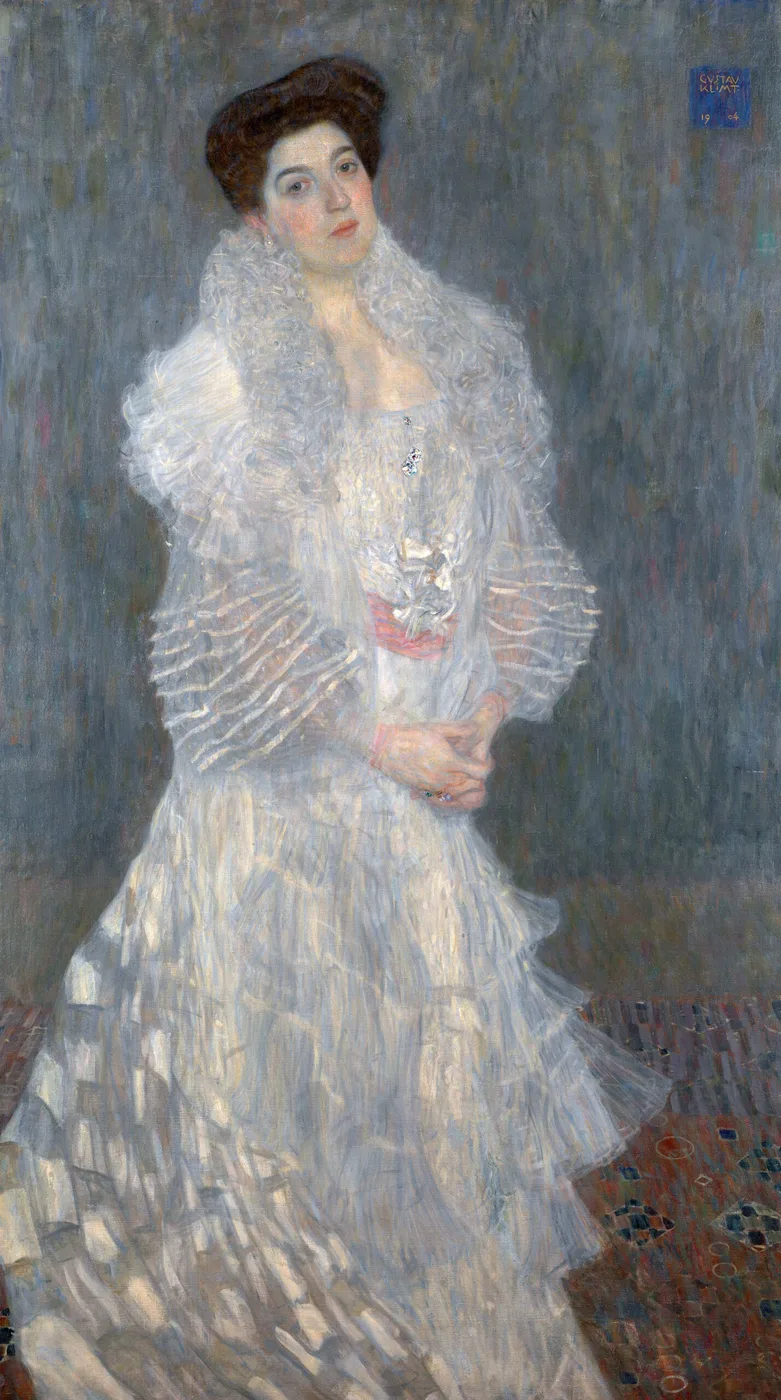
A seated Viennese woman in a pale dress, her face and clasped hands painted with soft realism while the chair, wall and mosaic forms around her are built from flat, repeated pattern in red, gold and silver.
Where is the original Fritza Riedler today?
The original hangs in the Belvedere, in Vienna, as part of its collection of Klimt’s portraits.
What is the difference between the hand-painted oil and the print?
The oil is painted by hand in layers on blank canvas, with real brushwork and natural variation between pieces. The print is a giclee on canvas from the same image, with consistent colour from one copy to the next.
Which size and frame suit this composition?
Fritza Riedler keeps a tall, near-square shape at every size, which suits a narrow wall or the space above a console. A dark or antique gold frame sits well against its red and gold background.
How long does a hand-painted order take to arrive?
The studio paints it first, which takes 2 to 4 weeks. Delivery after that takes 5 to 7 business days.
More from this collection
Bring this painting home
Choose a hand-painted oil reproduction for real brushwork, or an archival canvas print for a crisp museum-image edition. Every size preserves the original proportions.
View this work & options
Further reading
Verify the original in the Belvedere collection record and continue through related works in the catalogue.