
Margaret Stonborough-Wittgenstein: Klimt Paints a Wittgenstein in White, 1905
A Portrait From the Year Klimt Broke With the Secession
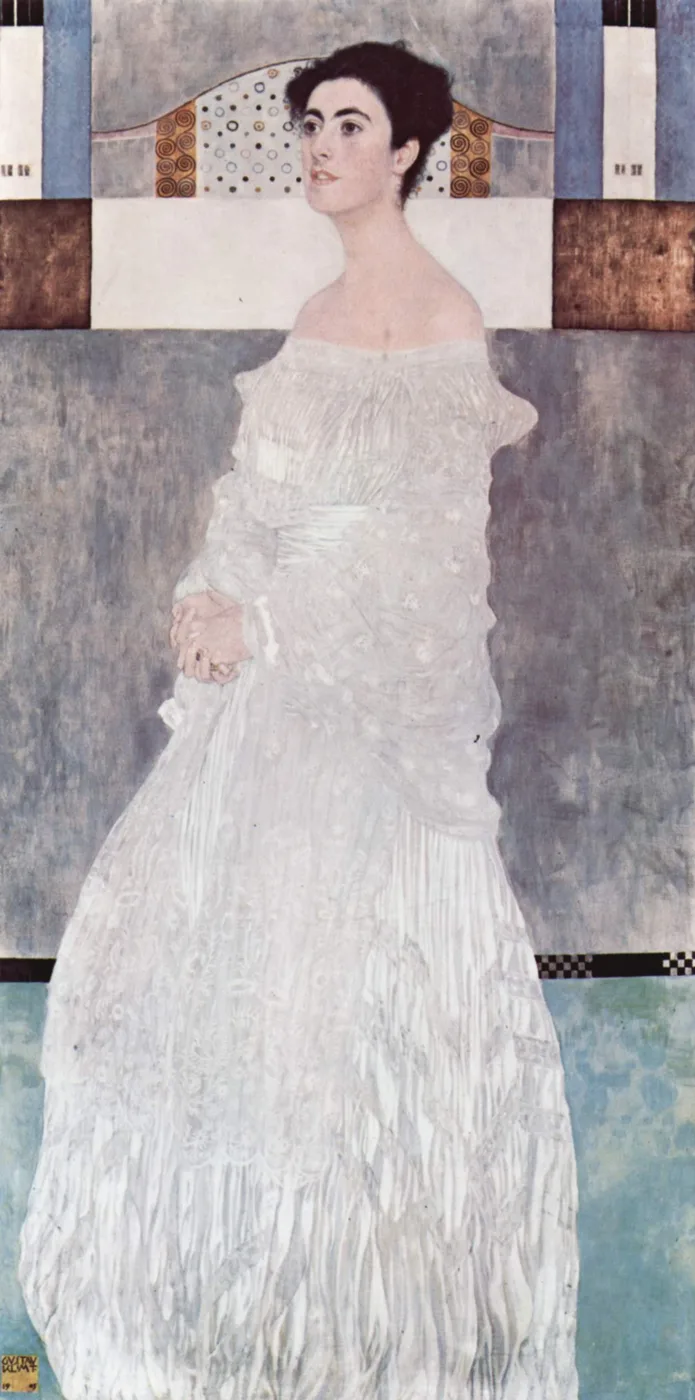
Gustav Klimt painted Margaret Stonborough-Wittgenstein in 1905, a full-length portrait held today by the Bavarian State Painting Collections. It belongs to a run of formal portraits Klimt made of women from Vienna’s wealthiest families in these years, each one a commission for the sitter’s own household.
Born in 1862 near Vienna, Klimt trained at the city’s School of Arts and Crafts and began his career on large decorative commissions for the city’s public buildings, before turning mainly to portraits. His early work leaned on academic realism, and by the time of this portrait his style had moved toward flatter fields of colour and decorative pattern, the manner now most associated with his name. By 1905 he was the portrait painter of choice for Vienna’s industrialists and bankers, a position that brought him steady work through the following decade.
1905 was the year of this portrait and the year Klimt broke with the Secession. That year he and a group of fellow painters left the Vienna Secession, the exhibiting society he had helped found and had led as its first president. The split ended his formal role inside the group whose exhibitions had built his public reputation.
The sitter was Margaret Stonborough-Wittgenstein, a member of the Wittgenstein family, one of Vienna’s wealthiest industrial dynasties. Her brother was the philosopher Ludwig Wittgenstein.
Klimt’s output around 1905 ranged widely in how much ornament it carried. In Fritza Riedler, painted in the same period, pattern spreads across much of the background; here the setting is reduced to flat bands of colour, and the dress itself carries the only close patterning in the whole canvas.
He went on painting women from Viennese society until his death in 1918. This canvas sits among the plainer, paler portraits of that run, its palette held to grey, white and bronze instead of the gold leaf he used in many of his other commissions from the same years.
Grey, White and a Border of Bronze and Chequered Tile
Margaret Stonborough-Wittgenstein stands turned three-quarters to one side, her face angled further still, dark hair gathered back and pinned up. Her eyes rest somewhere past the edge of the canvas instead of meeting the viewer, and her mouth stays closed and composed. Her weight seems to rest on one leg, and the long skirt falls in a slight diagonal from waist to hem that echoes the turn of her shoulders. Klimt stretches the figure the full height of the canvas, leaving the space around her largely empty.
The background is built from horizontal bands, not one continuous setting. Across the top, a pale arch of cream fabric patterned with small rust-orange circles and spirals sits between slate-blue panels, each upper corner marked with a small grid of dark squares.
Below the arch, a plain cream strip gives way to a band of dull bronze running the full width of the canvas, set above the figure like a lintel over a doorway.
Behind her torso and arms, the picture drops to a flat, almost textureless field of blue-grey. Against that plain ground the pale dress and bare shoulders carry the whole weight of the composition, with nothing else in the background competing for attention.
Near the bottom edge, a narrow strip of black and white chequered tiles crosses the canvas, and the ground below it turns pale blue-green, where the hem of the skirt pools. The bands read as a stage for the figure, flat colour standing in for any real room.
The dress carries the only close patterning on the figure itself. It falls off both shoulders with a loose ruffled edge at the neckline, gathers into a wide waistband at the middle, and drops in loose, vertical folds to the floor, the white fabric worked with a faint scatter of small floret shapes instead of a bold print. The sleeves end in a soft gathered cuff below the elbow, and her hands are clasped together at the waist, fingers interlaced, painted with the same careful modelling Klimt gives her face and bare shoulders.
Skin is built in smooth, blended strokes, while the folds of the skirt are laid in with looser, more visible brushwork and scratched lines that follow the fall of the fabric. A small gold signature panel sits in the lower left corner, the one note of gilding in a picture that otherwise keeps to grey, white, bronze and pale blue.
No Scene, Only a Woman Standing Still
Margaret Stonborough-Wittgenstein offers no story to decode, only a woman standing alone against a patterned backdrop. The picture reads as a study of composure: a straight spine, closed hands, a gaze turned away from the viewer. The eye settles on the pale dress before it reaches the face, so the first impression is of bearing more than character.
The flat bands behind her, the arched motif with its circles and spirals, the strip of chequered tile, draw on the decorative vocabulary Klimt was using elsewhere in these years, reduced here to a backdrop for the figure. They give her no interior to belong to: no chair, window or object that would place her in a particular room. She stands against pattern and colour alone, a figure set apart from any room of her own, almost an icon in a niche.
The white of the dress dominates the canvas and can be read two ways: as the colour of a formal evening gown suited to a society portrait, or as a deliberate restraint set against the gold and pattern Klimt used in other portraits of the same years, a choice that lets the sitter’s posture carry the picture, with no ornament doing the work for her.
Her clasped hands and closed mouth keep the picture quiet. She offers no smile to the viewer and holds no object that would explain who she is beyond the fact of her presence, upright and self-contained within a frame built from flat colour.
Set beside a portrait such as Portrait of Adele Bloch-Bauer I, where gold leaf is worked into pattern around the sitter, this canvas shows how differently Klimt could present a woman of Vienna’s upper class: restraint carrying the same weight that ornament carries elsewhere.
Seeing Margaret Stonborough-Wittgenstein at the Bavarian State Painting Collections
The original of Margaret Stonborough-Wittgenstein is held by the Bavarian State Painting Collections in Munich. The canvas measures 179.8 × 90.5 cm, a format far taller than it is wide, so the painting fills a visitor’s field of view in a way a seated or half-length portrait would not.
At that scale the figure stands close to life size. Looking at the original means meeting the sitter close to eye level, something no small image on a page or a screen can give. The pale dress and the bands of colour behind her read clearly from across a gallery room, since the picture relies on broad fields of tone more than on fine detail.
Seeing the brushwork itself, the looser handling of the skirt set against the smoother modelling of the face and shoulders, takes standing close to the canvas, which the height of the original allows. A visit rewards both distances: the full figure and its bands of colour from across the room, and the handling of paint, the scratched lines in the skirt and the smoother touch on the skin, from a few steps in.
Choosing a Size and Frame for This Tall, Pale Portrait
Every reproduction in this shop starts from a museum photograph of the original painting, the same image behind both the hand-painted oil and the archival print, so the choice between them is a matter of method: the same picture, painted by hand or printed. You can compare both editions on the product page for Margaret Stonborough-Wittgenstein.
A hand-painted oil is painted from scratch by an artist in oil on canvas, built up in real brushwork, so the surface carries the texture of paint the way the original does, in the looser handling of the skirt and the smoother modelling of the face. Painting the oil by hand takes 2 to 4 weeks.
The archival canvas print is a high-resolution giclee print of the same image, consistent from one print to the next and a practical choice on a tighter budget or when several pieces need to match each other. Printing takes 2 to 4 business days.
Every size keeps the original proportions, so the reproduction stays tall and narrow at every size instead of being cropped to fit a standard rectangle. That narrow format suits a hallway, a stairwell or the wall beside a doorway, anywhere with more height than width to spare. Its grey, white and bronze palette reads well against a plain or pale wall, where the picture itself supplies the contrast instead of needing a bold colour behind it, and the size options let you match the proportions of the original to the space you have. Delivery then takes 5 to 7 business days.
Before a hand-painted piece ships, the finished painting is photographed so you can see it and approve it before it leaves the studio. Framing options for the hand-painted version and the print both suit the picture’s quiet palette of grey, white and bronze, working well with a simple dark or pale frame and no heavy ornament.
Common Questions About This Portrait
Who is the woman in the painting?
She is Margaret Stonborough-Wittgenstein, a member of the Wittgenstein family and the sister of the philosopher Ludwig Wittgenstein. Klimt painted her portrait in 1905.
How big is the original painting?
The original canvas measures 179.8 × 90.5 cm, tall and narrow, and is held by the Bavarian State Painting Collections in Munich.
What is the difference between the hand-painted oil and the print?
The oil is painted by hand on canvas from the museum photograph, with real brushwork and texture that vary slightly from one canvas to the next. The print is a giclee reproduction of the same image, consistent from one copy to the next.
Which size and frame suit a tall, narrow wall?
Because every size keeps the original’s tall, narrow proportions, a larger size reads well in a hallway or stairwell, and a simple dark or pale frame suits the picture’s quiet grey, white and bronze palette best.
Will I see the painting before it ships?
Yes, for the hand-painted oil. The finished painting is photographed so you can approve it before it leaves the studio.
More from this collection

Bring this painting home
Choose a hand-painted oil reproduction for real brushwork, or an archival canvas print for a crisp museum-image edition. Every size preserves the original proportions.
View this work & options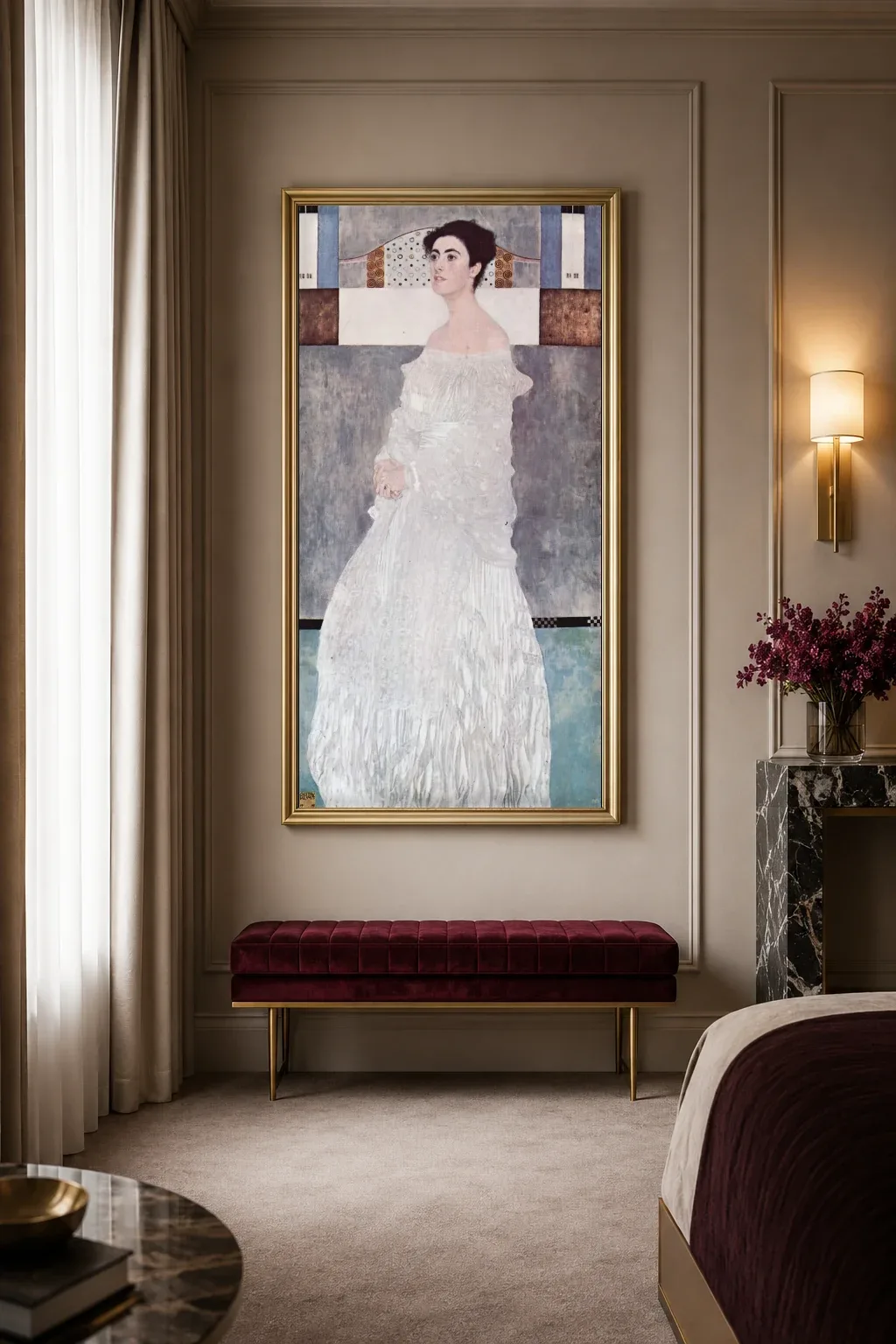
Further reading
Verify the original in the Bavarian State Painting Collections collection record and continue through related works in the catalogue.