
Portrait of Emilie Flöge: Klimt’s tall 1902 likeness of his closest companion
A portrait painted in the year of the Beethoven Frieze
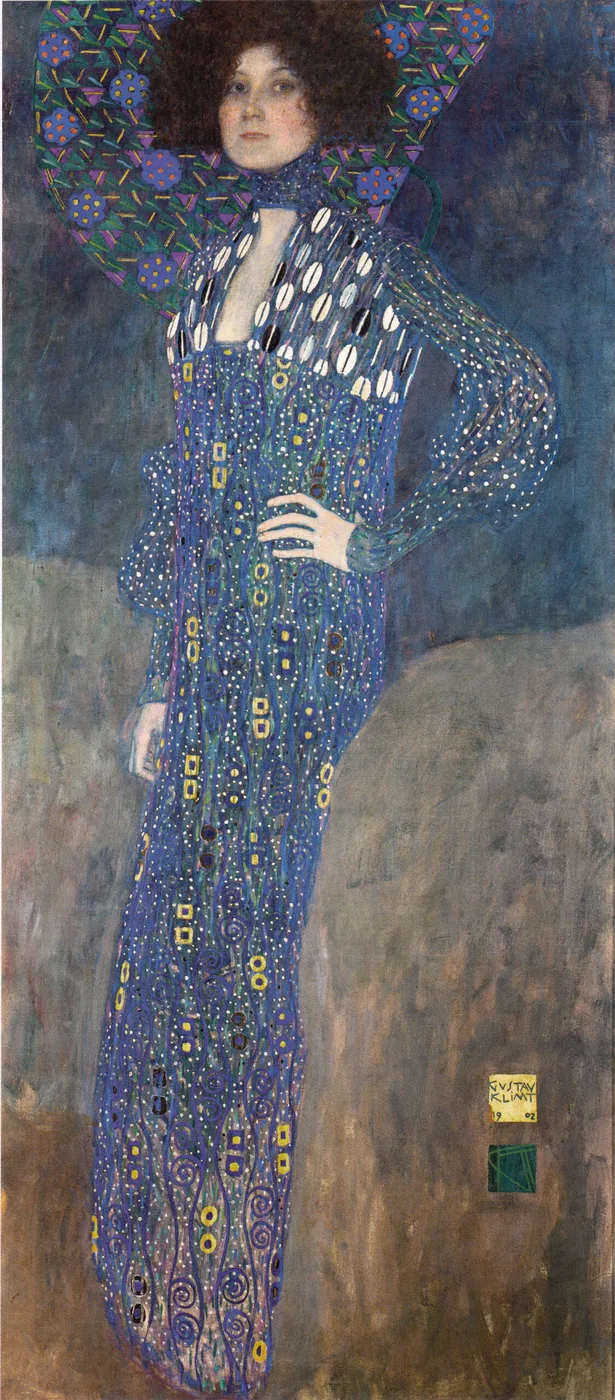
Gustav Klimt (1862-1918) painted Portrait of Emilie Flöge in 1902, a full-length image of the woman who stayed his closest companion for the rest of his life. The canvas is held today by the Vienna Museum, an upright format far taller than it is wide.
Klimt trained as a decorative painter in Vienna, the son of a gold engraver, and his first steady work was ceiling and wall decoration for public buildings, done with his brother Ernst and the painter Franz Matsch. Their joint commissions included the Auditorium of the Old Burgtheater, painted years before the gilded ornament of this portrait, a vocabulary Klimt built later, through the Secession.
1902 was the year of the Beethoven Frieze, the mural cycle Klimt painted for the Vienna Secession’s exhibition built around Max Klinger’s sculpture of the composer. He had helped found the Secession a few years earlier and led it through its most ambitious shows. The frieze ran across three gallery walls in gilded, allegorical scenes, painted straight onto the plaster rather than on canvas.
Alongside that public project, Klimt kept working on the private commissions and personal portraits that paid his studio’s bills. This canvas belongs to the second group: an oil on canvas, close to life size, made of a woman he knew rather than a client he had been introduced to.
Emilie Flöge came into Klimt’s circle through his brother Ernst, who had married her sister Helene. She ran a fashion salon in Vienna with her sisters, designing the loose, unstructured dresses that broke with the corseted fashion still worn by most Viennese women.
Klimt’s brother Ernst died young, not long after his marriage to Helene Flöge, and Gustav took on responsibility for Helene’s household in the years that followed. That obligation kept him close to the whole Flöge family, and his own friendship with Emilie grew out of those same family ties rather than from any formal introduction.
The salon Flöge ran with her sisters Helene and Pauline traded as Schwestern Flöge, on Mariahilfer Strasse in Vienna, and became a meeting point for the city’s reform-dress circle. Klimt photographed her there and at the Attersee wearing the salon’s own gowns, and those photographs, more than any surviving letter, are what document how close the two of them stood. The business outlasted him, and Flöge kept it running for decades after his death.
She and Klimt spent summers together at the Attersee, where he painted landscapes each year. Their relationship lasted decades and is documented in photographs taken at the lake, though no surviving letter settles whether it went beyond close friendship.
Flöge stayed near Klimt through his final illness. He suffered a stroke early in 1918 and died within weeks, and she was among the people at his side.
Klimt never married, and after his death several women came forward in paternity cases that the courts and his estate eventually settled, acknowledging children he had fathered outside any marriage. Flöge, unmarried herself and without children of her own, stood apart from that side of his life, tied to him by decades of friendship rather than by family.
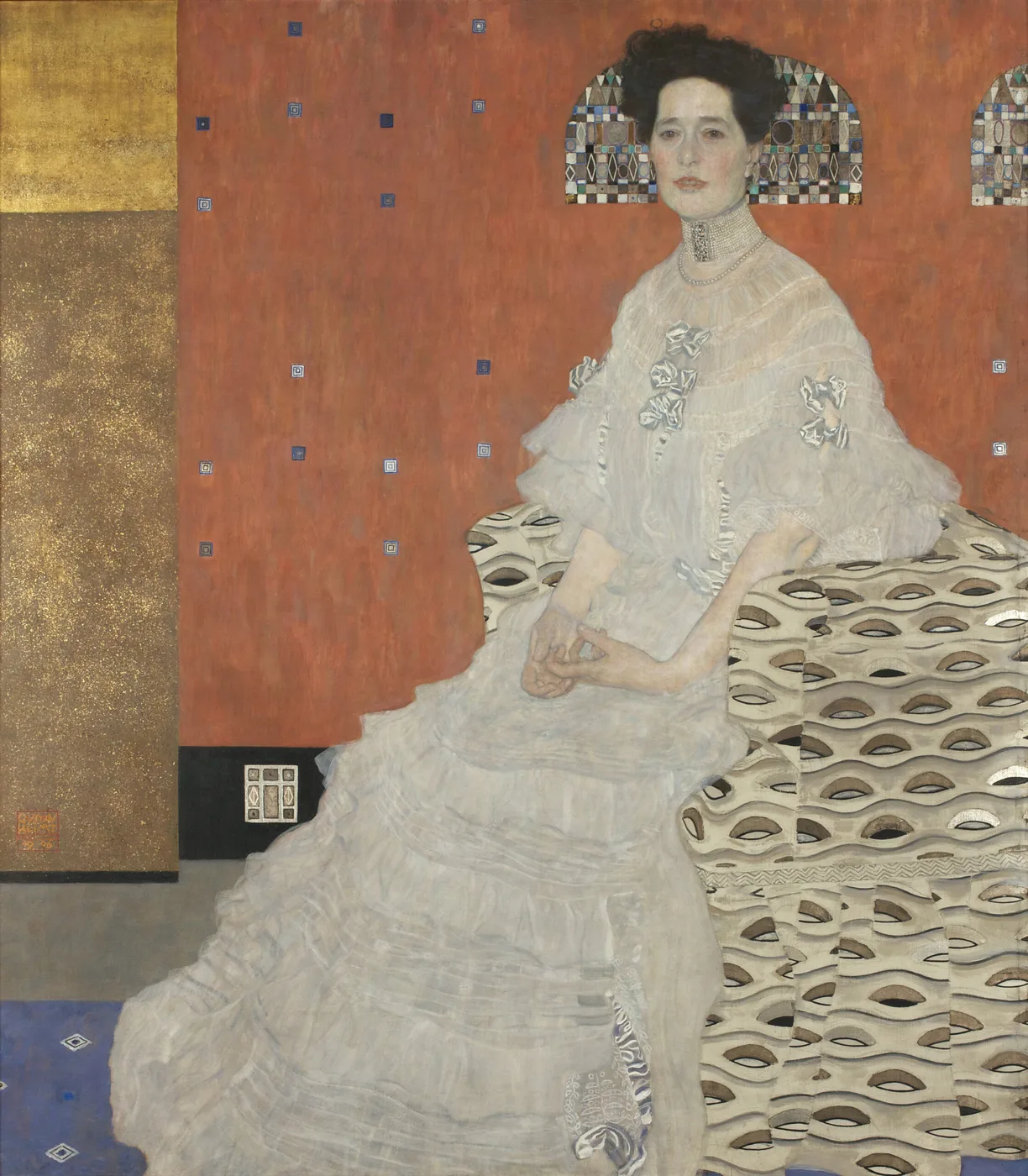
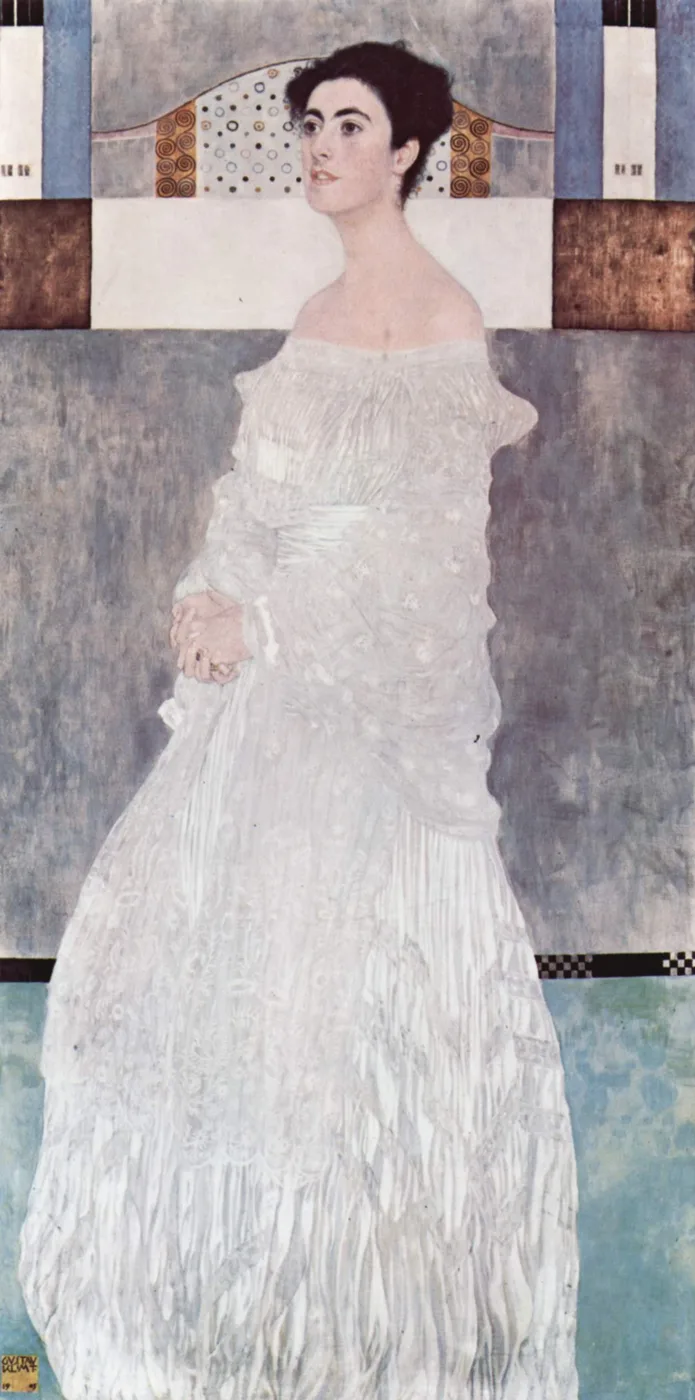
The portrait stands apart from the paid commissions of the same years, among them the later likenesses of women such as Fritza Riedler and Margaret Stonborough-Wittgenstein, because Flöge sat for Klimt as a friend rather than as a client who had hired him.
How the dress becomes the picture
The figure fills almost the whole height of the canvas, standing just left of centre and turned slightly at the hip, her head turned back toward the viewer. She is shown from the top of her hair down to where the dress meets the floor, her feet hidden under the hem.
Her right hand rests on her hip, fingers spread against the fabric. Her left arm hangs down and her hand holds a pale cloth close to the dress, well above the canvas’s lower edge.
Behind her shoulders and head sits a wing-shaped screen of ornament, a trellis of diamond lines in blue, green and violet, each diamond holding a small flower with blue petals and a red-orange centre. The screen frames her face without touching it, like a backdrop, not a garment.
Her bodice and sleeves sit against a pale ground and carry a pattern of elongated oval shapes, black and white in alternation, scattered with small blue dots. This lighter band runs from her shoulders to her wrists and lifts the face and chest above the darker gown below.
From under the bodice to the floor, the dress turns deep indigo blue and dense with small coloured motifs: yellow and red spirals, squares outlined in gold, circles in black and white, scattered across the whole surface like tesserae. Near the hem the motifs thin out into loose, swirling lines that trail onto the ground.
Klimt paints the face, neck and hands with soft, blended colour and real shading, pale skin with a little rose in the cheeks and dark eyes meeting the viewer directly. The ornament around her gets none of that modelling: each shape is flat colour bounded by a black outline, like mosaic tesserae rather than brushwork, while the background behind her is loosely blended into soft bands of grey-blue and warm brown-grey, with a strip of ochre-brown at the bottom for the floor.
In the lower right corner sits a small mustard-yellow cartouche with GUSTAV and KLIMT lettered in black and 1902 beneath it, next to a smaller patterned green square, a signature device Klimt used on several portraits from this period.
Reading the dress as a second portrait
The painting holds two subjects at once: the woman and the surface she wears. Flöge designed clothes for a living, and a dress covering almost the whole canvas works as a nod to that trade, and the dress says as much about her as the face does.
The contrast in handling supports that reading. Klimt gives the face and hands a warmth and specificity the rest of the picture does not share, while the dress and the screen behind her head turn into flat, repeating pattern. The warm, modelled face and the flat, patterned dress point in different directions: one reads as a person, the other as surface.
The wing-shaped screen behind her head can be read as a kind of halo or crown, though no object or gesture in the picture explains what it is meant to represent.
No furniture, window or object places her in a room. That absence leaves the picture resting entirely on the dress, the stance and the face, with nothing else to read into the scene.
Klimt painted several women from his own circle and from Viennese society in this upright, full-length format in these years, and Portrait of Emilie Flöge sits among the most personal of them, made of a woman who sat for him by choice rather than by commission.
The canvas in Vienna, seen at full height
The original Portrait of Emilie Flöge is held by the Vienna Museum. At 178 × 80 cm, it is a tall, narrow canvas that needs real distance to take in from the hair to the hem in one view.
From across the gallery the gown reads first as a single near-black mass of blue against the paler floor and walls behind it, and only on approach does that mass resolve into the hundreds of small gold, white and red motifs that cover it. The portrait rewards both kinds of looking, the one from the doorway and the one with your face close to the canvas.
The figure is painted close to adult life size within the 178 cm height of the canvas, a scale that is part of why the dress reads less like a flat piece of pattern and more like something a person could be wearing.
Close up, the dense pattern of the gown separates into its individual motifs, spirals, squares and small circles set one beside another.
At close range the portrait gives up details a photograph tends to flatten: her dark hair falls in loose curls to the shoulder, and a narrow dark ribbon sits at her throat, just above a small diamond-shaped opening cut into the bodice that bares a triangle of skin at the base of her neck. The hand resting on her hip gets the same close attention, each finger separately modelled against the pattern below it.
Sizing a tall, narrow figure for your own wall
This shop’s reproductions of Portrait of Emilie Flöge are made from the museum’s open-access photograph of the original, in two editions: a hand-painted oil or an archival canvas print. Both keep the proportions of the original painting, so a narrow upright canvas stays narrow at every size offered on the product page.
A hand-painted oil is painted from scratch in oil on canvas by an artist working from that photograph, building the large fields of colour first, then the pattern of the dress, then the detail of the face and hands. The brushwork is real, and no two canvases come out quite the same. Painting the oil by hand takes 2 to 4 weeks.
An archival canvas print is a high-resolution giclee print of the same image on canvas, giving close, repeatable colour and detail from one print to the next, a practical choice on a tighter budget or when several pieces need to match. Printing takes 2 to 4 business days.
Because the painting is so narrow next to its height, it suits a hallway, a stairwell or the wall beside a doorway better than a wide stretch of wall, and a size that keeps the full standing figure at a readable scale works best in those spots. The page for this painting lists the sizes and frame options available for the composition.
Before a hand-painted order ships, the finished canvas is photographed so you can check the colour and the detail of the dress against the original before it leaves the studio. Delivery then takes 5 to 7 business days. The hand-painted edition can be chosen on the product page alongside the print.
Questions about this portrait, answered
Who was Emilie Flöge to Gustav Klimt?
She was his closest companion for most of his adult life, linked to him through his brother Ernst’s marriage to her sister Helene, and a Viennese fashion designer who ran a salon with her sisters.
Why does the dress cover almost the whole painting?
Klimt gives the gown nearly the full height of the canvas and covers it in dense pattern, a composition that nods to Flöge’s own trade as a dress designer.
Does every size keep the same tall, narrow shape?
Yes. Every size on the product page keeps the proportions of the original, which is a tall canvas, far higher than it is wide, so it is never stretched to a standard rectangle.
What is the difference between the hand-painted oil and the print?
The oil is painted by hand on canvas and carries real brushwork and natural variation, while the print is a high-resolution giclee reproduction of the same image, more consistent from one copy to the next.
Where is the original painting kept?
The original hangs in the Vienna Museum.
More from this collection
Bring this painting home
Choose a hand-painted oil reproduction for real brushwork, or an archival canvas print for a crisp museum-image edition. Every size preserves the original proportions.
View this work & options
Further reading
Verify the original in the Vienna Museum collection record and continue through related works in the catalogue.