
Auditorium of the Old Burgtheater: Klimt Paints Vienna’s Old Court Theatre in 1888
Why Vienna Asked Klimt to Paint This Room in 1888
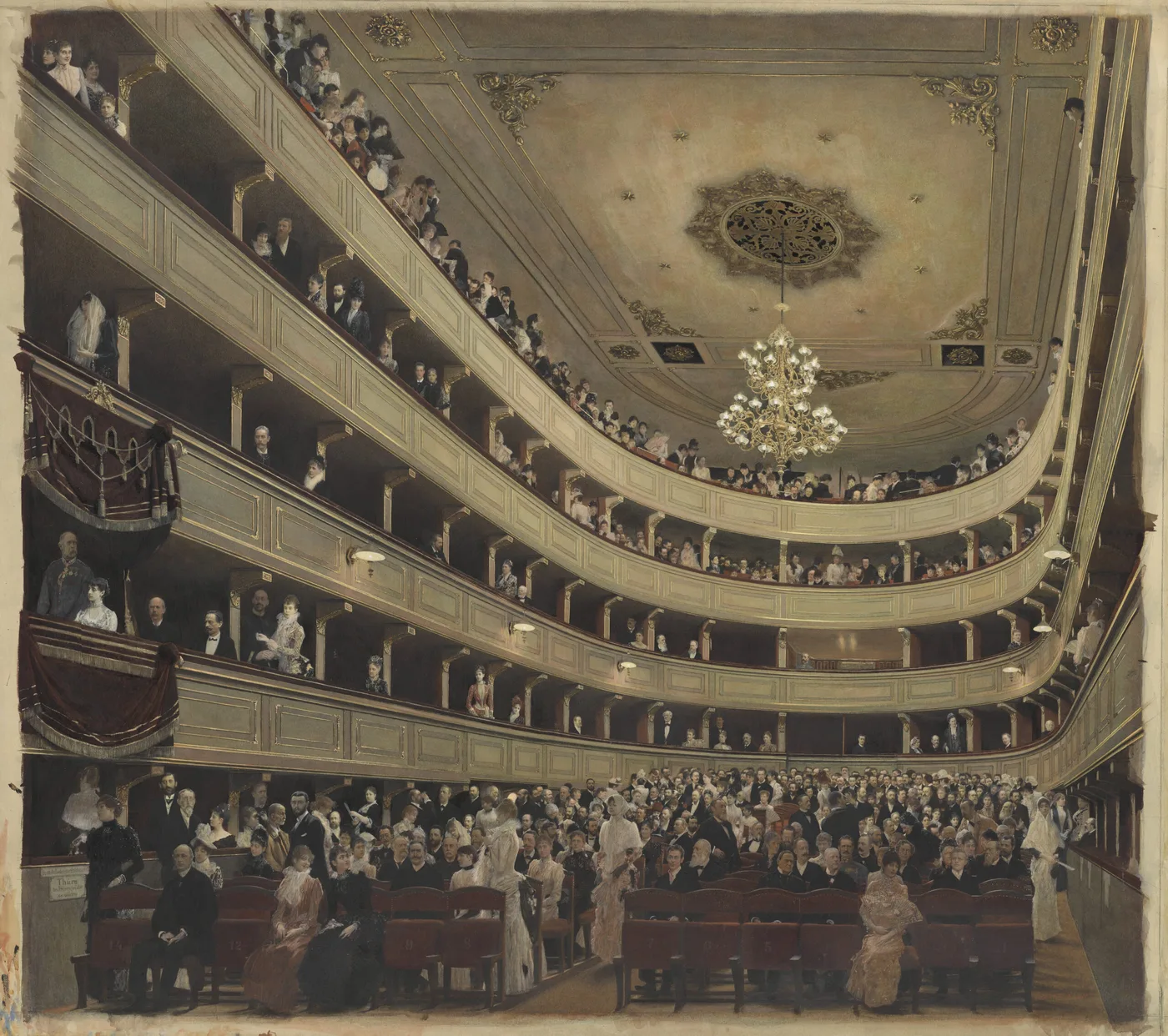
Auditorium of the Old Burgtheater is a gouache on paper that Gustav Klimt completed in 1888, the year Vienna’s new Burgtheater opened on the Ringstrasse and the old court theatre on Michaelerplatz closed its doors. The city commissioned the sheet as a record of the hall before it went out of use.
Klimt was twenty-six that year, born in 1862 in Baumgarten on the edge of Vienna, the son of a gold engraver. He trained at the city’s school of arts and crafts, then worked alongside his brother Ernst Klimt and their friend Franz Matsch as the Künstler-Compagnie, a workshop hired to decorate theatre ceilings and staircases across the Austro-Hungarian Empire.
By 1888 the three painters had already finished staircase decorations for the new Burgtheater itself, along with theatres in Fiume, Reichenberg and Karlsbad. Klimt arrived at this commission as a trained, exacting decorative painter, long before Vienna knew him for gold grounds and flattened ornament.
The old Burgtheater had stood on Michaelerplatz, facing the Hofburg, for generations of performances.
Klimt filled the tiers with individual faces rather than an anonymous crowd. Many of the figures can still be matched to real Viennese of the day, each placed in a specific box or row rather than invented for effect.
The painting won Klimt the Emperor’s Prize, and it helped establish him, still working as part of the Künstler-Compagnie, as an artist entrusted with major public commissions.
A decade on, Klimt broke from this precise, academic manner. The dense perspective and many small faces of Auditorium of the Old Burgtheater give way, in portraits such as Fritza Riedler and Portrait of Emilie Flöge, to flat gold grounds and pattern. In this early work the faces carry the picture; in the later portraits, gold and pattern do.
How Klimt Built the Hall, Tier by Tier
The view looks out from the stage into the hall, and the composition turns on one long diagonal: four curving tiers of boxes run from the lower left corner up and around toward the upper right, pulling the eye through the whole room in a single sweep.
Rows of red-upholstered stall seats fill the bottom of the sheet, holding men in black evening coats with white shirt-fronts and women in pale gowns, most seen from behind or the side. One woman in white stands in the centre aisle, her dress catching more light than anything else at this level.
At the left, two boxes hung with dark red velvet and gold fringe break the cream line of the balustrades below them. These are clearly the most prominent seats in the house, set apart from the plain tiers around them, with figures in black formal dress inside and a pale, veiled figure standing at the rail.
Above the stalls, tier after tier of cream and pale gold balustrades carries the audience proper, row on row of faces turned toward the stage. Klimt keeps each head small but distinct: collars, hair and individual expressions hold up even at this scale, which is what gives the crowd its weight.
A pale ochre ceiling closes the composition at the top, worked with gilt stucco medallions in each corner and a carved rosette at its centre, from which a tiered crystal chandelier hangs on a long chain. Its candle-shaped lights are the brightest passage on the whole sheet.
Colour carries most of the structure: cream, ochre and gold in the architecture, set against the deep red of the velvet seats and curtains, with black threaded through every tier in the men’s dress. Faces and hands are picked out in small, controlled touches of pink and cream against that ground.
Klimt varies the brushwork with the subject. Faces are built from small, separate touches, close to portrait painting in miniature, while the architecture is laid in with a steadier, more even hand. That contrast keeps the packed balconies readable even as they recede sharply toward the upper right corner of the sheet.
What This Crowd of Faces Can Mean
The subject is a Viennese theatre audience. Klimt built it from dozens of individual likenesses, each placed in a particular box or row, so the picture reads like many small portraits set side by side rather than one crowd scene.
One reading treats the room itself as the real subject. The commission existed because the old theatre was about to close, so the picture can be seen as the portrait of a space people were about to lose, with its audience caught inside it one last time.
Another reading follows the social order laid out across the tiers. The velvet-draped boxes at the left sit closest to the stage and stand apart from the plain balconies around them, and the arrangement of boxes, tiers and stalls follows the same order as Viennese society did that evening.
A third reading looks forward rather than back. This early, documentary way of painting faces sits a long way from the society portraits Klimt painted later, among them Margaret Stonborough-Wittgenstein, where pattern and colour carry as much weight as the sitter’s features.
Klimt left no account of which of these the commission meant most, and the old theatre he painted no longer stands, which leaves this sheet as the fullest record of the room as its audience knew it.
Seeing the Original at Vienna Museum
Vienna Museum holds Auditorium of the Old Burgtheater today, as part of its collection of the city’s own history, alongside other paintings and objects that record Vienna’s streets and public buildings. The sheet measures 91.2 × 103 cm, close to square, and large enough that the smallest faces in the upper tiers stay just legible without a magnifying glass.
Seen from across a gallery room, the picture reads as a warm block of cream, gold and red, with the chandelier as the brightest point. Walk closer and that block resolves into individual people, row after row of them, each one painted as a likeness rather than a mark of colour.
The reproduction sold on this painting’s own page keeps that near-square proportion at every size it offers, so the balance between the curving tiers and the ceiling above them stays the same whether the piece is small or large. Because the format sits close to a square, it suits a wall where a conventional tall or wide rectangle would feel cramped, a reason the piece works well in a study or office hung among other framed prints.
Choosing a Reproduction of This Near-Square Hall
Both editions sold here start from the same museum photograph of Auditorium of the Old Burgtheater, so the choice between them is a matter of method and feel: the hand-painted oil is built from scratch in oil on canvas, while the archival print is a high-resolution giclee on canvas, printed with pigment inks.
A hand-painted copy of this picture asks a lot of an artist, since the packed tiers of faces and the gilt stucco ceiling both depend on fine, controlled touches rather than broad colour. The canvas is painted by hand from the museum photograph, and real brushwork and texture carry across the whole surface. Painting the oil by hand takes 2 to 4 weeks.
The archival print reproduces the packed tiers and gilt ceiling with photographic consistency, which suits a tighter budget or a set of pieces that need to match each other closely. Printing takes 2 to 4 business days.
Every size on the product page keeps the near-square proportions of the original sheet, so the curve of the tiers is never stretched or cropped to fit a standard frame. A mid or large size suits this composition best, since the many small faces need room to read as individuals rather than as a pattern.
Before a hand-painted piece ships, the finished canvas is photographed so you can check colour and detail and approve it. Delivery then takes 5 to 7 business days. For a room with warm wood tones or deep red furnishings, a plain dark or gold-toned frame, shown on the painting’s page, keeps the attention on the tiers and the chandelier rather than competing with them.
Questions Readers Ask About This Painting
What does Auditorium of the Old Burgtheater show?
It shows the horseshoe-shaped hall of Vienna’s old court theatre, seen from the stage, with its tiers of boxes packed with individually painted members of the Viennese audience and a chandelier hanging from the gilt ceiling.
Where is the original kept?
Vienna Museum holds the original sheet, which measures 91.2 × 103 cm.
Should I choose the hand-painted oil or the print?
Choose the oil for real brushwork and texture built by hand from the museum photograph, or the print for a close match to the source image at a friendlier budget. Both keep the same near-square proportions.
How long does a hand-painted order take?
Painting the oil by hand takes 2 to 4 weeks. Delivery then takes 5 to 7 business days. You see a photograph of the finished canvas before it ships.
Which room suits this painting?
Its near-square format and warm palette of cream, gold and deep red suit a study, office or hallway, where the many small faces reward a closer look.
More from this collection
Bring this painting home
Choose a hand-painted oil reproduction for real brushwork, or an archival canvas print for a crisp museum-image edition. Every size preserves the original proportions.
View this work & options
Further reading
Verify the original in the Vienna Museum collection record and continue through related works in the catalogue.