
Portrait of Elisabeth Lederer: Klimt Frames a Viennese Sitter in an Imagined Chinese Court
Painted Between 1914 and 1916, in Klimt’s Last Working Years
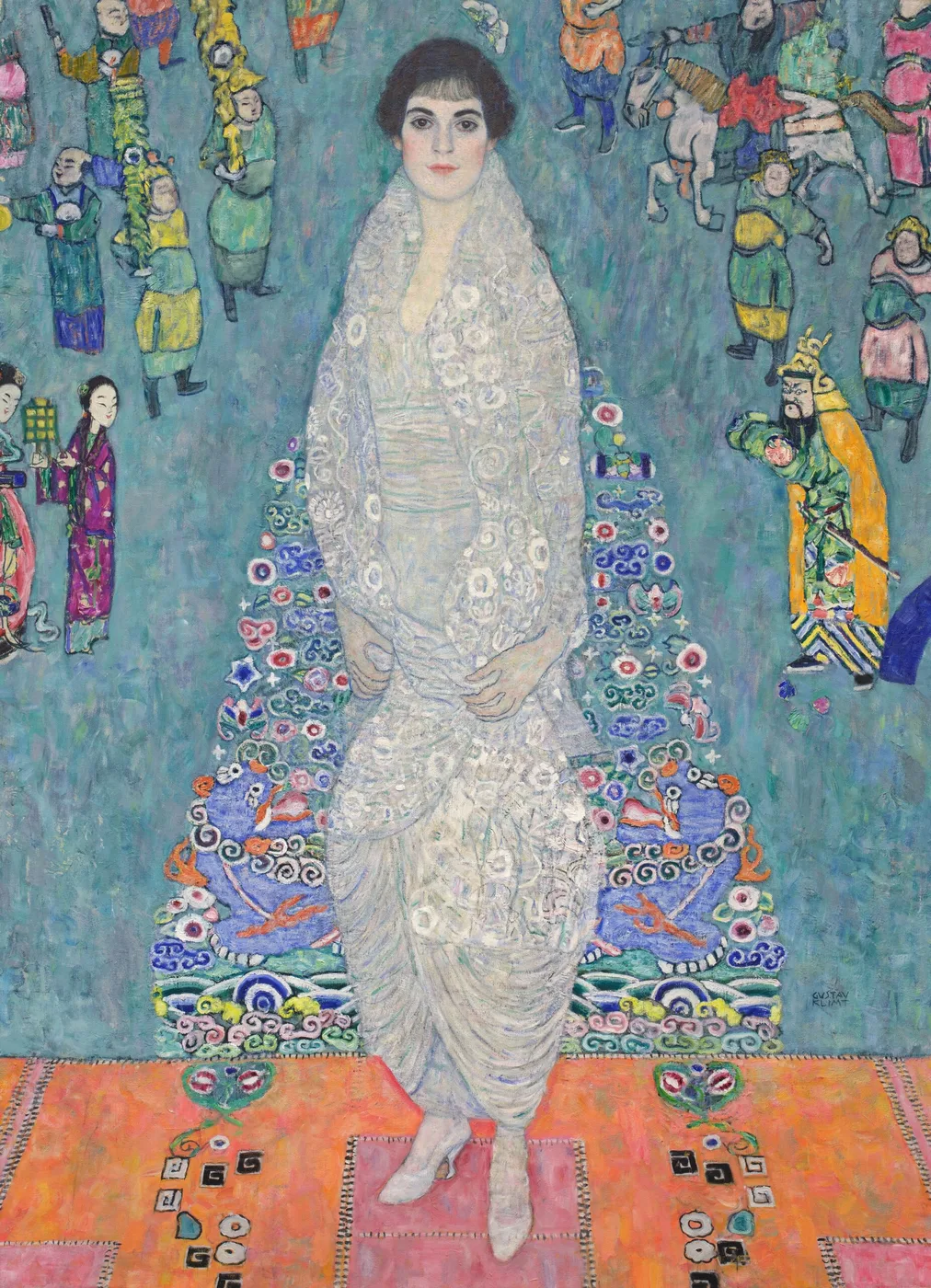
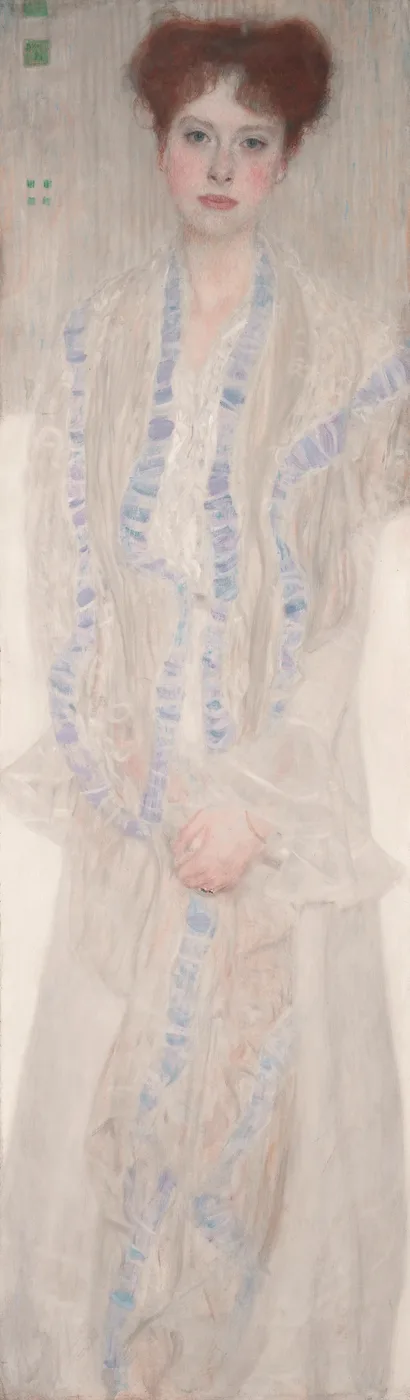
Portrait of Elisabeth Lederer shows a young woman standing nearly the full height of the canvas, wrapped from the shoulders down in a pale, patterned covering, against a teal ground crowded with small painted figures in Asian dress. Klimt painted it late in a career that ended with his death in 1918.
Klimt was born in 1862 in Baumgarten, on the edge of Vienna, and trained at the city’s School of Applied Arts before co-founding the Vienna Secession. By the time he started this canvas he had painted the Beethoven Frieze, decorated the dining room of the Stoclet Palace in Brussels, and built a name as the portraitist Vienna’s wealthiest families turned to for their wives and daughters.
The sitter belonged to the Lederer family, among the steadiest patrons Klimt had in Vienna. August and Serena Lederer had collected his paintings for years, and Serena had sat for her own portrait as well.
Austria had been at war since 1914, the year Klimt began this canvas, and shortages and news from the front had become part of daily life in the city around his studio. Portrait commissions for the Viennese upper class continued through the fighting all the same, and Klimt kept working on sitters from his established circle of patrons, painting society women much as he had before the war started.
His style had by then moved past the flat gold and silver grounds of his earlier work. Colour had grown more saturated, pattern looser and brighter, drawn less from Byzantine mosaic and more from the textiles and robes he kept in his studio.
Klimt collected East Asian robes, prints and ceramics, filling his studio with objects he returned to for years, and used them as source material for several late portraits, setting sitters against patterns borrowed from Chinese and Japanese dress instead of a plain wall or interior.
He finished the canvas in 1916, two years before his death in 1918. The canvas measures 180.4 × 130.5 cm.
A Pale Figure Wrapped in Pattern, Set Against a Painted Procession
The composition is vertical and symmetrical, built around a single standing figure. Elisabeth Lederer stands at the centre of the canvas, her figure running almost its full height, from her dark hair near the top edge to her white shoes near the bottom edge. The background behind her is as busy and crowded as her figure is still and pale.
Her face carries more finish than anything else in the picture. Dark hair, cut short with a straight fringe, frames a pale oval face. Her eyebrows are dark and even, her eyes dark brown, her mouth a clear red. She looks straight out at the viewer, her expression settled rather than posed.
From the shoulders down she is wrapped in a huge pale covering, off-white and silver-grey, patterned all over with circular floral medallions picked out in thick, raised strokes of white and cream paint. The wrap covers her arms and falls past her hips in loose folds, gathered where her hands rest, clasped lightly at her waist.
A narrow dark sash shows at the waist, under the wrap. Below it, the fabric continues in softer grey-white folds down to the floor, where small white shoes appear beneath the hem. The paint here is looser than on the face, built from short strokes that trace each fold.
Behind her, the teal-blue ground carries small painted figures in coloured robes, scattered instead of arranged into one scene. A group in green and yellow crosses the upper left corner, a rider on a white horse appears at upper right, trailed by more robed figures, and a single figure in yellow and green stands apart at lower right, armed and still. Two women in deep pink wraps stand near a small red tower-like shape at the left edge.
A triangular field of denser pattern rises directly behind the standing figure, from the floor to her shoulders: deep blue filled with floral medallions in red, white and blue, closing at the bottom in a band of wave-like scrolls, the kind of hem pattern often found along the bottom of an East Asian robe or ceremonial textile. It reads as a backdrop within the backdrop, framing her more tightly than the looser teal ground around it.
The floor is painted a warm orange, laid out like parquet, with a pink rug at her feet patterned in a black-and-white key design and a pale green floral medallion. Klimt’s signature sits small, in pale paint, in the teal ground to the lower right. Brushwork shifts across the surface: smooth on the skin, broken and textured everywhere the pattern takes over.
Reading the Portrait: A Viennese Sitter Inside an Imagined Chinese Court
The subject is a specific young woman, named and placed within Klimt’s circle of patrons, set against a background that invents an entire world around her. The painting can be read as staging two kinds of portraiture at once: a documented sitting, face and hands studied directly, and a decorative field built from imagery far removed from Vienna.
The wrap runs from shoulder to floor and isolates her from everything around it, pale against a saturated ground. The wrap keeps her calm and legible while everything behind her keeps moving, a quiet shape set against a restless field of ornament.
The small figures scattered across the ground do not add up to one scene. A procession in green and yellow crosses one corner, a rider on a white horse appears in another, a solitary armed figure stands apart from the rest: together they read more like a pattern of brightly dressed people, borrowed wholesale from the robes and prints in Klimt’s studio, than like a story with a beginning or an end.
The warm orange floor underneath her sits against the cool teal of the wall behind her, a shift in temperature that keeps the eye moving between the grounded, domestic space at the bottom of the canvas and the invented world above it.
Read this way, the background turns the portrait into something closer to a stage. Elisabeth Lederer stands in a real Viennese room, on a rug set over a parquet floor, in a wrap that could have come from a Viennese dressmaker, while the wall behind her dissolves into an imagined East that belongs entirely to decoration.
Among Klimt’s Last Full-Length Portraits of Viennese Women
Within Klimt’s run of full-length society portraits from his final years, this canvas sits alongside the Portrait of Mäda Primavesi and the Portrait of Eugenia Primavesi, standing figures set against dense, patterned grounds instead of plain walls or interiors, each one built around a single sitter from Klimt’s circle of Viennese patrons.
This canvas pushes the background further into invented scenes than the rest of that group. It fills the ground with small figures in Chinese and Japanese dress instead of abstract pattern, stylised flowers or a plain wall, more crowded with incident than the backgrounds of the Primavesi portraits. The imagery draws on the same Chinese and Japanese robes and prints Klimt kept in his studio.
Klimt was still painting portraits for this circle of patrons when he died in 1918, leaving several canvases in his studio unfinished, among them the Portrait of Amalie Zuckerkandl. Set beside that unfinished work, this portrait, completed in 1916, shows how far he had carried pattern and colour together before his career ended two years later.
Choosing a Reproduction for This Tall, Patterned Portrait
Every reproduction in this shop starts from a photograph of the original painting. Both editions on offer, a hand-painted oil and an archival canvas print, are made from that same photograph, and the choice between them is a matter of method and feel. The product page for this portrait lists both editions alongside the available sizes.
A hand-painted oil reproduction of this portrait is painted from scratch by an artist, in oil on canvas, using that photograph as the reference, with nothing printed beneath the paint. The large areas of colour go in first, the pattern in the wrap and the background follow, and the face and hands come last, so the result carries real brushwork visible from an angle. Painting the oil by hand takes 2 to 4 weeks.
Printed on canvas with pigment inks, the archival canvas print is a high-resolution giclee of the same image. It gives a consistent, photographic finish, useful for a dependable result or a smaller budget. Printing takes 2 to 4 business days.
Each size keeps the proportions of the original, so the tall, narrow shape of this composition stays intact at every size, never cropped to fit a standard rectangle. Before a hand-painted piece ships, we photograph the finished painting so you can see and approve it. Delivery then takes 5 to 7 business days.
The vertical format suits a wall with height to spare: a hallway, a stair landing, or a narrow space beside a window. A larger size lets the small background figures keep their detail from across the room, and a plain or narrow frame keeps attention on the pattern instead of competing with it. The sizes and frame options for this portrait are set out on the product page.
Questions Buyers Ask About This Portrait
What does Portrait of Elisabeth Lederer show?
A young woman standing full length, wrapped in a pale, patterned shawl, against a teal background filled with small painted figures in Chinese and Japanese dress. Klimt painted it between 1914 and 1916, late in his career.
Who was Elisabeth Lederer?
A member of the Lederer family, one of the steadiest patrons Klimt had in Vienna. Her parents, August and Serena Lederer, collected his work for years, and Serena had sat for her own portrait.
Should I choose the hand-painted oil or the archival print?
The oil carries real brushwork, closer to the contrast between smooth skin and dense pattern in the original. The print gives a more even, consistent finish for a smaller budget.
What size suits this tall composition?
A larger size suits a wall with height, such as a hallway or stair landing, since the proportions of the original are kept at every size on the product page.
Can I see the finished painting before it ships?
Yes. A hand-painted oil is photographed once finished so you can check the colour and detail before it leaves the studio.
More from this collection
Bring this painting home
Choose a hand-painted oil reproduction for real brushwork, or an archival canvas print for a crisp museum-image edition. Every size preserves the original proportions.
View this work & options
Further reading
Verify the original in the collection record and continue through related works in the catalogue.