
Portrait of Mäda Primavesi, a Child Who Stands Her Ground
A Commission from the Primavesi Household, 1912-1913
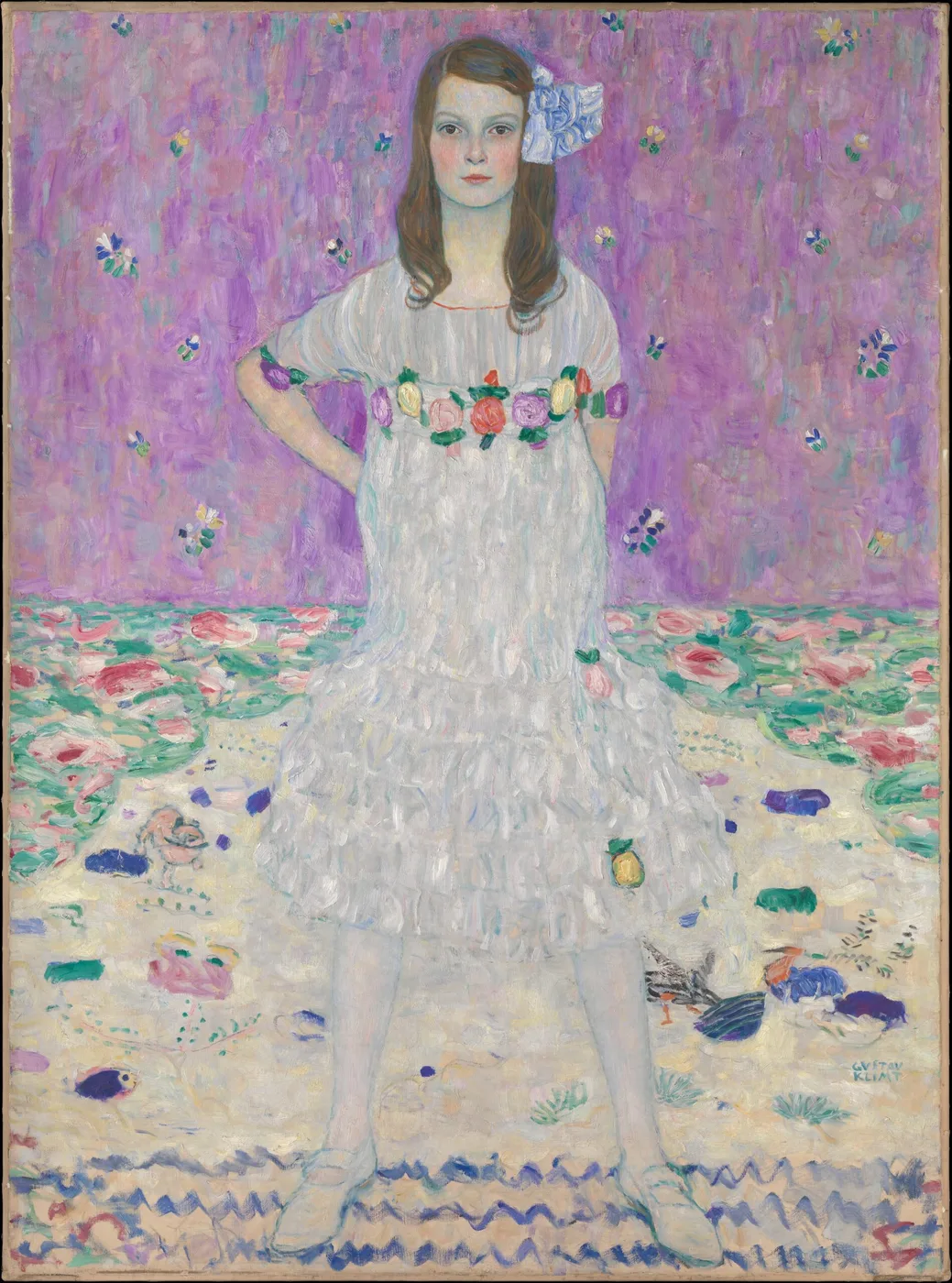
Portrait of Mäda Primavesi, painted by Gustav Klimt in 1912-1913, shows a young girl of the Primavesi family standing full length against a mauve wall. The canvas measures 149.9 × 110.5 cm and is held today at the Metropolitan Museum of Art.
Gustav Klimt, born in 1862, was by 1912 the central figure of Vienna’s art world and its most sought portraitist among the city’s wealthy manufacturing families. He had made his name decades earlier as a founding member of the Vienna Secession, the movement that pushed Austrian painting toward colour, pattern and decoration and away from the academic styles in which he had trained. Portrait commissions from these same families kept him working through the final years of his life, mostly portraits of wives and daughters, not of the men who paid for them.
The Primavesi family belonged to that circle. Otto Primavesi was a banker and industrialist from Olomouc in Moravia, and together with his wife Eugenia he supported Klimt’s work as well as the Wiener Werkstätte, the Viennese design workshop behind much of the furniture, textiles and metalwork found in progressive Vienna households of the period.
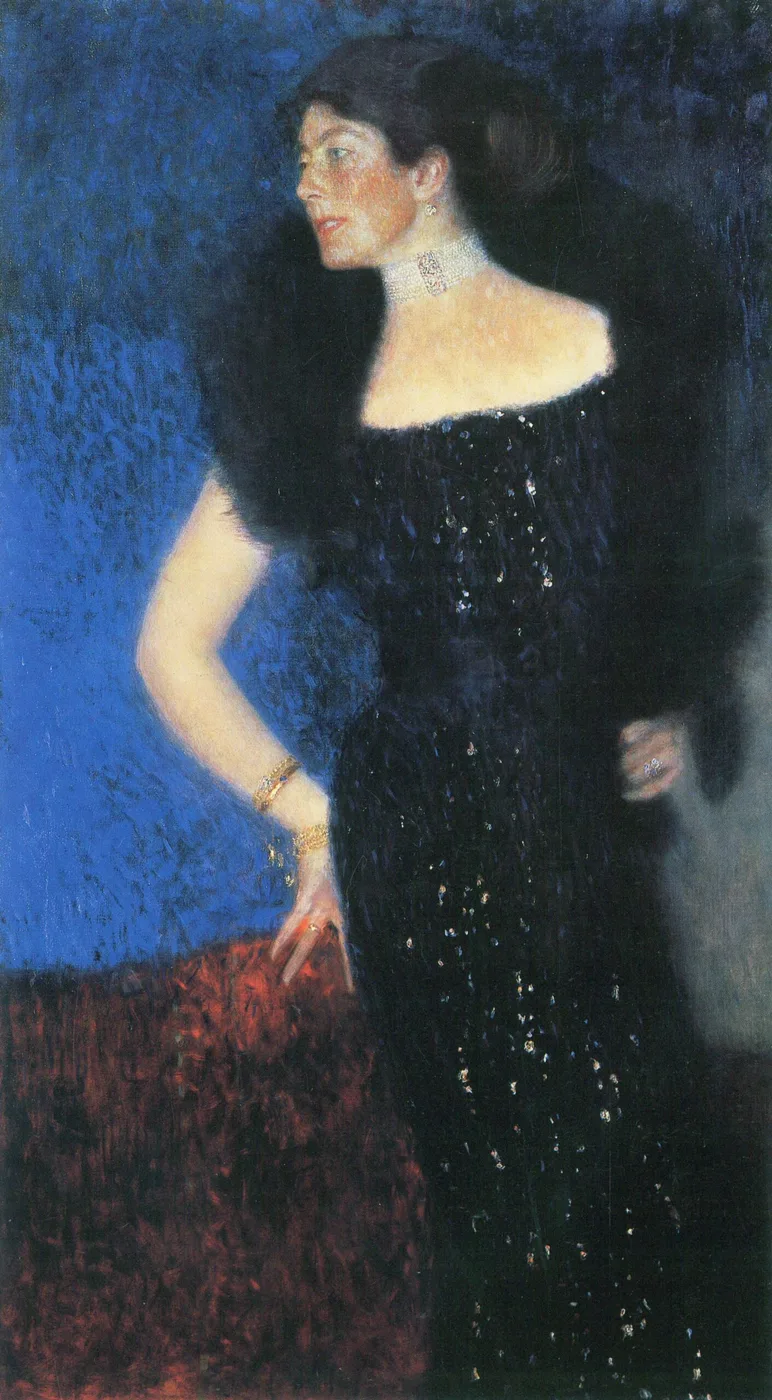
Their support produced more than one canvas. Klimt painted Eugenia Primavesi in these same years, a portrait told in our story on Portrait of Eugenia Primavesi, and this picture of her daughter comes from the same household commission.
Mäda was a daughter of that marriage, and Klimt paints her alone, not beside her parents. He gives her a full-length format he used less often for his adult sitters, a canvas tall enough to let her stand close to her own scale.
The setting around her has none of the gold grounds of Klimt’s earlier portraits, the kind built from gold leaf and flat ornament that had made his portraits of Viennese women in the previous decade instantly recognisable. By the time he painted Mäda, he had moved on from those gilded surfaces toward flatter fields of plain colour and small repeated pattern, the roses and flowers seen here in place of metal leaf.
Klimt kept painting portraits of this kind until his death in 1918. This canvas sits among the commissions of his last working years, made for a family that had already sat for him more than once.
Mauve Wall, White Dress, a Floor of Roses
Klimt divides the canvas into two flat zones. A wall of mauve and violet fills the upper two thirds of the picture, and a paler, cream coloured ground takes the lower third at the girl’s feet, with no attempt at real perspective or depth between them. The format itself runs taller than it is wide, built to hold a standing figure at close to full length.
She stands at the dead centre of the canvas, feet planted apart and both hands clasped behind her back, elbows pointing outward. Her shoulders square to the viewer, and her head turns only slightly, so her eyes meet the viewer’s directly.
Her face and hands carry the most careful modelling in the whole canvas: soft pink in the cheeks and lips, dark eyes under faint brows, rendered with a blended, almost porcelain finish. Her brown hair falls loose past her shoulders, and a large pale blue and white bow sits at the crown of her head.
The dress is pale, close to white, with a band of roses in pink, coral, yellow and violet wrapped around the waist and repeated in miniature on the short sleeve cuffs. Below the sash the skirt falls in tiers of soft ruffles, painted in thin, fluid strokes of white, grey and pale blue, as light as a drawing in places.
The mauve wall behind her is not left empty. Small dabs of white, blue and pink scatter across it, reading from a distance as stray flowers and tiny butterflies, applied loosely enough to keep the surface flat, never opening it into real space.
The cream ground at her feet carries the same scattering: pink roses and green leaves spread across it, along with a few small painted shapes, including what reads as a blue vessel with a floral handle near her right foot, and a dark, bird-like form in blue and rust red to her left, their outlines loosening into pure brushwork up close. A thin wavy blue line runs along the very bottom edge, marking off this floor like a ribbon of trim.
Across the canvas Klimt keeps two kinds of brushwork side by side: smooth and blended on the face, arms and legs, loose and broken in the background and the floor. Light falls evenly over the whole picture, with no single source and no strong shadow, so every colour stays equally bright wherever it sits on the canvas.
A Direct Gaze in a Child’s Portrait
Her stance, hands clasped behind her back, feet planted apart, chin level, reads as a pose of self-possession.
Here the ornament survives in the roses and the pattern on the wall and floor, but the sitter stands upright, squares her shoulders to the viewer, and meets the eye without softening. The effect can be read as Klimt giving a child sitter the same visual weight and the same direct address he gave his grown female subjects.
The small flowers and the floor of roses around her belong to the world of a child: soft colour, pattern, growth, the kind of setting a nursery or a garden might offer. Her face and stance belong to someone older, composed and unsmiling, with the bearing of an adult sitter posing for a formal commission, not a child caught at play.
Mäda’s family had earned its wealth in industry and banking, not through inherited title or old land. A picture like this one could be read as that family claiming, through paint, the same seriousness of treatment long reserved for aristocratic sitters, delivered this time to a child, not to a parent.
Seen next to Klimt’s portraits of grown women from these same years, such as Portrait of Adele Bloch-Bauer II, this child meets the viewer’s eye with the same directness.
On View at the Metropolitan Museum of Art
Portrait of Mäda Primavesi hangs today at the Metropolitan Museum of Art, one of a small number of Klimt paintings in American public collections. In the gallery it keeps its full scale: tall enough that the girl’s painted figure stands close to the height of an actual child, meeting a visitor near eye level rather than sitting small on a page or a screen.
That scale changes what the surface shows. Up close, the fluid strokes of the dress and the broken dabs across the wall and floor separate into individual marks, something a page or a screen flattens into a single field of colour. Stepping back pulls those marks together again into the mauve wall and the white dress, the way the picture was built to read from across a room.
Opening hours and gallery locations shift over time, so checking the museum’s own listings before a visit is worth the few minutes it takes. A painting of this size is rarely moved into storage, but which room it hangs in can still change between visits.
Choosing a Size and a Frame for This Portrait
Every reproduction sold here starts from a museum photograph of Portrait of Mäda Primavesi, so the colours, the proportions and the small details, the floral sash, the roses on the floor, the wavy blue line at the bottom edge, all follow the original. The hand-painted oil and the archival print are made from that same image, so the choice between them is about method, not about a different version of the picture.
A hand-painted oil reproduction is built from scratch by an artist, in oil on canvas, using that photograph as the reference, with nothing printed underneath, in the sizes listed on the Portrait of Mäda Primavesi page. The painter lays in the mauve wall and the cream floor first, then the pattern of roses and small flowers, then the fine work of the face and hands. Painting the oil by hand takes 2 to 4 weeks. Because it is painted and not printed, the surface keeps real brushwork, which suits a picture that already mixes smooth modelling with loose, broken pattern.
The archival canvas print is a giclee print of the same image on canvas, with consistent colour from one print to the next. It is the simpler choice when a dependable result or a smaller budget matters more than an original brush surface. Printing takes 2 to 4 business days.
Every size on the Portrait of Mäda Primavesi page keeps the proportions of the original, so the upright figure is never cropped at the shoulders or stretched to fit a wider frame. Because the composition is taller than it is wide, it suits a wall with some height around it, a stairwell, a hallway, or a bedroom wall where the figure can stand close to its own scale.
A hand-painted piece is photographed once finished so you can check it and approve it before it ships. Framing and stretcher choices are offered alongside the sizes on the Portrait of Mäda Primavesi page, and a plain, pale frame tends to suit this picture well, since the mauve and cream of the canvas already carry most of the colour a heavier frame would compete with. Delivery then takes 5 to 7 business days.
Common Questions About This Portrait
What does Portrait of Mäda Primavesi show?
A full-length portrait of a young girl of the Primavesi family, painted by Klimt in 1912-1913, standing against a mauve wall and a floor scattered with roses.
Who was Mäda Primavesi?
She was a daughter of Otto and Eugenia Primavesi, a Viennese family that commissioned more than one portrait from Klimt.
Where is the original painting today?
At the Metropolitan Museum of Art, as a canvas measuring 149.9 × 110.5 cm.
How long does a hand-painted reproduction take?
Painting the oil by hand takes 2 to 4 weeks. Delivery then takes 5 to 7 business days.
Does the reproduction keep the same proportions at every size?
Yes. Every size keeps the proportions of the original, so the standing figure is never cropped or stretched.
More from this collection
Bring this painting home
Choose a hand-painted oil reproduction for real brushwork, or an archival canvas print for a crisp museum-image edition. Every size preserves the original proportions.
View this work & options
Further reading
Verify the original in the Metropolitan Museum of Art collection record and continue through related works in the catalogue.