
Hope I: Klimt’s Pregnant Figure Facing Down a Skull
Painted in 1903, in Klimt’s Most Contested Years
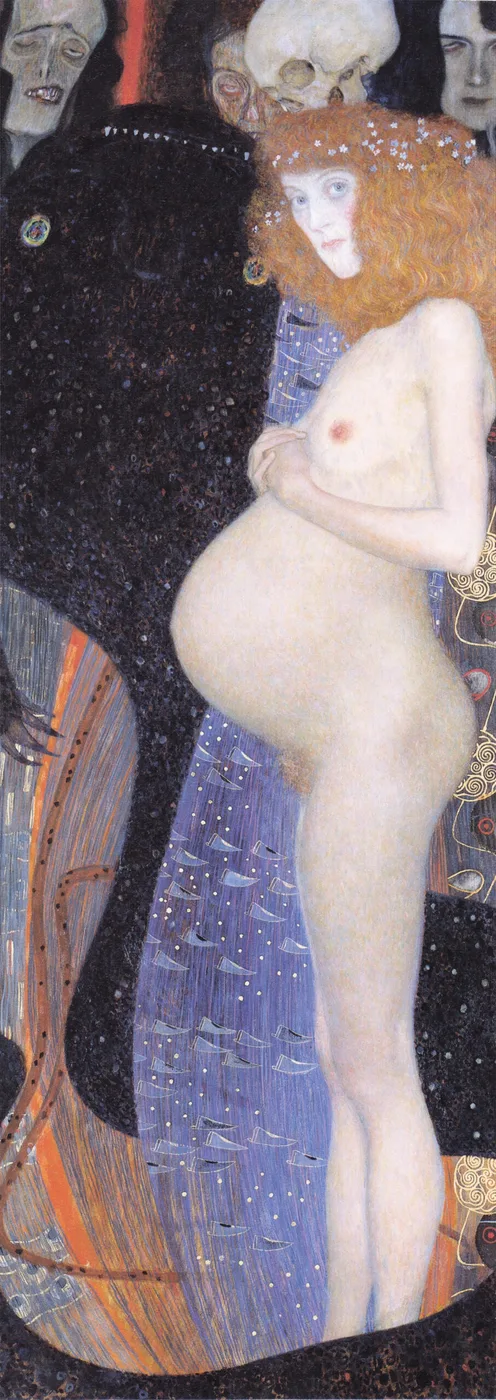
Gustav Klimt’s Hope I is a tall vertical canvas, 189 × 67 cm, now held by the National Gallery of Canada.
Klimt was born in 1862 outside Vienna, the son of a gold engraver, and trained at the city’s School of Arts and Crafts. His first two decades as a painter went into ceiling decorations and theatre curtains for public buildings across the Austro-Hungarian empire, polished, symmetrical work meant to satisfy committees and juries.
By 1903 that manner was behind him. He had turned to flatter, symbolic compositions, often built around one female figure standing for an idea instead of a sitter. In the same years he painted a continuous frieze for the Secession’s Beethoven exhibition, made for the building’s own walls and not for sale, and it marks the same turn away from portraiture toward symbol.
The University of Vienna had commissioned him to paint large ceiling panels on Philosophy, Medicine and Jurisprudence. When he showed them, professors objected to the nudity in the figures and to how bleak a view of knowledge the paintings gave. The dispute dragged on and coloured how Vienna read any new Klimt nude that followed, Hope I included.
That same year, 1903, the Secession gave Klimt a full retrospective, the fullest public account yet of a decade spent moving from decorative commissions toward symbolist subject matter. Hope I belongs to that exact moment: a single standing nude, pregnant, flanked by faces that read as omens more than as portraits.
Pregnancy was rarely painted as a subject on its own in Vienna at the time, and almost never shown without a classical or religious disguise to soften it. A nude, visibly pregnant woman, painted close to life size, read as blunt to an audience already unsettled by the university panels.
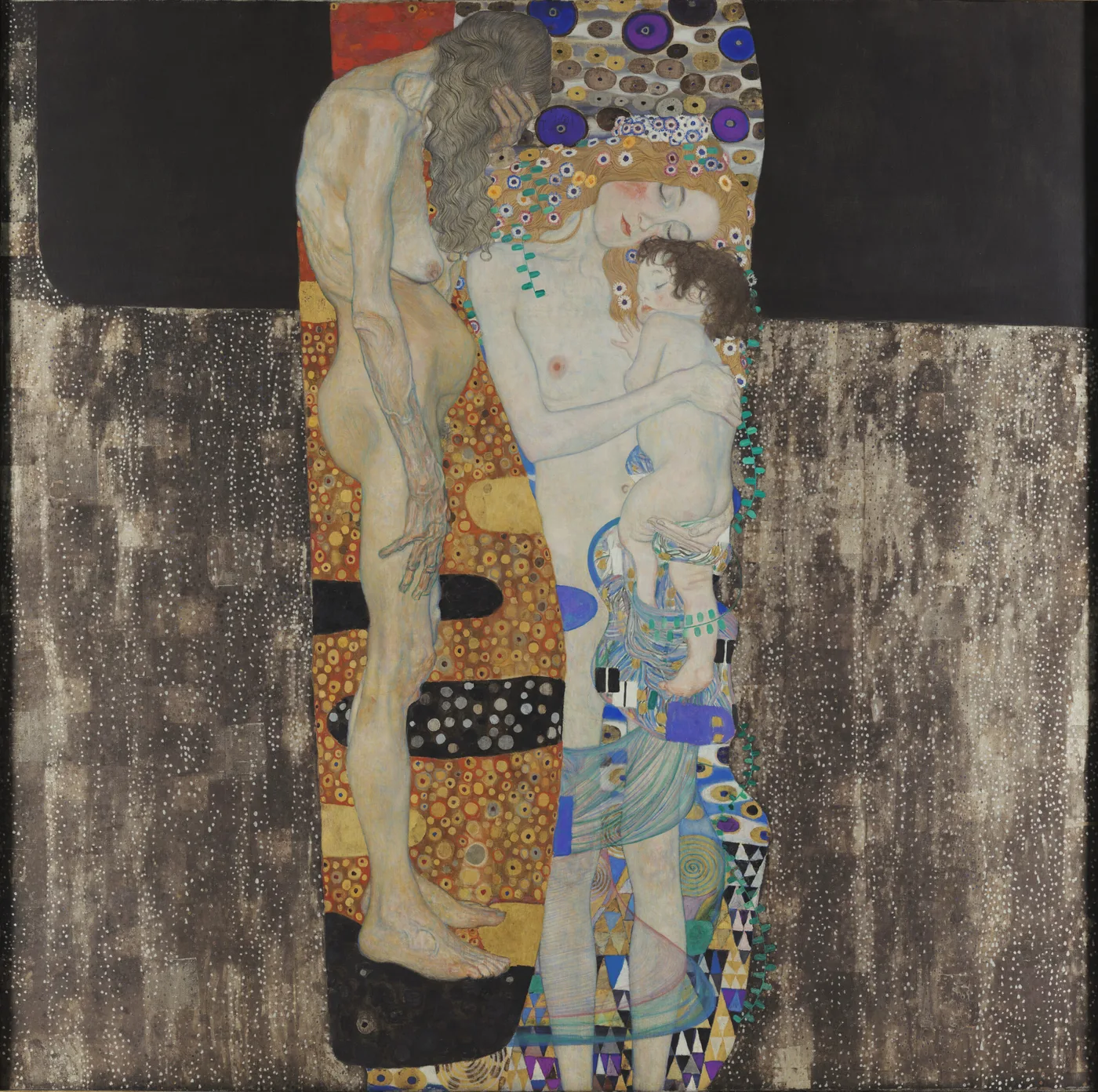
Klimt kept the female body as his central subject for the rest of his career, in paintings such as Danaë and The Three Ages of Woman, until his death in 1918. Hope I sits early in that run, still close to the hard symbolism of the university panels, before the fully gilded portraits of his later career, and is the only point in his work where he paints a pregnant nude this directly.
A Pale Nude Between a Night-Black Ground and a Lavender Pattern
The canvas is cut narrow and tall, barely a third as wide as it is high, and Klimt lets one standing figure carry almost the whole of it. She stands in profile, weight settled on one leg, belly leading the eye, but her head turns to meet the viewer directly, so the body reads sideways while the gaze comes straight at you.
Her hands are clasped together just below the breasts, fingers laced over the upper curve of the belly, a small, contained gesture set against the scale of the pregnancy itself. The skin is an even, pale ivory, modelled with soft grey shadow under the breast and along the hip, left bare of the pattern that fills most of the rest of the canvas.
The hair carries the strongest colour in the painting, a mass of copper-red curls falling past her shoulders, scattered through with small white flowers worked into the waves like a loose wreath, the one passage built from paint alone, free of the flat pattern that covers the rest of the canvas.
Behind her left shoulder the ground turns almost black, flecked with small grey-blue dots like scattered stars, and a row of pale faces crowds the top edge of the canvas: one with its mouth open, one reduced to a bone-white skull, two more pressed in beside them. A long, greenish hand with spread fingers reaches out of that dark field at roughly waist height, close to her hip.
To her right the ground changes completely: a dusty lavender-blue panel patterned with small pale shapes like boats or leaves and scattered with dots, giving it the flat, repeating look of a woven textile. The two backgrounds meet directly behind her shoulder, with no transition between the dark field and the pattern.
At the base of the canvas both fields are stitched together by a band of rust-orange, swirling linework, curling like smoke or loose hair across the full width of the painting, the only place where the dark ground and the patterned ground share a colour.
Across the canvas Klimt keeps the body in soft, descriptive shading and paints everything around it flat: faces, pattern, swirl and dot sit on the surface with no attempt at depth. That contrast, rounded flesh against flat ornament, is the device he used throughout his Secession years, carried here into a narrower, more upright frame than his better known square compositions.
A Pregnant Body Watched Over by a Skull: One Reading
Read as an allegory, Hope I sets a single pregnant body against one of painting’s oldest subjects: how close life and death sit to each other. The title points to the first half of that pairing, but Klimt gives at least as much canvas to the second. The skull and the pale faces are not an aside tucked into a corner; they share the top edge of the picture with her hair.
The clasped hands can be read as protective, a gesture that shields the belly from whatever crowds the air above and behind it. The hand reaching out of the dark ground allows more than one reading: a threat aimed at the living figure, or grief, one of the faces still reaching toward her.
The lavender, patterned ground on her other side has no such weight: flat ornament, without the faces or the reaching hand. It keeps the figure from being boxed in by darkness on every side. One reading takes the pattern as the ordinary, continuing world the pregnancy belongs to, set against the faces as a world of memory or fear.
None of this is explained inside the painting, and Klimt left no inscription to settle it.
Klimt builds other paintings around a single female figure carrying an abstract idea: Nuda Veritas gives truth a body in the same way. Hope I asks for the same kind of reading, except the idea here, a pregnancy watched over by death, resists being folded into one sentence.
Hope I at the National Gallery of Canada
The original Hope I hangs at the National Gallery of Canada, in Ottawa, part of the museum’s collection of European painting from the turn of the twentieth century. It keeps company there with other work from the years when Vienna moved toward Symbolism.
Seeing it in person means standing in front of a canvas 189 cm tall and 67 cm wide, narrower than most reproductions on a screen prepare you for. From across the room the pale body reads first against the near-black ground; the lavender pattern and the row of faces at the top only separate out as you get closer.
Fitting Hope I’s Tall Frame Onto a Narrow Wall
Every reproduction of Hope I sold here starts from the same museum photograph, so the hand-painted oil and the archival print show the same composition: the same copper-red hair, the same lavender pattern, the same dark ground with its row of faces. The two editions share the same image; what differs between them is the method used to make the canvas.
A hand-painted oil reproduction of Hope I is built up in oil on canvas by an artist working from that photograph, with nothing printed underneath, so the smooth modelling of the skin and the flat ornament around it keep real brushwork as light moves across the canvas. Painting the oil by hand takes 2 to 4 weeks.
An archival canvas print of Hope I is a high-resolution giclee print of the same image on canvas, a steadier choice when you want the colour to match closely from one piece to the next, or when the budget is tighter. Printing takes 2 to 4 business days.
The tall, narrow format of this painting suits a narrow wall: beside a door frame, at the end of a corridor, on a stair landing, or between two windows where a wide canvas would not fit. Every size on the Hope I product page keeps the original proportions, so the figure is never cropped to fit a squarer frame.
Before a hand-painted order ships, the studio photographs the finished canvas so you can check the colour and the detail against the original. Delivery then takes 5 to 7 business days. The full range of sizes and frames for this painting is on the Hope I reproduction page.
Questions About This Hope I Reproduction
What does Hope I show?
A standing nude, pregnant woman with copper-red hair, her hands clasped below her breasts, set against a near-black ground on one side and a patterned lavender panel on the other, with pale faces and a skull crowding the top edge of the canvas.
Why does a painting called Hope include a skull?
Klimt paints life and death side by side instead of choosing one. The skull and the pale faces sit along the top of the canvas while the pregnant body fills the rest, and most readings of the picture turn on that pairing.
Which edition keeps the colours closest to the original, the oil or the print?
Both start from the same museum photograph, so the copper hair, the lavender pattern and the dark ground match in either. The hand-painted oil carries real brushwork across the contrast between smooth skin and flat ornament; the archival print gives a steadier, more consistent result from piece to piece.
What size suits this painting on a home wall?
Because the original is tall and narrow, it suits a narrow wall more than a wide one: beside a door, at the end of a hallway, or between two windows. Every size on the Hope I product page keeps that same proportion.
Can I see the finished painting before it ships?
Yes. For a hand-painted oil, the studio photographs the finished canvas so you can check the colour and detail before it leaves. Delivery then takes 5 to 7 business days.
More from this collection
Bring this painting home
Choose a hand-painted oil reproduction for real brushwork, or an archival canvas print for a crisp museum-image edition. Every size preserves the original proportions.
View this work & options
Further reading
Verify the original in the National Gallery of Canada collection record and continue through related works in the catalogue.