
Nuda Veritas: the 1899 nude that holds up a mirror and a line from Schiller
Painted in 1899, in the middle of Klimt’s break from Vienna’s art establishment
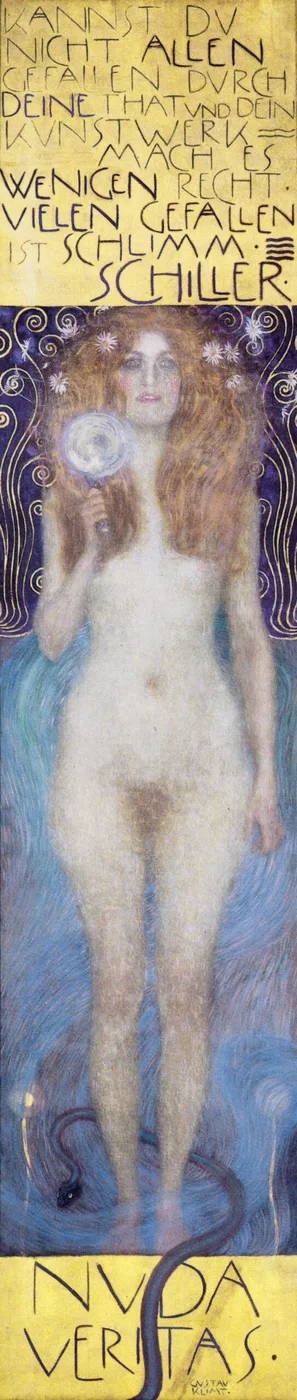
Gustav Klimt painted Nuda Veritas in 1899, a tall narrow panel now held by the Austrian Theatre Museum and measuring 244 by 56.5 centimetres. A single standing nude fills nearly the whole height of the canvas, a small mirror raised in one hand and a block of German text set above her head.
Born in 1862 near Vienna, Klimt trained at the city’s School of Arts and Crafts. With his brother Ernst and a fellow student he formed a partnership often called the Company of Artists, decorating theatre and museum interiors across the Austro-Hungarian Empire in a polished, illusionistic style close to academic taste.
By the time he painted Nuda Veritas, he had moved to the centre of a new group of Viennese artists who broke from the official exhibition society. The group rejected the conservative taste of that older body and pushed instead for work shaped by Symbolism and the wider European avant-garde, shown in exhibitions of their own and in a journal they published under the title Ver Sacrum.
Nuda Veritas belongs to that break. Klimt built it as a public statement rather than a private commission, and its directness unsettled viewers used to the softer allegories of the academic salons.
Nude figures painted this plainly, without the mythological costume academic painters used to soften them, met criticism from parts of the Viennese press in these years. Klimt held to the plainer treatment regardless, in line with the new group’s wider argument that an artist should answer to their own standard rather than to popular taste.
It still relies on a plain, cool palette and naturalistic modelling of the body, painted a few years before he began combining paint with gold leaf in the fully ornamental works for which he later became best known.
Inside the panel: the text, the figure, the mirror and the snake
The panel’s shape sets the whole composition. It is far taller than it is wide, so Klimt built a composition that works along a single vertical line, with the standing figure close to full length inside that narrow field.
Across the top third runs a block of German lettering in pale gold capitals, set against a dark blue-violet field. A thin gold scrollwork of looping, spiralling lines runs down each side of the text, close to the decorative line work of the new Viennese art of these years, and the passage ends with the single word SCHILLER, naming the poet quoted above it.
Below this band stands a nude woman, turned to face the viewer directly, her weight even on both feet. Her skin is a pale, almost ivory tone, shaded softly around the shoulders, breasts, stomach and thighs in a manner close to conventional academic figure painting, while loose copper-red hair falls past her shoulders to below her hip, with a scatter of small white flowers set into it near the crown of her head.
In her raised hand she holds a small round mirror close to her chest, its glass a pale, faintly reflective disc tilted outward and slightly upward, away from her own face and toward whoever stands in front of the canvas. Her other arm hangs loosely at her side, mostly hidden behind the fall of her hair.
Behind her, the ground turns into a pale blue-green field that loosens into wavy, horizontal strokes of darker blue near her feet, suggesting water or mist rather than solid floor. A black snake winds from around her ankles down toward the bottom edge of the panel, its body painted as a flat, unmodelled line against the paler colour around it.
A band of mustard yellow closes the panel at the bottom, carrying the words NVDA VERITAS in bold black capitals across two lines, lettered in the classical Roman style that uses V in place of U. A small signature sits beneath the title, in the same black.
Only the figure’s body is built with conventional light and shadow. Everything around her, the gold scrollwork, the lettering, the yellow band at the bottom, stays flat on the surface rather than receding into space, so a softly modelled figure sits inside a field of flat decorative passages, a pairing found across Klimt’s paintings from this period.
What the mirror, the snake and the title suggest
Nuda Veritas is Latin for naked truth. The figure is a personification, a body built to stand for an idea rather than for a specific woman, continuing a long habit in European art of showing abstract concepts through a female figure.
The mirror she holds, angled outward rather than back toward her own face, can be read as truth turned onto the viewer rather than kept for herself. Whoever stands in front of the canvas becomes the one being shown something, not the figure holding the glass.
Beneath her feet, the snake carries an old association with deceit in Western painting. Set under a figure named naked truth, it can be read as what truth leaves behind or stands over, though the panel offers no caption to confirm this, and the reading stays open.
The German text above her, ending in the name of the poet Schiller, argues that an artist cannot please every viewer through their work, and that trying to please too many people is itself a poor sign. Read against the figure below it, the panel works as an argument for art that states its subject plainly rather than softening it for a wider audience.
Read alongside other single-figure allegories in Klimt’s work, Nuda Veritas sits close to paintings such as Hope I and Danaë, where a lone nude body again carries the full weight of the picture’s subject.
Seeing Nuda Veritas at the Austrian Theatre Museum
The original Nuda Veritas is held by the Austrian Theatre Museum. The panel is tall enough that the standing figure reads close to true scale against anyone standing in front of it, an effect you only get standing in front of the actual panel.
Seeing the work in the gallery also makes the contrast in paint handling easier to read. The flat gold pattern and lettering at the top sit differently under gallery light than the softly shaded body below them, a difference easy to miss from across the room but clear close up.
Readers who want to see how Klimt handled a related subject at a different scale can look at The Three Ages of Woman, another of his allegorical figure paintings from later in his career.
Choosing a Nuda Veritas reproduction for a tall narrow wall
Every reproduction of Nuda Veritas sold here starts from a museum photograph of the original. You can choose a hand-painted oil or an archival canvas print, both made from the same source image, and the available sizes and both editions are shown on the Nuda Veritas page.
Each hand-painted oil is painted by an artist working from that same photograph, building the image with a brush rather than a printer: the broad fields of blue-violet and pale blue-green first, then the gold scrollwork and lettering, then the fine detail of the face, the hair and the small mirror. The surface carries real brushwork, and the slight variation between canvases is part of what you are buying, not a flaw.
Painting the oil by hand takes 2 to 4 weeks. Before it ships, the finished canvas is photographed so you can see and approve it. If you choose the print instead, printing takes 2 to 4 business days. Delivery then takes 5 to 7 business days.
Every size keeps the proportions of the original, so the tall narrow shape stays intact rather than being cropped into a standard rectangle, which suits a panel built to be read as a single rising vertical. Frame options for both editions are also listed on the Nuda Veritas page.
A composition this narrow suits a wall where height is the resource rather than width: beside a doorway, down a stairwell, or along the blank end of a hallway, where the eye can follow the whole panel from the yellow band at the bottom to the gold lettering at the top.
Questions about Nuda Veritas
What does the title Nuda Veritas mean?
Nuda Veritas is Latin for naked truth. Klimt gives the phrase a literal form here, a nude woman holding up a mirror, with the same words painted into the yellow band at the foot of the panel.
Where is the original painting kept today?
The original is held by the Austrian Theatre Museum.
Why is the composition so tall and narrow?
The gold text sits above, the figure fills the centre, and the snake and the title band close the bottom, so the panel reads from top to bottom in one continuous line rather than across the width of the canvas.
Does a reproduction keep this narrow shape?
Yes. Every size keeps the original proportions, so the shape is never cropped to fit a standard frame.
What is the difference between the hand-painted oil and the print?
The oil is painted by hand with real brushwork and natural variation between canvases. The print is a high-resolution giclee on canvas, consistent in colour and detail from one copy to the next.
More from this collection
Bring this painting home
Choose a hand-painted oil reproduction for real brushwork, or an archival canvas print for a crisp museum-image edition. Every size preserves the original proportions.
View this work & options
Further reading
Verify the original in the Austrian Theatre Museum collection record and continue through related works in the catalogue.