
Cottage Garden with Sunflowers: A Square Canvas with No Sky and No Horizon
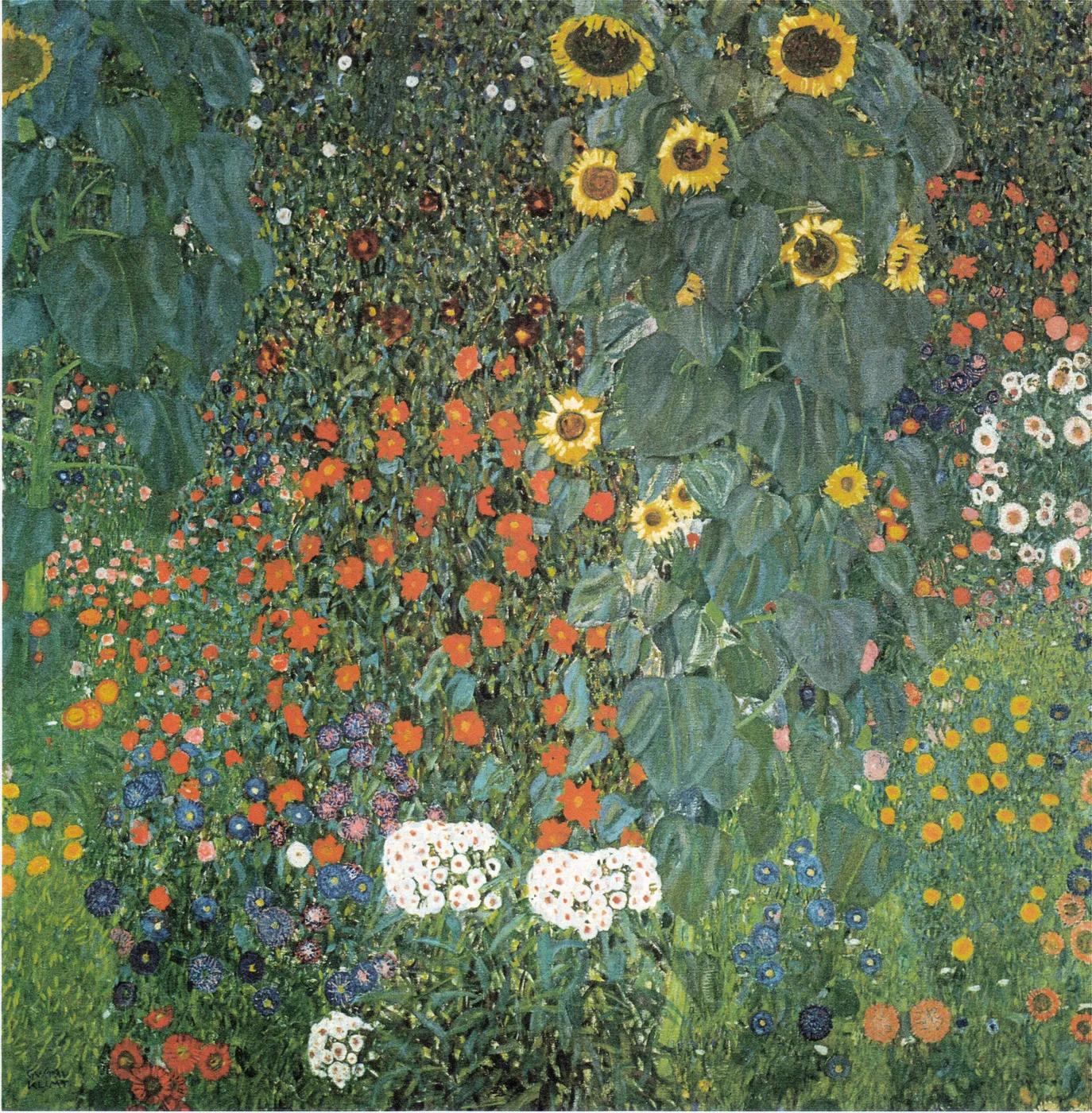
A Lakeside Summer, 1906
Gustav Klimt painted Cottage Garden with Sunflowers in 1906, a square canvas measuring 110 × 110 cm now held by the Belvedere in Vienna. It belongs to a run of garden and lake pictures he made in the early years of the century, painted away from the portrait commissions that paid most of his bills.
Klimt was born in 1862 in Baumgarten, near Vienna, the son of a gold engraver. He trained at the city’s School of Arts and Crafts and began his career painting decorative schemes for public buildings with his brother Ernst, including ceiling panels for Vienna’s Burgtheater and the staircase of the Kunsthistorisches Museum.
By the time he painted this garden, Klimt had already led the Vienna Secession as its first president. A dispute over the group’s direction split it apart the year before, and Klimt left with a number of fellow painters who shared his view of what the group should be.
Away from that quarrel, he kept to a habit he held for the rest of his working life: leaving Vienna each summer, often for months at a stretch, to paint outdoors rather than return straight away to the portrait work waiting for him in the city.
He spent those summers at the Attersee, a lake south-east of Salzburg, usually in the company of Emilie Flöge and her family, who ran a well-known fashion house in Vienna and kept property near the water. The gardens, orchards and farmhouses around the lake gave him subjects close at hand, year after year.
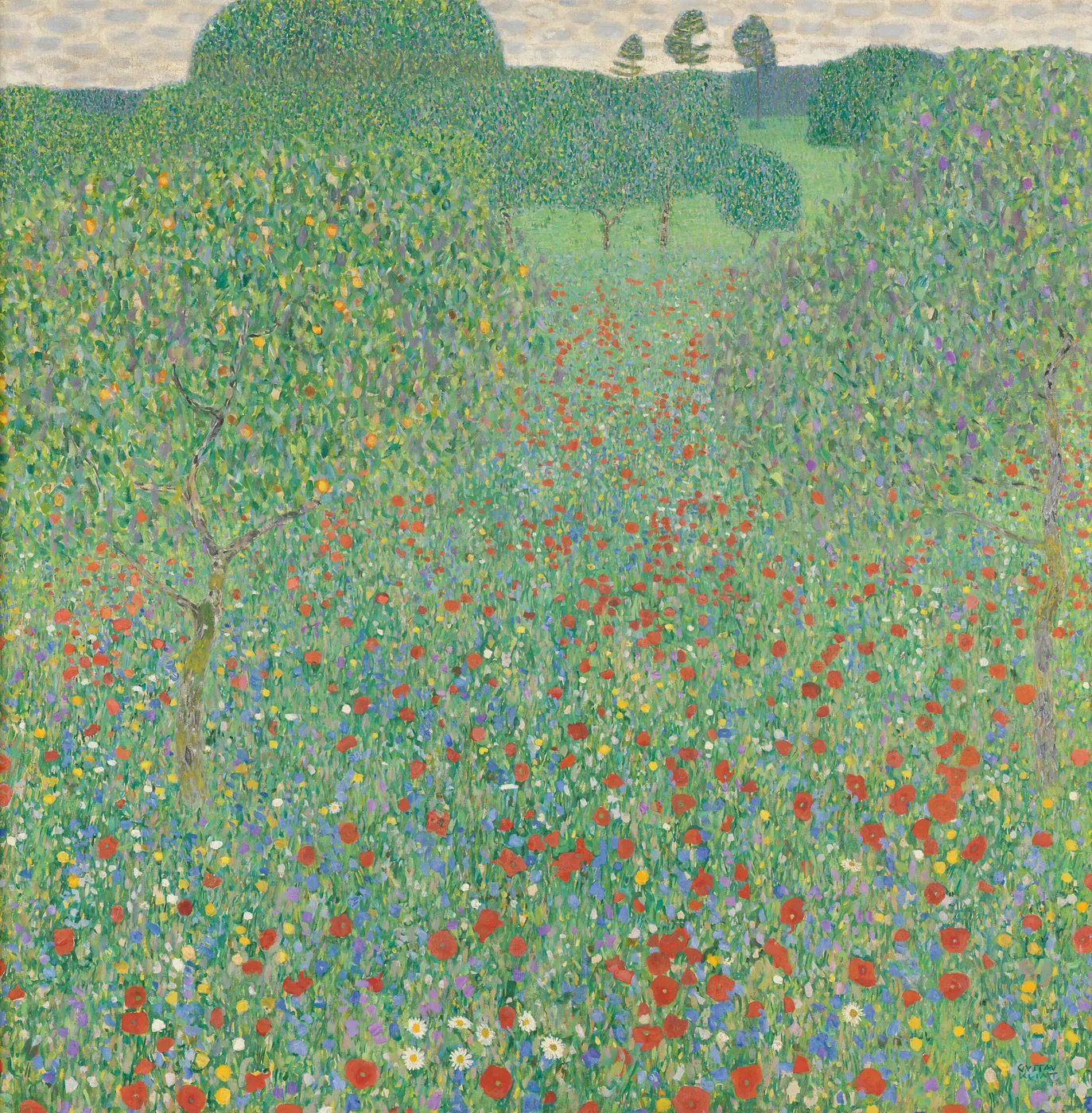
Cottage Garden with Sunflowers is one of the most crowded of these pictures, a bed of planted flowers seen from close enough that the garden itself fills the entire frame. Klimt returned to garden subjects more than once in these years, as in Flowering Poppies and Roses beneath Trees, painted at the same lake in the same stretch of his career.
He kept painting square garden and lake views alongside his portraits and allegorical subjects for the rest of his career, until his death in 1918. Today those garden pictures sit among the best known parts of his output, next to the gold-ground portraits that made his reputation in Vienna.
Inside a Square Canvas Packed with Flowers
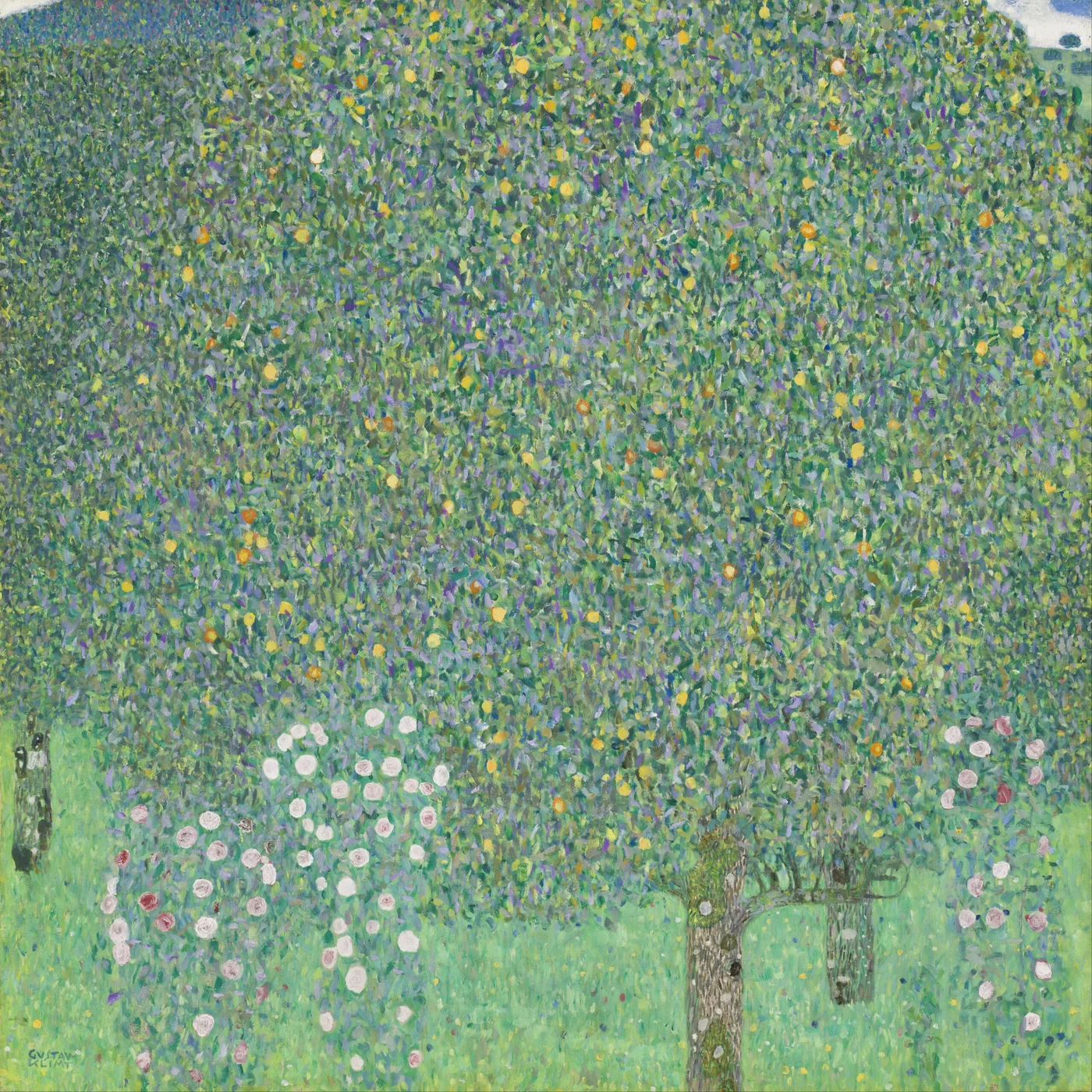
Planting runs edge to edge, so the eye never leaves the garden, and sunflowers fill the upper right quadrant, the tallest point of the composition. Several heads face the viewer fully, with dark brown centres ringed in short yellow petals; others turn away or sideways, showing the green underside of the flower head rather than its face. Broad, overlapping blue-green leaves fill the space around them, each leaf built from a few long curved strokes.
A second patch of dark teal foliage fills the upper left corner, with a single yellow bloom clipped by the edge of the canvas, only partly visible. Between the two corners the garden rises on a diagonal, as though the ground itself tilts up toward the sunflowers. The effect is closer to standing inside a bed of flowers that climbs away from you than to looking across a lawn toward open sky.
Below the sunflowers, the bed thickens into smaller flowers in close-set colour. Vermilion and orange-red blooms climb in a loose band left of centre, clusters of white daisies with pink and yellow centres sit lower down, and small round orange and yellow flowers gather in rows across the bottom right corner. Patches of blue and indigo flowers run through the lower left and lower right.
Klimt builds each flower from small, separate touches of paint set side by side, with colour doing the work an outline would do elsewhere. A daisy might be four or five dabs of white around one dot of red or yellow; a poppy head is a cluster of short orange-red strokes with a darker centre. Seen from a distance these touches resolve into flowers; seen close, the canvas is closer to a woven mass of coloured marks.
Light spreads evenly across the picture rather than falling from a single source, and the surface stays free of cast shadow. Klimt separates one plant from another with changes of colour and value alone, so a lighter green leaf can sit directly beside a darker one in a sharp, flat contrast. Depth comes from overlap rather than from perspective or shading.
Colour and texture carry the picture rather than any single focal point. The square format holds the composition together, and the sunflowers give the top of the canvas more visual weight than the rest.
A Garden Painted for Its Own Sake
Cottage Garden with Sunflowers puts all its attention on the planted bed, filling the canvas with growth rather than incident. The subject is the act of looking closely at a planted bed until it fills the whole field of vision, with nothing held back for scale or context.
That choice can be read as part of the decorative turn in painting that Klimt’s circle pursued in Vienna, where pattern and colour carried as much weight as the subject itself. Read this way, the garden sits close to a textile or a mosaic, built from repeated shapes rather than individual studies.
The sunflowers themselves can be read as a marker of the season inside a picture that otherwise gives few clues to time of year. They flower in late summer, so their place at the top of the canvas marks the garden at the peak of its growing season.
Unlike Klimt’s portraits and allegorical paintings, the picture leaves its reading open.
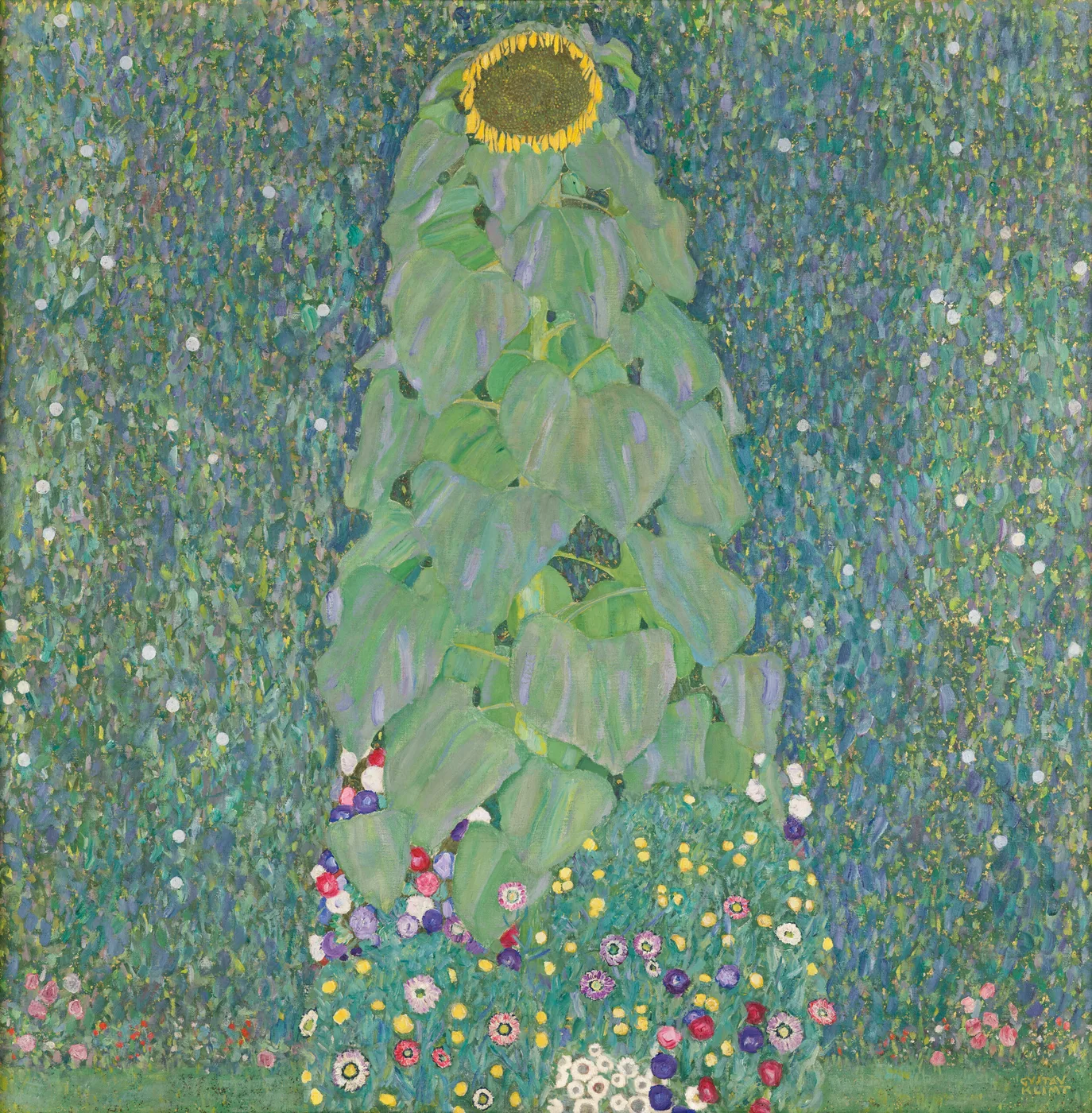
Seen beside Sunflower, a closer study of the same flower from Klimt’s garden years, this picture reads as the crowded version of a motif he also painted standing alone.
Seeing the Original at the Belvedere
The Belvedere in Vienna displays it among other Klimt paintings from the same years.
At 110 × 110 cm, the painting is large enough to fill most of a viewer’s field of vision at a normal gallery distance, which matches how densely Klimt packed the garden into the frame. Standing back lets the colour read as a single mass of green, red, orange and white; stepping closer brings out the separate touches of paint that build each flower.
For anyone who cannot get to Vienna, or who wants the same composition on their own wall, the painting’s page sets out the sizes and finishes available as a reproduction.
Choosing Your Cottage Garden with Sunflowers
Every reproduction of Cottage Garden with Sunflowers in this shop keeps the same composition and colour as the original, whether as a hand-painted oil or an archival canvas print. The choice between them comes down to method and feel.
A hand-painted oil is painted from scratch, in oil on canvas, by an artist who follows the original’s composition and colour. Nothing is printed underneath: the large fields of green are laid in first, then the flowers, then the fine detail of the sunflower centres and petals. Because a person paints it, the surface carries real brushwork, and no two canvases come out quite the same.
The archival print is a high-resolution giclee on canvas, which keeps the colours and the fine pattern of flowers consistent from one print to the next. It suits a tighter budget, or a kitchen or dining room where more than one picture might need to read as a set.
Every size on the product page keeps the original’s square proportions, so the dense planting is never stretched into a rectangle or cropped at the edges. Painting the oil by hand takes 2 to 4 weeks. Printing takes 2 to 4 business days. Before a hand-painted piece ships, it is photographed so you can see and approve the finished canvas. Delivery then takes 5 to 7 business days.
Given how much the composition relies on its square shape and its all-over pattern, a plain stretched canvas lets the planting run straight to the edge, uninterrupted by any border, which suits a kitchen, dining area or living room wall seen from across the room. Framing options are available too, for anyone who prefers a defined edge, and the full range of sizes sits on the Cottage Garden with Sunflowers page.
Questions Readers Ask About This Painting
What does Cottage Garden with Sunflowers show?
A dense bed of garden flowers with sunflowers rising at the top. The frame holds only the garden itself, planted from edge to edge.
Where is the original painting kept?
The original, painted in 1906, is held by the Belvedere in Vienna.
How big is the original canvas?
It measures 110 × 110 cm, a square format Klimt used for most of his garden and lake pictures.
What is the difference between the hand-painted oil and the print?
The oil is painted by hand in real paint on canvas, with its own brushwork and texture. The print is a high-resolution giclee on canvas, with consistent colour from one copy to the next.
Does a smaller reproduction lose any of the composition?
No. Every size keeps the original’s square proportions, so the same planting and the same sunflowers appear at every size offered.
More from this collection
Bring this painting home
Choose a hand-painted oil reproduction for real brushwork, or an archival canvas print for a crisp museum-image edition. Every size preserves the original proportions.
View this work & options
Further reading
Verify the original in the Belvedere collection record and continue through related works in the catalogue.