
Flowering Poppies: Klimt’s 1907 Meadow With No Horizon and No Figure
A Painter’s Summer Habit, Fixed in 1907
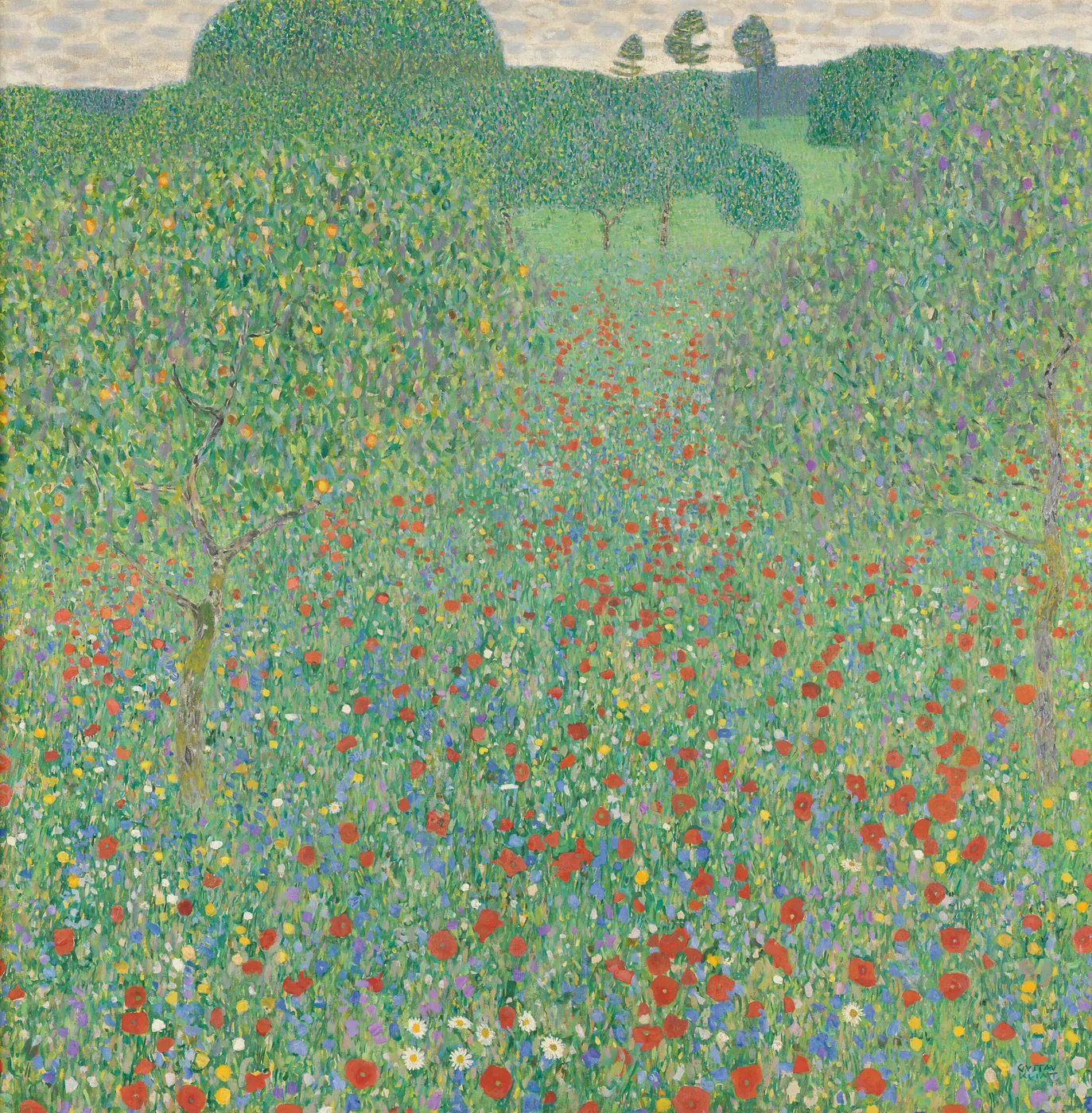
Flowering Poppies is a square landscape Gustav Klimt painted in 1907, now held by the Belvedere in Vienna and measuring 110 × 110 cm. It belongs to the garden and meadow pictures he set beside his portrait work in those years, built without a single figure in the frame.
The same year, 1907, Klimt finished the Portrait of Adele Bloch-Bauer I, the gold-covered portrait usually placed at the centre of his golden period. Flowering Poppies comes from a different corner of that year’s work, made in plain oil with no gold leaf and no sitter to pose for it.
Many of Klimt’s landscapes date from his summer stays at the Attersee, a lake east of Salzburg, where gardens, orchards and lake shores gave him subjects that owed nothing to a client’s likeness or a sitting room. Flowering Poppies reads as one picture from that same habit: a close view of planted ground with no sitter in it.
His meadow pictures show this emphasis: perspective gives way to an even field of small, repeated marks that cover the canvas edge to edge, with no single area asked to carry more weight than another.
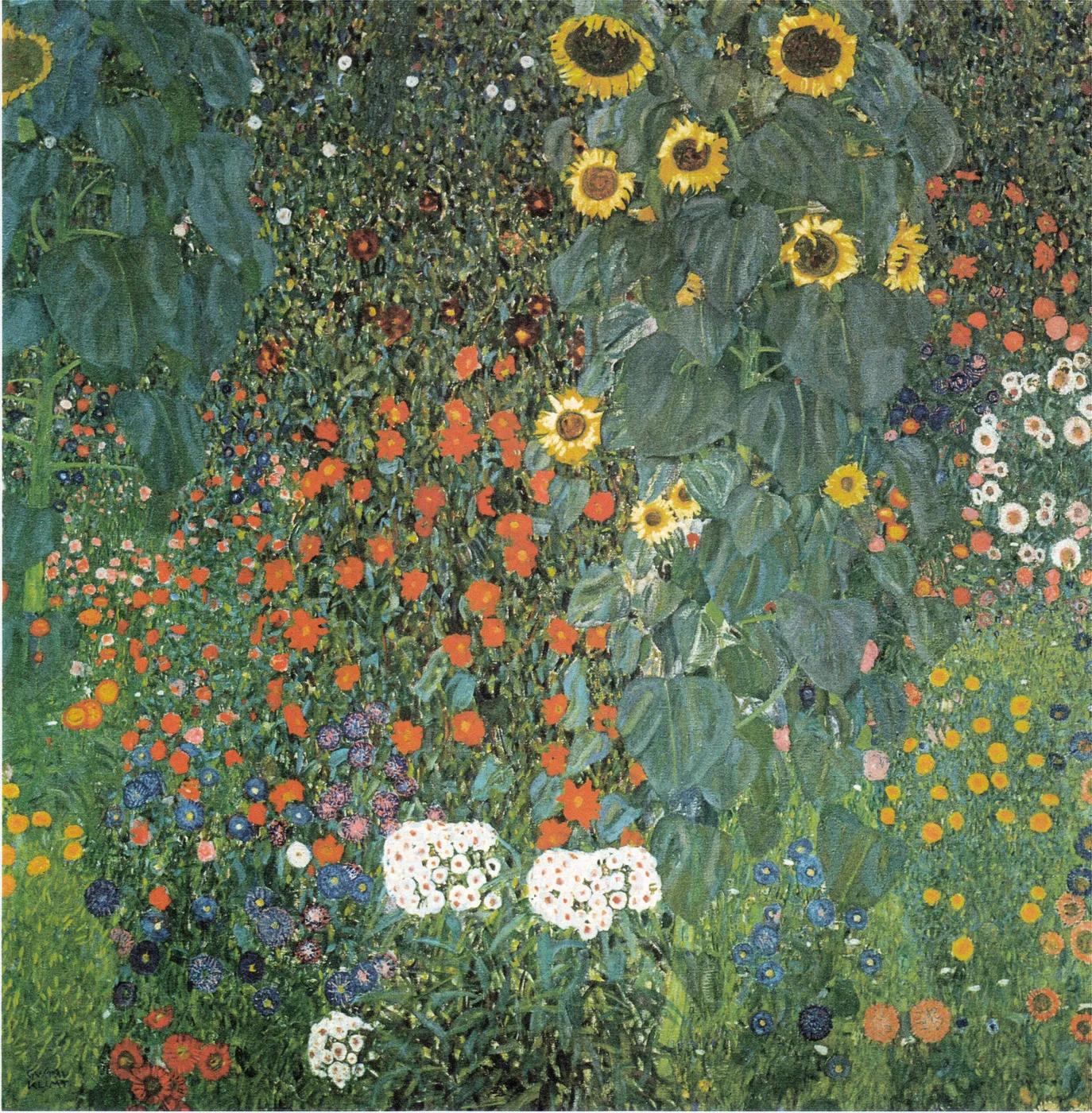
Several other garden paintings date from this part of his career, among them the pictures now known as Cottage Garden with Sunflowers and Sunflower. Klimt gave Flowering Poppies a square canvas, 110 × 110 cm, a shape he returned to for this kind of close, all-over planting.
Klimt lived from 1862 to 1918, and 1907 sits past the midpoint of that life, in years when the Secession’s early fights over style had already settled. The meadow paintings gave him a working rhythm apart from his portrait commissions.
What remains on the canvas is a field built from small, even touches of paint, carrying no gold leaf and no face turned toward the viewer.
Inside the Square Canvas: Hedges, Poppies and Bare Trunks
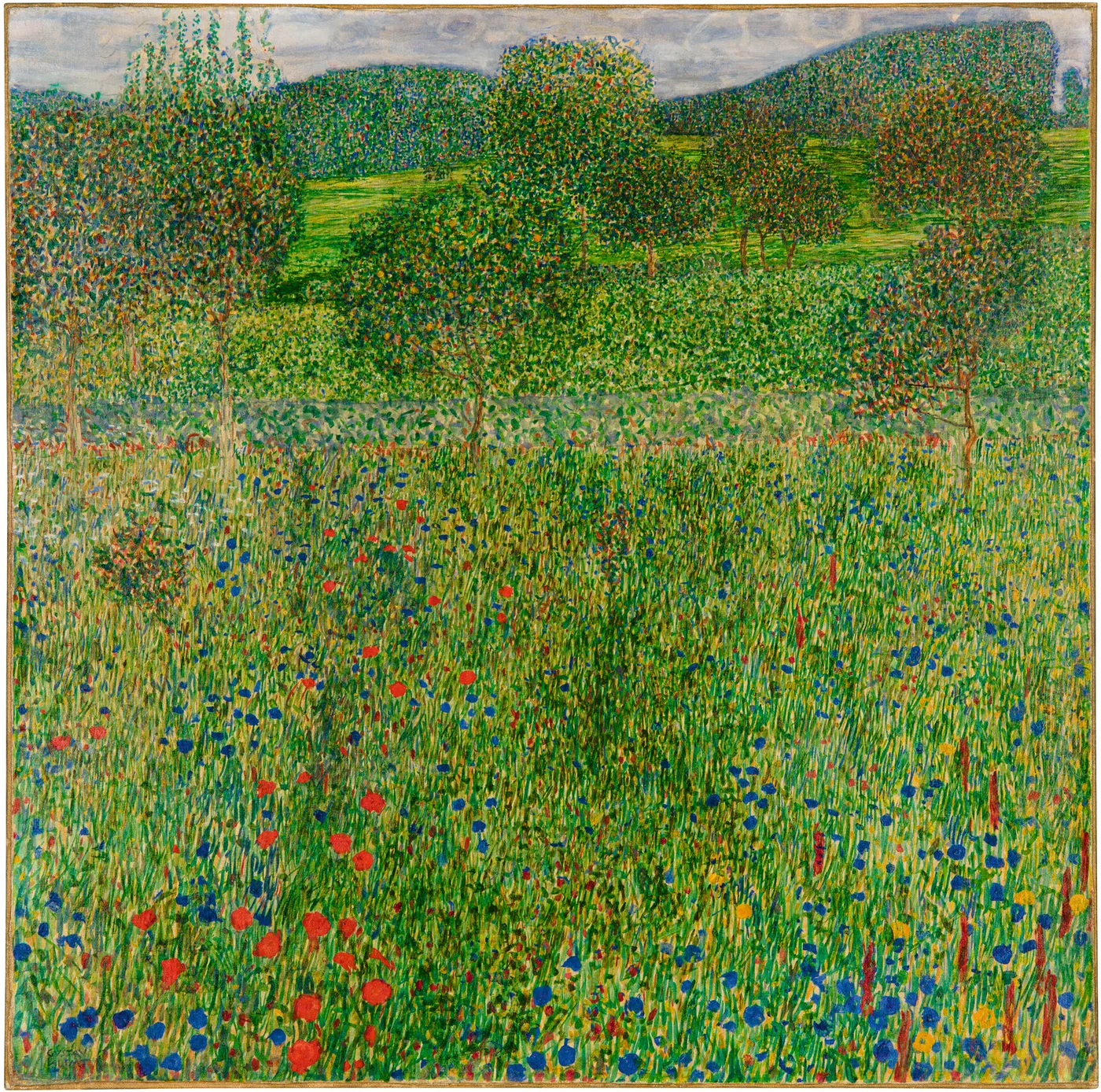
The canvas is a full square, and Klimt fills it edge to edge with no horizon in the usual sense. A narrow band across the very top holds a pale strip of sky and a line of dense, rounded hedges and shrubs; everything below that band, roughly four-fifths of the canvas, is meadow.
Just right of centre, the hedge line breaks open for a short stretch, and three slender trees with dark, rounded canopies rise into the pale sky through that gap. It is the one place in the picture where the eye can see past the planted screen built along the top edge.
From that opening, a corridor of red poppies runs down through the middle of the canvas towards the viewer, packed closer together there than at either side. It is the single device in the painting that reads as depth, since nothing else in the field of flowers points toward a vanishing point.
Two bare tree trunks, thin and grey-brown, rise through the lower meadow, one set low on the left side of the canvas and one on the right, each with only a few sparse branches. They are the only vertical lines in a picture otherwise built from short, scattered marks, and they anchor the lower corners against the drift of colour around them.
Red poppies are set across the whole width of the meadow, thickest down the central corridor and scattered more thinly towards the edges. Among them sit small touches of blue and violet flowers, dabs of yellow, and a gathering of white daisies along the bottom edge of the canvas, closest to the viewer’s own position.
The green beneath all of this ranges from a cool, blue-tinted shade in the shaded hedge line to a warmer, yellow-tinted shade where the open meadow catches more light. Klimt lays each tone in beside its neighbour without blending, so the grass reads as a mass of short, separate strokes.
Light falls evenly across the meadow, with the pale sky at the top the only sign of its source; no shadow models any single flower or stem into relief. The brush marks keep a consistent small size from corner to corner, which flattens hedge, tree trunk and poppy alike into one dense, even surface.
Reading a Field With No Figure, No Path, No Sky
Nothing in Flowering Poppies tells a story. There is no path through the meadow, no building beside it, and no person to set the flowers against a human height. The subject is colour and growth, nothing more than what has already pushed up through the grass that summer.
Cutting out the horizon and filling the square with meadow places the viewer inside the field rather than at the edge of a lawn looking in. Without a middle distance or a far tree line, there is little to measure how far back the flowers go.
No single poppy or daisy is given more weight than its neighbours; the small, even brush marks spread the same attention across the whole canvas. This levels the canvas: a flower at the centre of the corridor counts for no more than one lost among the green at the edge.
Poppies hold their petals for a short stretch each summer before they drop, so a field this full marks one brief point in a garden’s year, caught before the petals fall.
Read as pattern or read as a record of one short season, the canvas stays the same object on the wall: a square field built from brushstrokes, not from a story that needs telling.
Seeing the Original at the Belvedere
Flowering Poppies hangs in the Belvedere in Vienna, a museum that holds one of the largest groups of Klimt’s paintings under one roof, spanning his portraits, allegories and landscapes.
The canvas measures 110 × 110 cm, a true square, which gives it a different presence on the wall than his taller portrait canvases. Standing in front of it, the small, separate brush marks only resolve into flowers and leaves at a certain distance; step closer and the picture breaks back down into dabs of red, green, blue and white paint.
Choosing a Hand-Painted Oil or Print of This Meadow
Two versions of Flowering Poppies are available: a hand-painted oil reproduction and an archival canvas print, both based on the same image of the original held at the Belvedere. Picking one is a matter of method and feel, since both start from the same image, and the full range of sizes sits on the painting’s own page.
An artist paints each hand-painted oil from scratch, laying in the large green passages first and adding the red, blue, yellow and white dabs over them, so the surface keeps real brushwork that catches the light as you move past it. That suits a field this dense, where texture carries as much of the picture as colour does. Painting the oil by hand takes 2 to 4 weeks.
The archival print is a high-resolution giclee on canvas, printed with pigment inks that keep the reds and greens consistent from one print to the next. It is the steadier choice if you want a dependable result or more than one piece to match across a room. Printing takes 2 to 4 business days.
Every size keeps the square proportions of the original, so a small print stays as square as a large one, with nothing stretched to fit a stock frame. A dense, all-over field like this one tends to hold up best at a larger size, where the separate touches of colour stay visible instead of flattening into plain green, and a plain black or pale frame keeps the meadow as the only pattern on the wall; both are shown with the sizes on the product page.
Before a hand-painted copy ships, the finished canvas is photographed so you can check the colour and the detail and approve it. Delivery then takes 5 to 7 business days. For a second garden piece on the same wall, Roses beneath Trees offers another planted view with the same choice between oil and print.
What Buyers Ask About Flowering Poppies
What does Flowering Poppies show?
A square meadow filled with red poppies, daisies and small blue and violet flowers, closed off at the top by a line of clipped hedges and a narrow strip of sky, with no figure anywhere in the frame.
How big is the original, and where is it kept?
The original measures 110 × 110 cm and is held by the Belvedere in Vienna.
Can I order it as a hand-painted oil?
Yes. An artist paints every oil reproduction by hand from the original artwork, and painting it takes 2 to 4 weeks.
Does a smaller print keep the same square shape?
Yes. Every size, hand-painted or printed, keeps the 110 × 110 cm proportions of the original, so the square is never stretched into a rectangle.
Which rooms suit this painting?
Rooms with pale or neutral walls let the reds and greens carry the colour, which is why the picture works well in a dining area or a living room wall that otherwise has little red in it.
More from this collection
Bring this painting home
Choose a hand-painted oil reproduction for real brushwork, or an archival canvas print for a crisp museum-image edition. Every size preserves the original proportions.
View this work & options
Further reading
Verify the original in the Belvedere collection record and continue through related works in the catalogue.