
A Single Bloom Fills Klimt’s Square Sunflower Canvas
Painted Between Klimt’s Portraits and His Summers at the Attersee
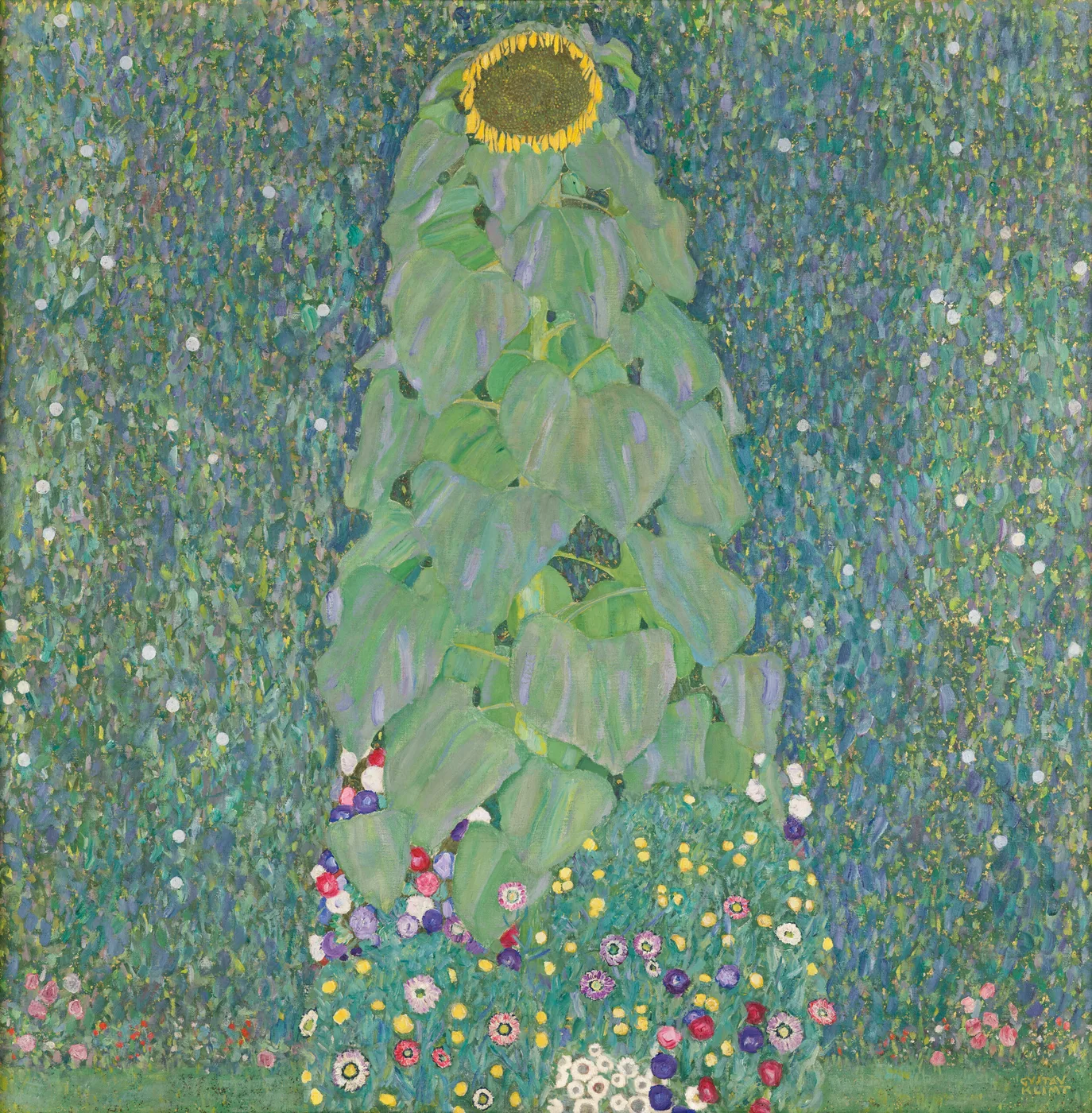
Sunflower is a square canvas Gustav Klimt painted in 1907-1908, now held by the Belvedere and measuring 110 × 110 cm. It shows a single sunflower rising through a mass of leaves, with no sky and no horizon anywhere in the frame. The painting belongs to the years when Klimt was also finishing his gold-ground portraits of Vienna’s wealthiest women.
Klimt was born in 1862 in Baumgarten, a suburb of Vienna, the son of a gold engraver. He trained at the city’s School of Applied Arts and began his career painting murals and ceiling decorations for public buildings across the empire. Before he painted portraits of Vienna’s society women, Klimt had already built a reputation as one of the city’s most skilled decorative painters.
He later led a group of artists who broke away from Vienna’s official exhibition society to show more experimental work, becoming the first president of the new association. That split let him develop the flat, patterned style that marks his mature paintings, portraits and gardens alike.
By 1907 Klimt had completed Portrait of Adele Bloch-Bauer I, a work covered in gold and silver leaf that became one of his best known portraits. The following year, 1908, he showed major new paintings, including The Kiss, at a large exhibition in Vienna.
Each summer during these years Klimt left Vienna for the Attersee region, where he stayed with the family of Emilie Flöge and painted the lake, the gardens and the farmhouses around him. These landscapes are mostly square, a format Klimt rarely used for his figure paintings but returned to often for the gardens and lake views he painted on these breaks.
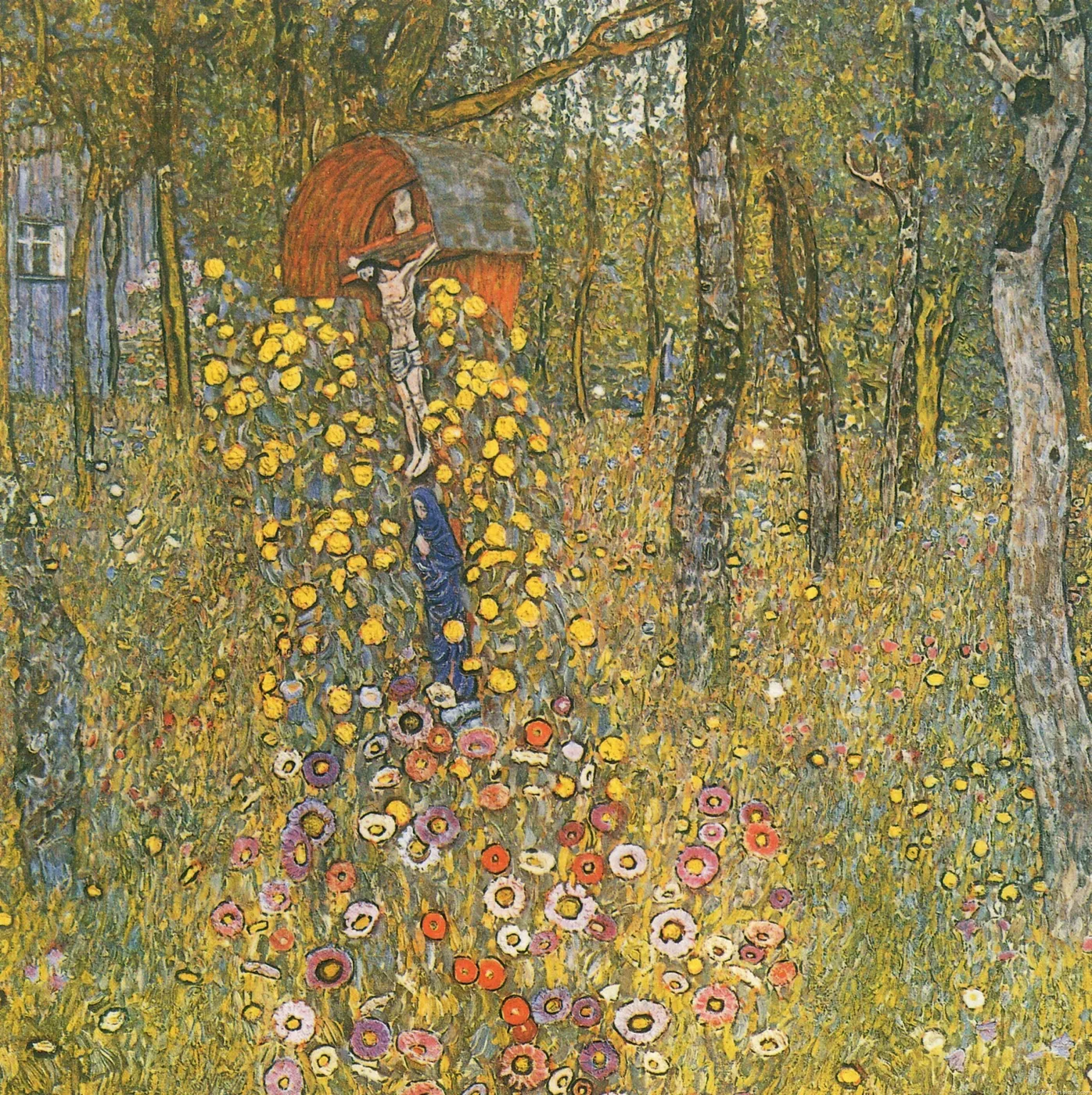
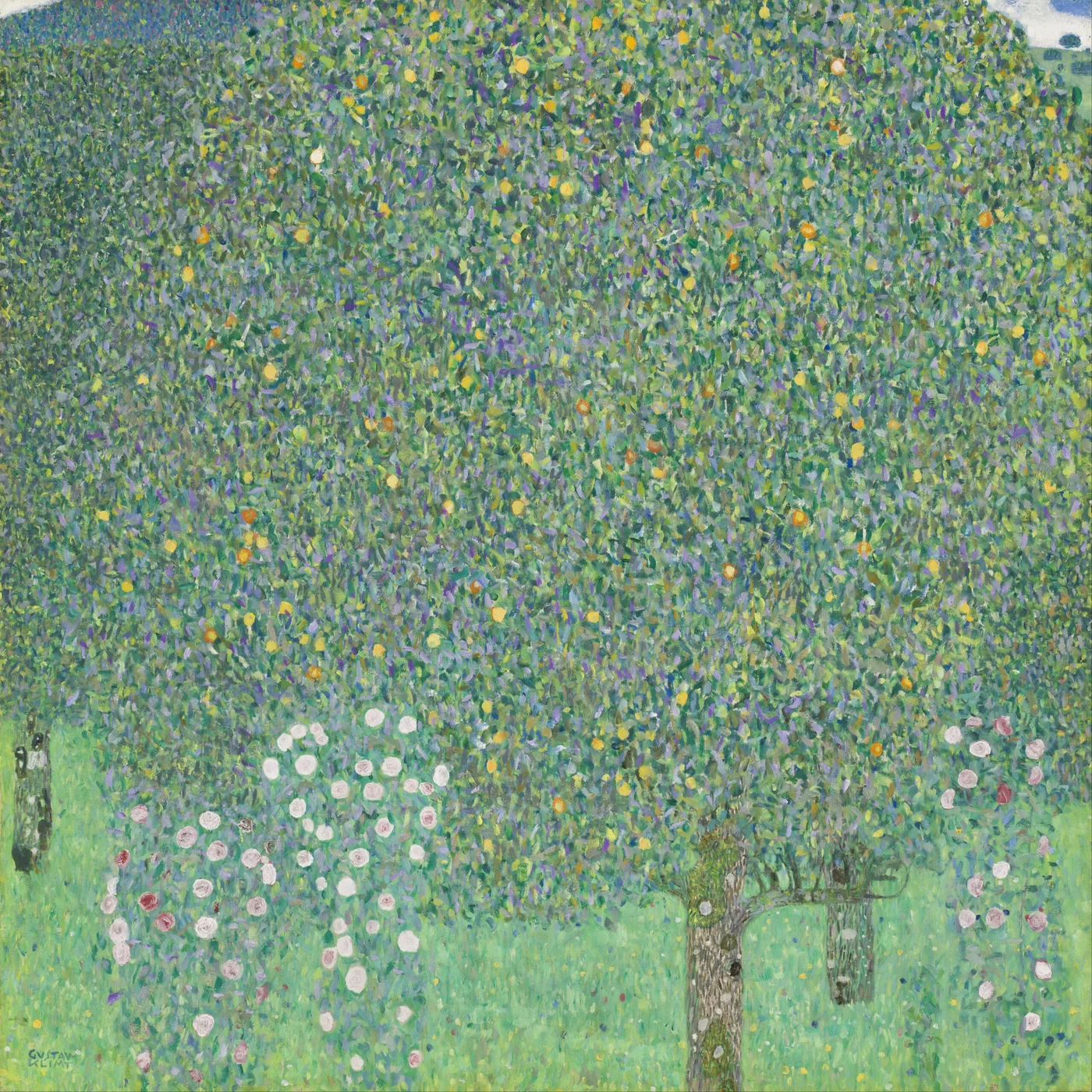
The painting, dated 1907-1908, sits among this group of garden pictures, close in subject to Cottage Garden with Sunflowers and to Roses beneath Trees. These pictures carry no sitter and no interior, only the plants themselves, unlike his portraits.
Klimt died in Vienna in 1918, after a stroke left him partly paralysed during the influenza epidemic that reached the city that year. Sunflower belongs to the last full decade of his working life, the decade that also produced Portrait of Adele Bloch-Bauer I and The Kiss.
Green Leaves, a Golden Head and a Field of Small Strokes
The canvas is square, 110 × 110 cm, and Klimt gives it no sky and no horizon. The plant fills the frame from the bottom edge to a point near the top, so the eye has nowhere to rest outside the garden itself.
Near the top of the canvas, the flower head tilts slightly to the left. Its centre is a dense disc of dark brown and black florets, ringed by yellow petals that curl and overlap rather than lying flat. It is the only warm, bright note in the upper half of the picture.
Below the flower, large heart-shaped leaves stack on top of each other down the centre of the canvas, widening as they near the bottom edge. Klimt paints them in two tones of green, a deep shade in the shadowed folds and a paler, lavender-grey green where light catches the surface of each leaf.
Around the plant, the background is built from short, dabbed strokes of blue, teal and green, packed closely enough to read as one continuous textured field. Small white dots sit scattered across this field at irregular intervals, breaking up the blue-green surface with flecks of light.
At the base of the stem, a band of small garden flowers runs across the lower edge of the canvas: red, pink, purple, white and yellow blooms painted as simple daisy-like shapes. A few stray flowers appear again in the bottom corners, in red and pink, outside the main cluster.
The handling of paint changes by zone. The background keeps to short, repeated dabs that give it a mosaic texture, the leaves are built with broader, flatter strokes that follow each leaf’s shape, and the flower head and lower blooms carry tighter, more defined marks. Klimt signs the canvas in gold lettering in the lower right corner.
Green covers most of the canvas, cooled by the blue of the background, so the yellow flower head and the small reds and purples at the base stand out as the only warm colours in the picture.
A Flower Given the Weight of a Portrait
Klimt centres the sunflower the way he centres the women in his portraits, straight on, filling most of the height of the canvas, with nothing around it to compete for attention. The flower head takes the position a face would take in one of his portraits, raised above a body built from layered, patterned shapes.
There is no sky and no horizon, so the garden becomes a closed world instead of a view into open landscape. The picture reads as an interior scene moved outdoors, with one subject held close to the viewer.
Read beside Klimt’s gold portraits, the painting suggests the same attention he gave to a sitter’s face and dress applied instead to a plant, the dense leaf pattern standing in for the ornament of a dress and the flower head for a face turned toward the viewer.
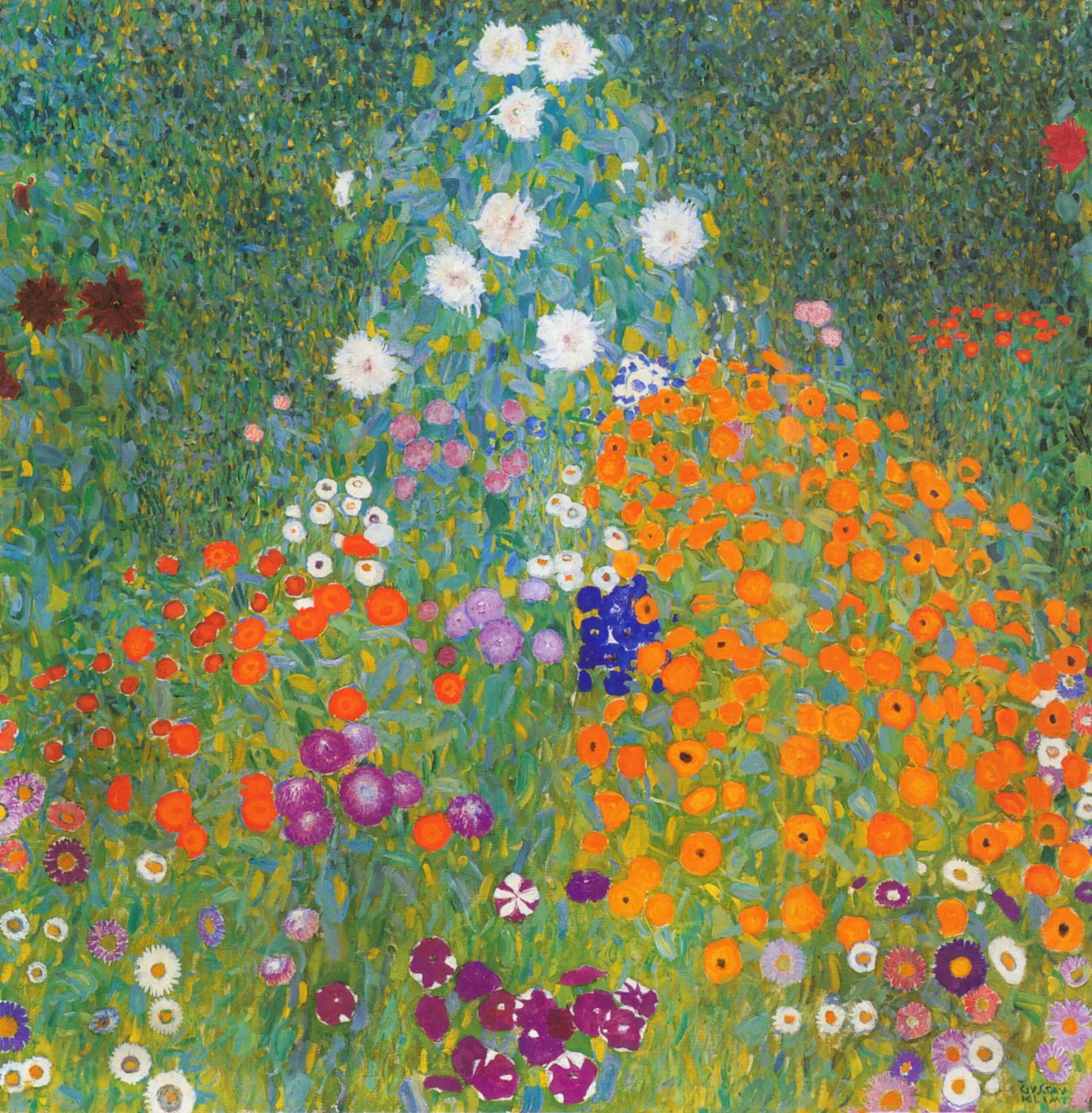
The small white dots scattered through the background and the crowd of small blooms at the base read as a second kind of life running under the main flower, filling the garden with growth beyond the single central bloom. Flowering Poppies, also painted by Klimt, shares this same crowded, bed-level view of growth.
Klimt leaves the reading open: one sunflower, its leaves and the bed of small flowers beneath it, painted with the same density of pattern that marks his portraits of women.
The Original at the Belvedere
The original Sunflower is held by the Belvedere. It measures 110 × 110 cm, a true square, a proportion Klimt used often for the garden and lake paintings from these years, unlike the taller or wider formats of his portraits.
Seen in front of the canvas, the short dabbed strokes that build the background and the two-toned greens of the leaves read with more depth than in a photograph. Paint sits thickly in places, especially around the flower head and the small blooms at the base, where the brushwork is tightest.
A reproduction cannot match the scale of standing before the original square canvas, but it can keep its proportions and its colours. The Sunflower reproduction page shows the sizes and finishes available, from a hand-painted oil to a printed canvas, each kept to the same square shape as the painting at the Belvedere.
Choosing a Hand-Painted Oil or a Print of This Square Canvas
Every size of the Sunflower reproduction keeps the square proportions of the original instead of being cropped into a standard rectangle. A narrow wall, a spot beside a doorway or a square gap above a sideboard all suit this shape better than a picture built to a wide or tall rectangle.
The hand-painted oil version is painted from scratch by a studio artist, using the museum photograph of the original as reference, in oil on canvas. The small dabbed background and the layered leaf shapes in this composition suit a painted surface well, since real brushwork catches light across the canvas the way the original does. Painting the oil by hand takes 2 to 4 weeks.
A tighter budget or several matching pieces call for the archival canvas print instead, which reproduces the same image with consistent colour and detail from one print to the next. Printing takes 2 to 4 business days.
Before a hand-painted order ships, the studio photographs the finished canvas so you can check the greens, the yellow of the flower head and the overall balance before it leaves. Framing and stretcher options for the square canvas sit alongside the size choices on the Sunflower product page.
Delivery then takes 5 to 7 business days.
Questions Buyers Ask About This Painting
Is this the only version of Klimt’s Sunflower?
This page covers the square canvas Klimt painted in 1907-1908, held today by the Belvedere and measuring 110 × 110 cm. Other works carry a similar title, so check the date and the museum before ordering a reproduction.
What does the painting show?
A single sunflower rising through a mass of green leaves, with a bed of small red, pink, purple, white and yellow flowers at its base. There is no sky, no horizon and no figure in the composition.
Should I choose the hand-painted oil or the archival print?
The oil gives real brushwork and texture, suited to the dabbed background and layered leaves of this picture. The print gives even, consistent colour at a friendlier budget, useful for matching more than one piece on a wall.
Will the reproduction keep the square shape of the original?
Yes. Every size offered on the Sunflower product page keeps the same square proportions as the 110 × 110 cm original and is never stretched into a rectangle.
How long does a hand-painted order take?
Painting the oil by hand takes 2 to 4 weeks. Delivery then takes 5 to 7 business days.
More from this collection
Bring this painting home
Choose a hand-painted oil reproduction for real brushwork, or an archival canvas print for a crisp museum-image edition. Every size preserves the original proportions.
View this work & options
Further reading
Verify the original in the Belvedere collection record and continue through related works in the catalogue.