
Roses beneath Trees Fills a Square Canvas With No Horizon at All
1905, the year a private garden set off from Klimt’s public battles
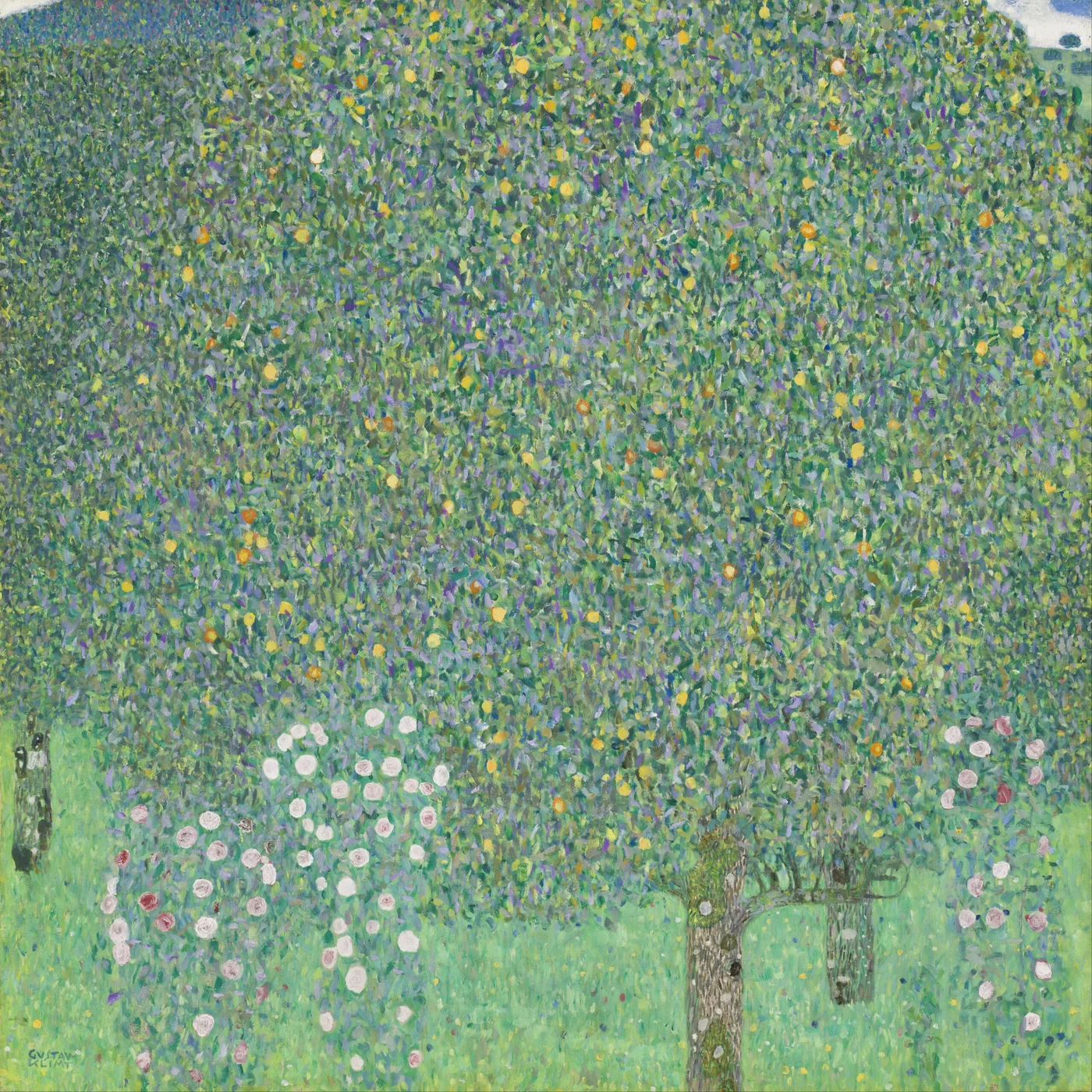
Roses beneath Trees is a square garden picture Gustav Klimt painted in 1905, a canvas of 110 × 110 cm built from rose bushes and a dense screen of trees. No path leads the eye towards a distance: the canvas holds only the gathered mass of a garden in full growth.
Klimt was born in 1862 near Vienna, the son of a gold engraver, and trained at the city’s School of Arts and Crafts before moving into mural and portrait work. By 1905 he led the group of Secession painters and designers he had helped found, and his public name rested on commissioned portraits of Vienna’s wealthy women and on decorative schemes for public buildings, a reputation built through exhibitions across Vienna and abroad.
The Secession split apart that year. Klimt and a number of his closest allies, including the architect Josef Hoffmann, resigned from the society they had led since its founding, after a dispute between painters who wanted the Secession to stay close to applied art and design, and others who wanted painting to stand separate from craft.
Klimt closed a second public commission that same year. He withdrew the ceiling paintings he had been commissioned to make for the University of Vienna, Philosophy, Medicine and Jurisprudence, after years of attack over their content, and bought the canvases back from the ministry that had ordered them.
Garden and landscape painting stayed removed from this public struggle. Klimt made these pictures mostly in the summer months he spent at the Attersee lake with Emilie Flöge and her family, away from Vienna’s portrait sitters, committees and newspapers.
Roses beneath Trees belongs to that private body of work, clear of the committees and the ministry he had just left behind. Its square shape, its lack of sky and its surface built from small touches of paint match a wider group of garden and orchard pictures Klimt returned to across these summers, work that stayed distinct from the portrait commissions that made his public name.
Inside the square canvas: how this garden is built
The canvas is square, and the canopy of the trees fills almost all of it. Only two narrow slivers escape it: pale blue sky in the upper right corner and a flat dark-blue patch in the upper left, so the horizon never properly arrives. The square shape removes the usual coordinates of a landscape; there is no foreground road or middle-distance field, only the garden pressed close against the picture plane.
That canopy is built from thousands of short, separate touches of paint: no blended passage of leaf or branch runs across it. Greens dominate, from a cool sage to a darker olive, set against grey-violet dabs that read as shadow inside the mass of leaves, with small flecks of yellow-orange scattered through like fruit or late blossom catching light. A few white dots sit among them too, small enough to read as a bloom glimpsed through the leaves.
No single light source organises the scene. The colour shifts from patch to patch across the canopy, never running from a bright side to a shaded one, so the whole surface stays flat and even, with no sense of a form turning in light.
Below the canopy, a plain green lawn carries two clusters of rose bushes, one at the left edge and a smaller one on the right. Both rise in loose columns of small round touches, pale pink and white for the open blooms, with occasional deeper red and magenta low down near the grass. A strip of bare green shows between the two clusters, the only open ground the lawn allows.
A thick trunk anchors the centre of the lower canvas, its bark grey-brown and patched with pale green lichen, splitting into two or three limbs that climb and disappear into the foliage above. It is the one solid, modelled form in a picture built mostly from dabs.
At the far left edge, a slim dark shape stands beside the roses, cropped by the frame before it resolves into anything certain. Its outline narrows towards the top in a way that suggests a shoulder and head as much as a tree trunk in shadow, though the paint commits to neither reading. Klimt signs the canvas in the grass at the lower left, in plain capitals.
The same dabbing technique covers rose petal, leaf, bark and grass alike, so the whole surface reads as one continuous weave of small marks. Up close, the picture breaks into these individual touches of colour; a few steps back, they settle into the shapes of a garden.
A garden with no path: what it offers to read
The subject is plain: a bed of roses growing under trees, in a corner of garden given no name and no location.
Read one way, the picture carries into landscape the same decorative eye Klimt used behind his portrait sitters, where patterned fields of gold and colour often press close to the surface. Here the pattern is made of leaf and petal, and it keeps the eye on the surface of the canvas, with no illusion of depth to draw it further in. His portraits from this period are often built the same way, filled edge to edge with ornament that leaves little empty ground.
Read another way, the garden’s density and its missing horizon give it the feel of an enclosed space, a private plot walled in by its own trees. There is no gate in view and no path leading out of it, only the screen of leaves that closes the picture on every side.
The dark sliver at the left edge invites a third reading. It can be a half-seen presence at the border of an otherwise empty garden, a shape the painting lets the viewer complete or leave unresolved. Klimt sets it at the very edge of the canvas, almost outside the frame, which keeps it from settling into a clear role in the scene.
Among Klimt’s other square gardens and orchards
Roses beneath Trees sits among a run of square garden and orchard paintings Klimt made in this period, pictures with no horizon to anchor them. The stories behind Pear Tree (1903) and Apple Tree II (Green Apple Tree) (1916) cover two more orchard canvases, built with the same all-over touches of paint across trunk, leaf and fruit.
Some of Klimt’s garden pictures raise a single flower above the rest of the canvas. In Roses beneath Trees, no bloom sits apart from the mass, and the roses stay level with the leaves, bark and grass around them. Flowering Poppies spreads its flowers the same way, as a field that covers the whole canvas.
The square format itself runs through this group, the shape Klimt kept for garden pictures that give the eye no single path to follow and no sky to rest in beyond a narrow strip at the top edge. He used the same shape for close orchard views and for open meadows alike, a choice about how the surface is built, independent of the particular subject it holds.
Choosing a reproduction of this square garden for your wall
Two editions of Roses beneath Trees are available, a hand-painted oil on canvas and an archival print, both made from the same open-access image of the original painting. Sizes and frame options for both sit on the painting’s own page.
The hand-painted oil is painted from scratch by an artist, in oil on canvas, using that image as the reference, with nothing printed underneath. For a canopy built from thousands of small touches of paint, a hand-painted surface keeps that texture: the brush lays in the broad greens first, then the scattered flecks of colour, so the paint carries the same kind of mark the original does. Painting the oil by hand takes 2 to 4 weeks.
The archival print is a giclee print of the same image on canvas, made with pigment inks, and gives a close, consistent match from one order to the next. It suits a dependable result, a smaller budget, or a set of garden pictures meant to match on the same wall. Printing takes 2 to 4 business days.
Every size keeps the 110 × 110 cm proportions of the original, so the square is never stretched into a rectangle or trimmed to fit a stock frame. A composition this dense reads well in a stairwell, a hallway, or above a low sideboard, spaces where a wide rectangular landscape would feel too long for the wall.
A plain wood frame in a pale or mid tone suits the green and grey-violet palette here without competing with the small flecks of pink and orange in the canopy, and a dark frame also works if the wall around it stays pale. Approval happens before anything ships: the finished hand-painted piece is photographed so you can check colour and detail before it leaves the studio. Delivery then takes 5 to 7 business days. The full range of sizes for this garden sits on the product page for Roses beneath Trees.
Questions buyers ask about Roses beneath Trees
What does Roses beneath Trees show?
A square view of rose bushes growing under a dense screen of trees, painted by Gustav Klimt in 1905. The canopy covers almost the whole canvas, with only one small strip of sky and one dark patch at the top corners.
Why does Klimt use a square canvas for this garden?
He kept this square shape, used here at 110 × 110 cm, for a number of his garden and orchard pictures, a format that holds a dense view with no horizon or vanishing point to organise it.
Can I order Roses beneath Trees as a hand-painted oil?
Yes. Each hand-painted order is painted by an artist from an open-access image of the original, in oil on canvas, and photographed for your approval before it ships. Sizes and the frame options are on the painting’s page.
What is the difference between the oil and the print?
The oil carries real brushwork, which suits a canopy built from so many small touches of paint. The print is a consistent giclee on canvas, a practical choice on a smaller budget or for matching several pieces.
Which room suits this painting?
Its square shape and green, grey-violet palette suit a stairwell, a hallway or a wall above a sideboard, especially where the surrounding wall stays plain.
More from this collection
Bring this painting home
Choose a hand-painted oil reproduction for real brushwork, or an archival canvas print for a crisp museum-image edition. Every size preserves the original proportions.
View this work & options
Further reading
Verify the original in the collection record and continue through related works in the catalogue.