
Pear Tree: Gustav Klimt’s Square Orchard Canvas from the Summer of 1903
A Square Canvas from Klimt’s Summers at Lake Attersee
Pear Tree is a square canvas Gustav Klimt painted in 1903, during the years he spent his summers at Lake Attersee in Upper Austria, away from Vienna’s portrait commissions. It belongs to a run of orchard and garden paintings from those holidays, a group that also gave Klimt collectors Apple Tree II (Green Apple Tree) and Cottage Garden with Sunflowers, each built around a single motif pressed close to the picture plane.
Klimt was born in 1862 in Baumgarten, a village on the edge of Vienna, the son of a gold engraver. He trained in decorative painting before moving into the portraits, allegories and public commissions that made him the central figure of Vienna’s new art scene by the turn of the century.
He had co-founded the Vienna Secession, the society of artists who broke from the city’s official academy to exhibit on their own terms, and was its first president. His ceiling paintings for the University of Vienna had already drawn public argument over their nudity and their politics, a dispute that coloured his reputation through these years.
Away from that argument, Klimt spent each summer with Emilie Flöge and her family at the lake. There, away from the portrait sitters who filled his Vienna diary the rest of the year, he painted gardens, orchards, farmhouses and the lake itself.
Pear Tree belongs to that lakeside work, in the square format Klimt returned to for landscapes through these years. Without a horizon to settle on, each of these canvases reads as a close, continuous field of paint, with no view opening into the distance, the orchard filling the frame edge to edge.
Around the same years, Klimt also completed the Beethoven Frieze, a wall-sized work made for the Secession’s own exhibition building, painted in a decorative, allegorical style far removed from the quiet, repetitive brushwork of his orchard pictures. The two bodies of work, public and private, ran side by side through this period of his career.
Klimt kept dividing his year between Vienna’s commissioned portraits and these private lakeside landscapes until his death in Vienna in 1918. The dense, patterned brushwork he worked out in canvases like Pear Tree stayed part of his landscape painting for the rest of his career.
Inside the Canopy: How Klimt Built the Square Picture
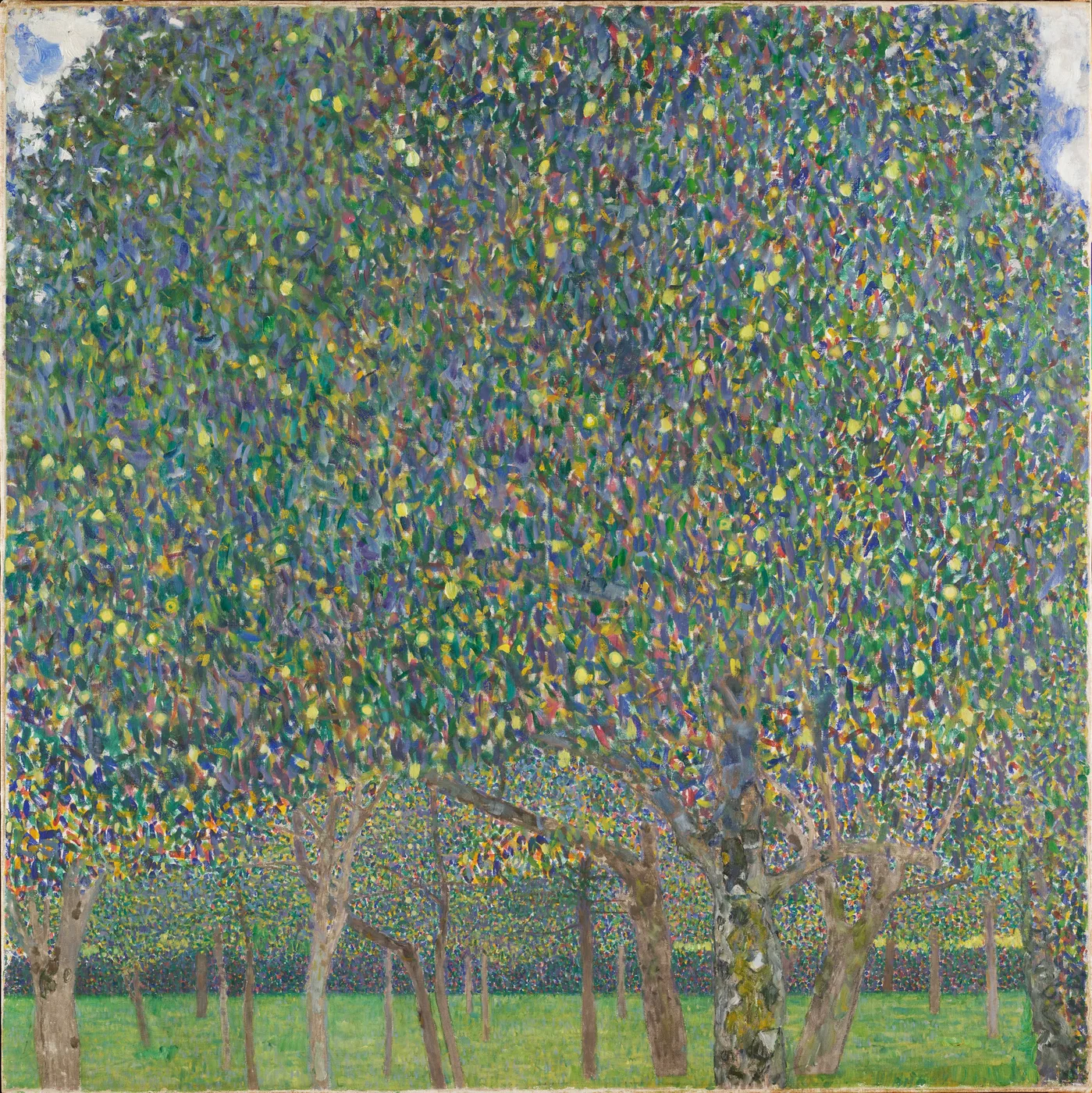
The canvas is square, and Klimt fills nearly all of it with the canopy of the tree. Sky appears only in two small corners at the top, pale blue brushed with hints of white, while the rest of the surface, from edge to edge, is given over to leaves, fruit and branch.
Below the canopy, a row of trunks rises from a band of bright green grass along the bottom edge. One trunk, right of centre, is thicker than the rest, its bark painted in patches of grey, rust and moss green; around it, several slimmer, darker trunks lean at different angles, suggesting other trees standing close by in the same orchard row. Further back, paler, thinner trunks are visible through gaps in the foliage, pushing the orchard floor a little deeper into the square.
Klimt builds the canopy from thousands of short, separate, unblended dabs of colour. Dark green and blue-violet dominate, broken by small round touches of mustard yellow scattered through the mass, standing in for the pears that give the painting its name. Flecks of white, pink and orange-red sit among the greens too, no bigger than a fingernail, so that from close up the canopy reads as a field of small, separate marks of colour.
Seen from across a room, these dabs merge into a single dense, shifting surface, with no single leaf or fruit standing out from its neighbours. Up close, the same passage breaks back into hundreds of individual, unblended strokes, each one a separate decision of colour and direction.
No single light source is visible in the picture. The pale sky in the two top corners is the only sign of open air, and the scattered white and pale yellow dabs through the canopy read as light breaking through leaves.
The trunks and the ground are painted more descriptively than the canopy above them. Bark is built from patches of warm brown, grey and green, carrying the texture of real wood and moss, and the grass at the bottom is laid in as a flatter, more continuous field of bright green. This lower band gives the eye a place to rest before the dense canopy takes over the rest of the square.
The square format leaves no horizon and no sky to balance the mass of leaves above. Everything in the lower band, trunks, grass and the hint of more trees behind them, reads as the floor that holds up the canopy that dominates the rest of the canvas.
What the Crowded Canopy Might Say
Pear Tree shows a single fruit tree, an orchard floor and a narrow strip of sky, offered without any story attached to it. Unlike Klimt’s portraits and allegorical paintings, it carries no figure and no symbol named by its title beyond the tree itself, so any reading of the picture has to come from what the canvas shows.
The density of the canopy can be read as a picture of abundance, a tree so full of leaf and fruit that no gap opens onto the sky, every inch of the square given over to growth. The small yellow dabs standing in for pears repeat across the whole canopy, less like individual fruit than like a steady rhythm filling the surface.
A square format shuts out a wider landscape too: there is no path, no building, no figure walking through the orchard, nothing to draw the eye past the tree itself. The picture holds the viewer inside the foliage.
Painted in the same years Klimt was working on more public, more argued over commissions in Vienna, including the university ceiling paintings and the Beethoven Frieze, Pear Tree can be read as a private subject, made away from that argument. That reading stays a possibility rather than a documented fact, since Klimt left no account of what this particular picture meant to him.
The canvas’s surface is not in dispute: dense, patterned colour built from one motif, closer to the decorative passages in Klimt’s figure paintings than to a conventional view of a garden or an orchard.
Seeing Pear Tree at the Busch–Reisinger Museum
The original Pear Tree is held by the Busch–Reisinger Museum. It is a square canvas, 101 × 101 cm, so the picture reads the same height as it does width, with no portrait or landscape orientation to favour one side over the other.
The dabs of colour that build the leaves and fruit separate out into individual marks up close, then merge back into a single dense field from farther away.
Seeing the original also means seeing the paint itself: the texture built up stroke by stroke across the canopy, and the different, more descriptive handling of the bark and grass below it. These are details a photograph flattens, but seeing the canvas itself does not.
Choosing a Pear Tree Reproduction for a Real Wall
Every reproduction in this shop starts from a museum photograph of the original painting, the same image behind both editions we offer. The hand-painted oil version is painted from scratch, in oil on canvas, built up in the same order as the original: large fields of colour first, then the mass of small dabs across the canopy, then the texture of the bark and grass. Painting the oil by hand takes 2 to 4 weeks.
The archival canvas print is a high-resolution giclee print of the same photograph, printed on canvas with pigment inks, and it keeps the colour and detail consistent from one print to the next, a practical choice if you want a dependable result or several pieces that match. Printing takes 2 to 4 business days.
Both editions keep the square proportions of the original at every size we offer, so the canopy is never cropped into a rectangle or stretched to fit a different shape. You can compare the sizes, the stretcher and the frame choices on the Pear Tree product page, where the square format stays constant from the smallest size to the largest.
Because the square has no horizon, Pear Tree reads well close to eye level, in a kitchen, a dining room or a stairwell landing where a viewer passes near it. A hand-painted version is worth choosing here for the texture of the dabbed canopy, something a flat print cannot fully carry; the hand-painted oil option is photographed before it ships so you can check the colour and the brushwork before it leaves the studio.
If you are building a small group of garden or orchard pictures on the same wall, Pear Tree pairs well with a piece such as Avenue to Schloss Kammer, another square-leaning Attersee landscape, its avenue of trees opening a view the dense canopy of Pear Tree does not. Delivery then takes 5 to 7 business days.
Pear Tree: Questions Buyers Ask
What does Pear Tree show?
A single pear tree fills nearly the whole square canvas, its canopy built from small dabs of green, blue-violet and mustard yellow standing in for the fruit, with a strip of grass and several tree trunks along the bottom edge and sky visible only in the two top corners.
How big is the original, and does the reproduction keep that shape?
The original is square, held by the Busch–Reisinger Museum, as described above. Every size on the product page keeps that same square proportion, so the composition is never cropped into a rectangle.
What is the difference between the hand-painted oil and the print?
The hand-painted oil is painted by hand in oil on canvas from the museum photograph, so the dabbed texture of the canopy carries real brushwork, and no two canvases are identical. The archival print is a giclee print of the same photograph on canvas, with consistent colour from one print to the next.
How long does a hand-painted reproduction take?
Painting the oil by hand takes 2 to 4 weeks. Delivery then takes 5 to 7 business days.
Which room suits Pear Tree?
Its square shape and even density work well at eye level in a kitchen, dining room or stairwell, where a viewer passes close enough to see the individual dabs of colour.
More from this collection
Bring this painting home
Choose a hand-painted oil reproduction for real brushwork, or an archival canvas print for a crisp museum-image edition. Every size preserves the original proportions.
View this work & options
Further reading
Verify the original in the Busch–Reisinger Museum collection record and continue through related works in the catalogue.