
Girlfriends (Water Serpents I): Two Women Afloat in a Narrow Field of Gold
How This Small Gold Panel Fits Into Klimt’s Vienna Years
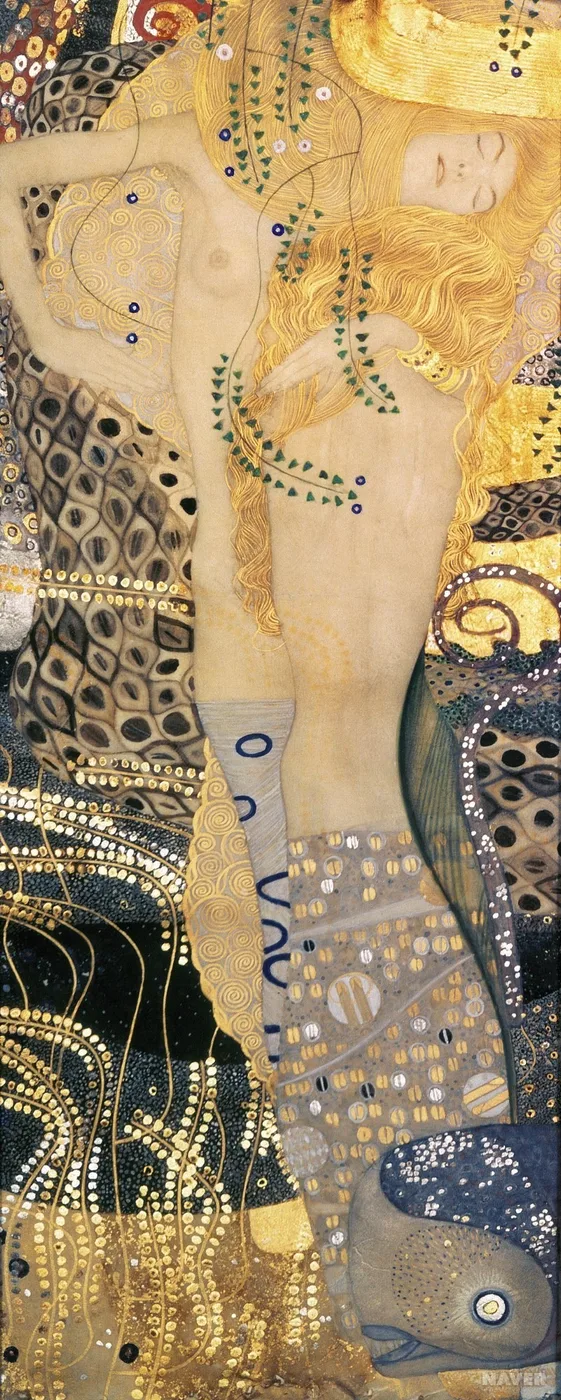
Girlfriends (Water Serpents I) is a tall, narrow painting Gustav Klimt painted in 1904 and reworked before 1907, showing two women’s bodies merged in gold and water. Klimt was in his early forties and working in Vienna, where he had spent most of his career building his reputation as a painter.
Klimt (1862-1918) trained at Vienna’s School of Arts and Crafts and spent his twenties and thirties on ceiling paintings and official portraits, work that brought him early honours inside the same academic system he would later challenge. By the time he painted this picture, he had already led a group of painters out of the Künstlerhaus, Vienna’s established artists’ association, to found the Vienna Secession, arguing that Austrian art needed room for subjects and surfaces the Künstlerhaus did not allow.
His paintings from these years turned away from the illusion of depth that academic training demanded. Faces and hands stayed closely observed, built up with the same patient modelling he had learned as a young painter, while everything around them flattened into pattern: gold leaf, laid the way a goldsmith works metal, spread across backgrounds that gave no sense of a floor, a horizon or a room.
The picture belongs to this stretch of his career, when he worked on a run of paintings built around water and the female nude, among them Goldfish, another canvas of bodies drifting through a pond of gold and green. The subject of Girlfriends (Water Serpents I) draws on the nixies, mermaids and water spirits common in Central European painting of the time, reworked through Klimt’s own vocabulary of flat gold ground and curving line.
The title, Girlfriends, sits alongside the subtitle Water Serpents I and holds two readings in one picture: an intimate bond between two women, or a pair of water-born creatures with no stated myth behind them. Klimt never explained which reading he intended, and leaves both open.
A field this narrow pushes a composition to run from top to bottom, and Klimt answers that pressure by letting hair, limbs and pattern cascade down its length.
Josef Hoffmann, Koloman Moser and Fritz Waerndorfer founded the Wiener Werkstätte around the same idea of decorative unity; Klimt was not among its founders, though he was a fellow Vienna Secession member alongside Hoffmann and Moser. Girlfriends (Water Serpents I) is a private, inward example of that programme, built with the same gold ground and pattern he used at a far larger scale on public and ceremonial commissions.
Two Bodies, One Column of Hair, Pattern and Gold
The canvas is built as a single vertical column with almost no empty ground to rest the eye. Two women’s bodies occupy nearly the full height, their forms locked together so closely that the second figure reads less as a separate body than as an arm, a shoulder and a hand folded around the first.
Eyes closed, the nearer woman faces away and down, her head tipped so her blond hair falls in thick, rope-like strands past her shoulder and down the full length of the canvas. Klimt paints that hair as a continuous ribbon of yellow and ochre, each strand a separate curving line laid over the last, so it reads as hundreds of fine threads overlapping.
Her torso, turned in three-quarter profile, carries the only passage of careful flesh modelling in the picture: soft shading under the breast, a faint blush along the ribs, fingers drawn with individual knuckles as her hand crosses her body to hold a sprig of small, dark green leaves and berries. Behind her, a second hand, paler and more loosely painted, rests against her hip, the only visible sign of the second woman the title promises.
Below the waist the body stops reading as anatomy and dissolves into the same decorative surface as the background: grey scale-like patches, dense rows of small gold circles, and a narrow panel of grey ovals dotted with dark blue, as if skin, fabric and water had been given the same kind of mark.
Behind the figures, the ground splits roughly in two. Its left side is packed with irregular, mottled patches in grey, cream and black, like scales or worn stone, set with horizontal rows of small gold dots, while its right side and lower edge turn to loose gold spirals and scattered flecks of white and gold over near-black ground, with thin gold lines trailing down like currents or weed.
A single fish appears at the lower right corner, bronze and gold scaled, with one large round eye, swimming in from the edge of the frame and cut off by it. Nothing else states the setting as directly: the bodies float free of any shore or floor, and the sense of water comes mainly from the fish, the drifting gold lines and the loose, current-like spirals around them.
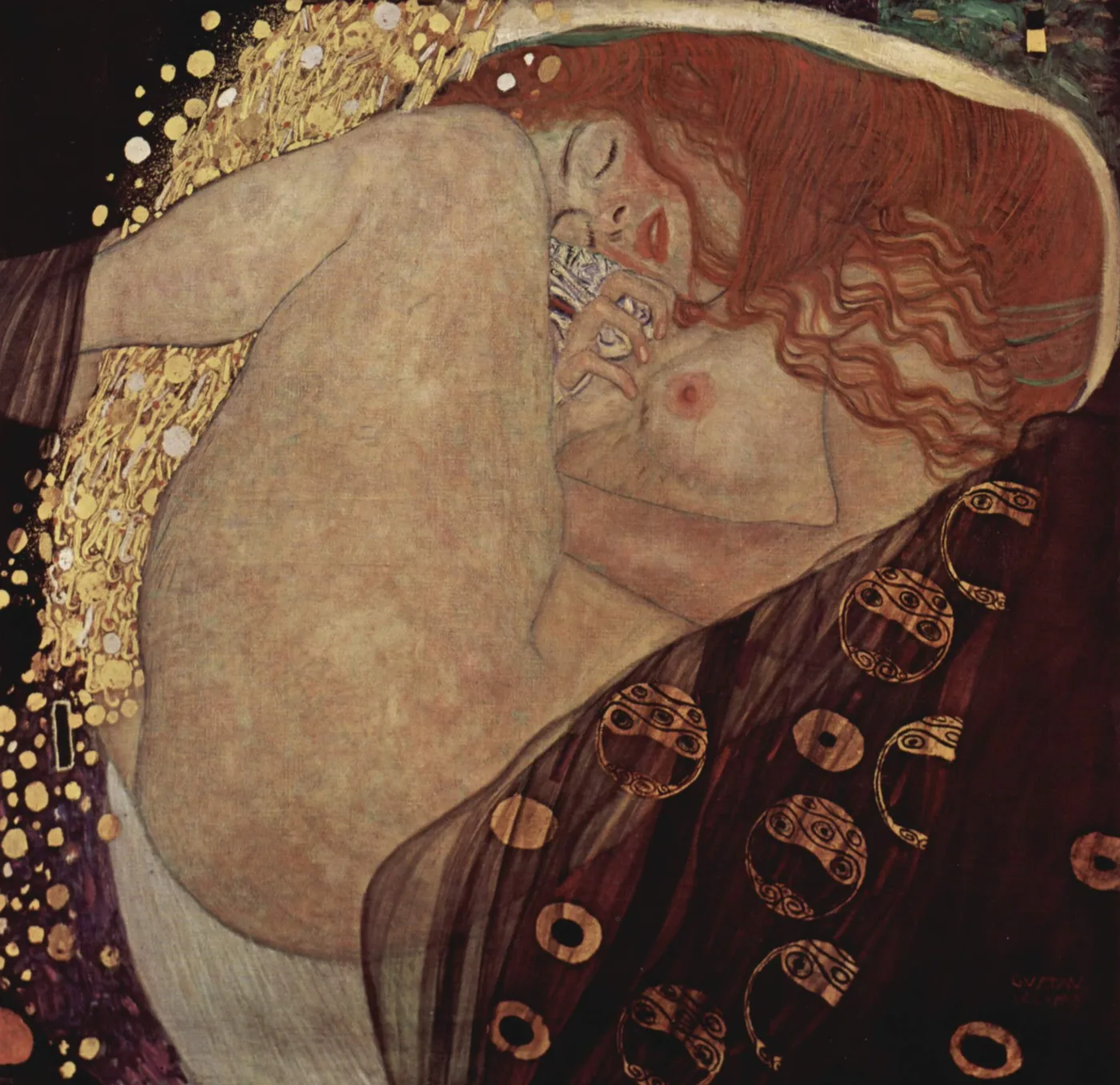
Klimt uses no single light source in the ordinary sense. Gold itself, laid as flat leaf and built up in paint to catch real light off the canvas, supplies the picture’s brightness, concentrated around the hair and the patterned gold passages and withheld from the darker, scaled ground on the left. He returns to this same pairing of flat gold leaf and closely modelled flesh in Danaë, another small, private nude from the same body of work.
Girlfriends or Water Serpents: Two Readings in One Embrace
The painting can be read two ways at once, and nothing in the image forces a choice between them. Read as Girlfriends, it shows a close, physical bond between two women, one holding the other, both faces turned inward and away from any outside viewer.
Read as Water Serpents, the same embrace turns into something less human. The lower bodies that dissolve into pattern, the fish at the corner and the water-coloured ground all support a reading of the two figures as creatures of water, in the company of the nixies and sirens that recur across Central European painting of the period.
Klimt returned to the female body often in these years, usually without a fixed myth to explain the picture, and keeps that same openness here. The embrace can be taken as affection between two women, as something more charged, or as two halves of one watery creature; Klimt paints both bodies and setting, and leaves the choice to the viewer.
Along with the fish near the lower corner, the sprig of small, dark leaves held against her body is one of the few objects in the painting that is neither hair, flesh, gold nor pattern. Held close against the body at the point where the two figures meet, it invites a reading as a token of intimacy, though Klimt does not spell one out.
The closeness of two bodies folded into one shape recurs across Klimt’s work, most directly in The Kiss (Lovers), where the embrace is stated outright. Here it stays folded inside gold, pattern and water, read as closeness between two women or as something closer to myth; Klimt makes no final claim.
Seeing the Original at the Belvedere, in Vienna
Girlfriends (Water Serpents I) hangs in the Belvedere, in Vienna, a museum that holds one of the largest groups of Klimt’s paintings anywhere, spanning his full career from early academic commissions to late landscapes, with several other works from the same gold-ground period on view nearby.
At 50 by 20 centimetres, the canvas is small and markedly narrow, closer in scale to a tall, slim panel than to a conventional painting. Standing in front of the original puts a viewer close to the surface, near enough to see individual strands of hair and the texture where gold leaf sits proud of the painted ground.
A visit there also sets this small, private canvas next to the far larger paintings the museum holds from the same part of Klimt’s career, including public and ceremonial works built from the same gold ground and pattern, so the shift in scale is visible within the same rooms.
Choosing a Size and a Frame for This Narrow Composition
Every reproduction of Girlfriends (Water Serpents I), hand-painted oil or archival print, starts from the same museum photograph of the original painting. Choosing between the two editions is a question of method: a canvas built up by hand in oil, or a high-resolution print of that same image.
The hand-painted oil is painted from scratch by an artist, in oil on canvas, using the museum photograph as reference, building the gold hair, the patterned ground and the modelled flesh in paint. Because it is made by hand, the surface carries real brushwork, and no two canvases come out quite the same.
The archival print is a high-resolution giclee of the same image, printed on canvas with pigment inks, which gives a closer match from one order to the next and suits a tighter budget or a set of pieces that need to match each other.
Because the original is so narrow, a reproduction of this painting suits a tall, slim stretch of wall more than a wide one: beside a doorway, in a stairwell, or between two windows, where a wider canvas would not fit. The product page lists the sizes on offer, each one keeping the original’s narrow proportions. A plain, narrow frame in black or dark wood keeps the attention on the gold and suits the picture’s close, private subject.
Painting the oil by hand takes 2 to 4 weeks. Delivery then takes 5 to 7 business days.
Before a hand-painted order ships, the studio photographs the finished canvas so you can check the colour and the brushwork before it leaves. The Girlfriends (Water Serpents I) page shows both editions and their sizes side by side, so you can compare the hand-painted version against the print before choosing.
Questions Buyers Ask About This Painting
What does Girlfriends (Water Serpents I) show?
Two women’s bodies, closely entwined, afloat in a gold and dark patterned ground with no shore, floor or horizon in sight. A sprig of small leaves sits held against the nearer figure, and a single fish swims in at the lower corner.
Where is the original painting kept?
The Belvedere, in Vienna, holds Girlfriends (Water Serpents I).
What size suits a narrow wall best?
The product page lists sizes that all keep the original’s tall, narrow proportions, which makes this painting suit a stairwell, a hallway or the wall beside a doorway.
What is the difference between the hand-painted oil and the print?
The oil is painted by hand on canvas from the museum photograph, with real brushwork and natural variation between canvases. The print is a high-resolution giclee of the same image, which gives a closer match from one order to the next.
Can I see the painting before it ships?
Yes, for the hand-painted oil. The studio photographs the finished canvas before it leaves, so you can check the colour and the brushwork first.
More from this collection
Bring this painting home
Choose a hand-painted oil reproduction for real brushwork, or an archival canvas print for a crisp museum-image edition. Every size preserves the original proportions.
View this work & options
Further reading
Verify the original in the Belvedere collection record and continue through related works in the catalogue.