
Death and Life: A Skeleton Faces a Crowd of the Living
Painted in 1910-1911, After a Decade of Gilded Portraits
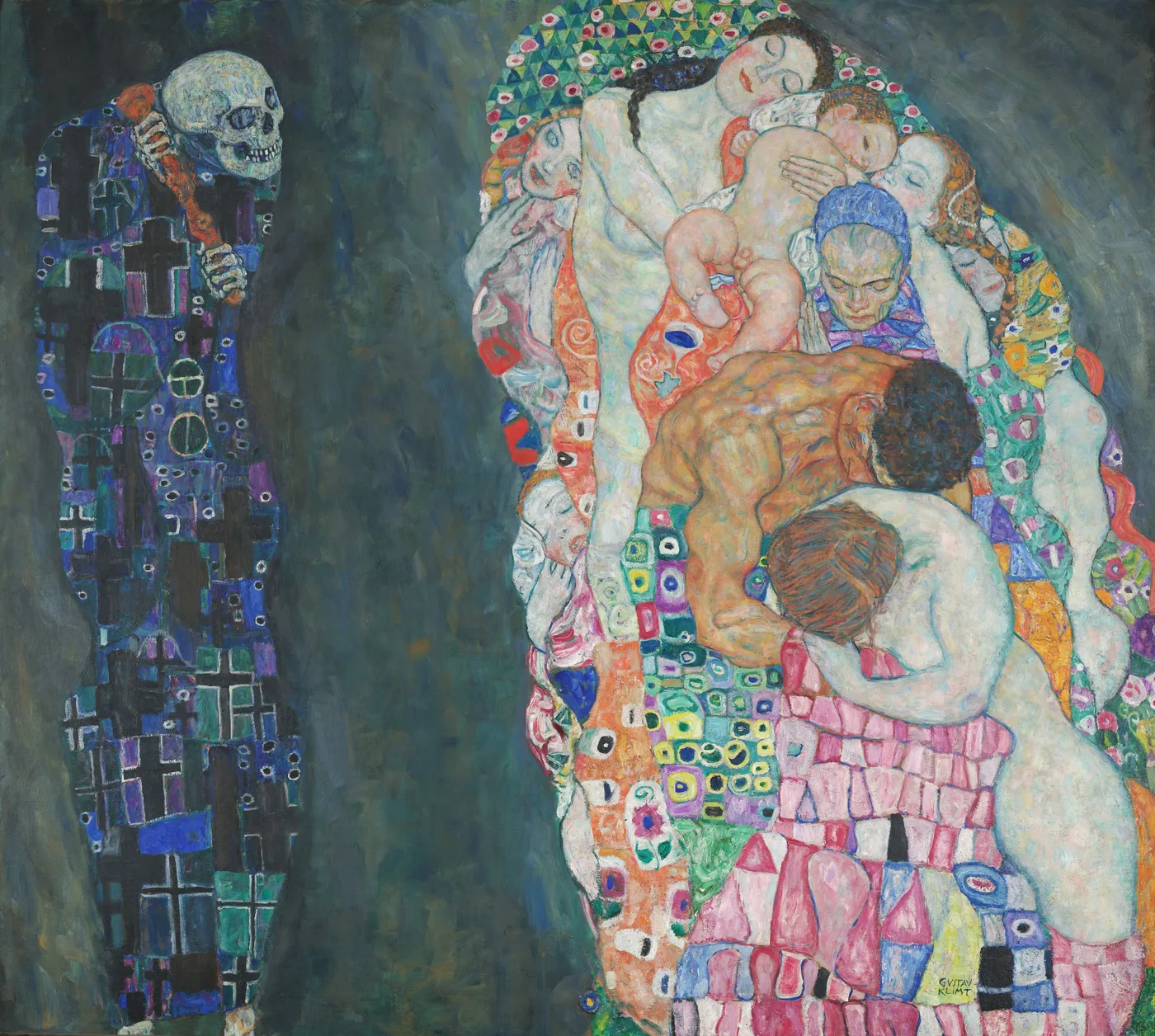
Death and Life is a near-square canvas that Gustav Klimt painted in 1910-1911 and reworked in 1915, now held at the Leopold Museum, measuring 180.8 × 200.6 cm. It sets a skeletal figure of Death against a tall, crowded mass of the living, and the narrow gap between the two halves carries most of the picture’s weight.
Klimt was born in 1862 in Baumgarten, near Vienna, the son of a gold and silver engraver. That trade gave him the skill with gold leaf and fine line that marks his best-known portraits, which makes this canvas an odd case: it carries almost no gold at all.
By the time he started this painting, Klimt had already built his name on gilded portraits of Viennese women, work that made his name as a portraitist of Viennese society. He was moving away from gold grounds toward flat fields of colour and pattern, a shift this canvas carries through in the chequered robe of Death and the floral drapery wrapped around the Life group.
Mortality was not new ground for him. He had earlier painted large allegorical ceiling pictures for the University of Vienna, including one on medicine that set birth, sickness and death inside a single composition, and the public reaction to those paintings was hostile enough that he turned away from further state commissions.
Years before this canvas, he had already set a pregnant woman against hovering figures of illness and death in Hope I. Death and Life returns to a version of the same opposition, built at a far larger scale and with a crowd standing in for the single figure.
Vienna’s own art scene fed that interest: Klimt had co-founded the Secession, the group of painters who broke from the conservative academy to show allegorical and symbolist work, and across that circle, subjects of love, life and death came up often. Outside portrait commissions, much of his output in this decade was landscape, square canvases of gardens and orchards painted during summers at the Attersee.
He died in 1918, in Vienna, after a stroke. Death and Life belongs to the final decade of his working life, one of the few times after the university paintings that he returned to an allegorical subject on this scale.
A Skeleton in Cold Blue, a Crowd in Warm Pattern
The canvas divides into two unequal fields. Death occupies roughly the left third, standing against a flat, dark grey-green ground that fills the rest of the background behind both groups. Life fills the remaining width, a tall rounded mass of overlapping bodies that rises almost to the top edge of the canvas. Between the two, a narrow strip of that same bare ground runs up to the top.
Death is a skeleton wrapped in a dark robe painted with a field of crosses and circles in blue, violet and black over a chequered ground. Its skull is pale cream, the eye sockets and the gaps between the teeth filled in flat black, and an arm is raised, gripping a reddish-orange club above its head.
The Life group reads from the top down. A woman with dark auburn hair tilts her head back, eyes closed, holding an infant against her chest. Around her, more faces press into the crowd: a pale young woman with lowered eyes to her left, an older woman in a blue cap with grey hair and open eyes further along, and, at the right edge, a young woman with loose hair painted in strands of yellow and gold.
Lower in the group, a man with dark curly hair and bare, tanned shoulders bends forward, his head resting against a second figure whose face turns away, hidden in reddish-brown hair. The pose reads as sleep, or grief; no single incident is shown. Below them, the composition closes into a wide field of pink and red cloth laid out like patchwork, broken into small geometric shapes, with the signature GUSTAV KLIMT worked into the pattern at the lower right.
Colour runs cold on one side, warm on the other. Death’s robe stays blue, violet-black and grey against the same dark green ground behind it. Life runs warm: orange swirls, a pink and red chequerboard, a green ground dotted with small red flowers, a strip of yellow patterned in blue, closing in around the paler flesh tones of the faces and arms at the centre.
Klimt paints the faces and hands with soft, graded shading that models the skin in the round, while the fabric around them stays flat, each shape outlined in black and filled as a single block of colour, close to a mosaic. No single light source is visible anywhere on the canvas. The flesh in the Life group reads as lit from within its own pale colour, while Death’s skull and robe sit in the same even grey light, without that warmth.
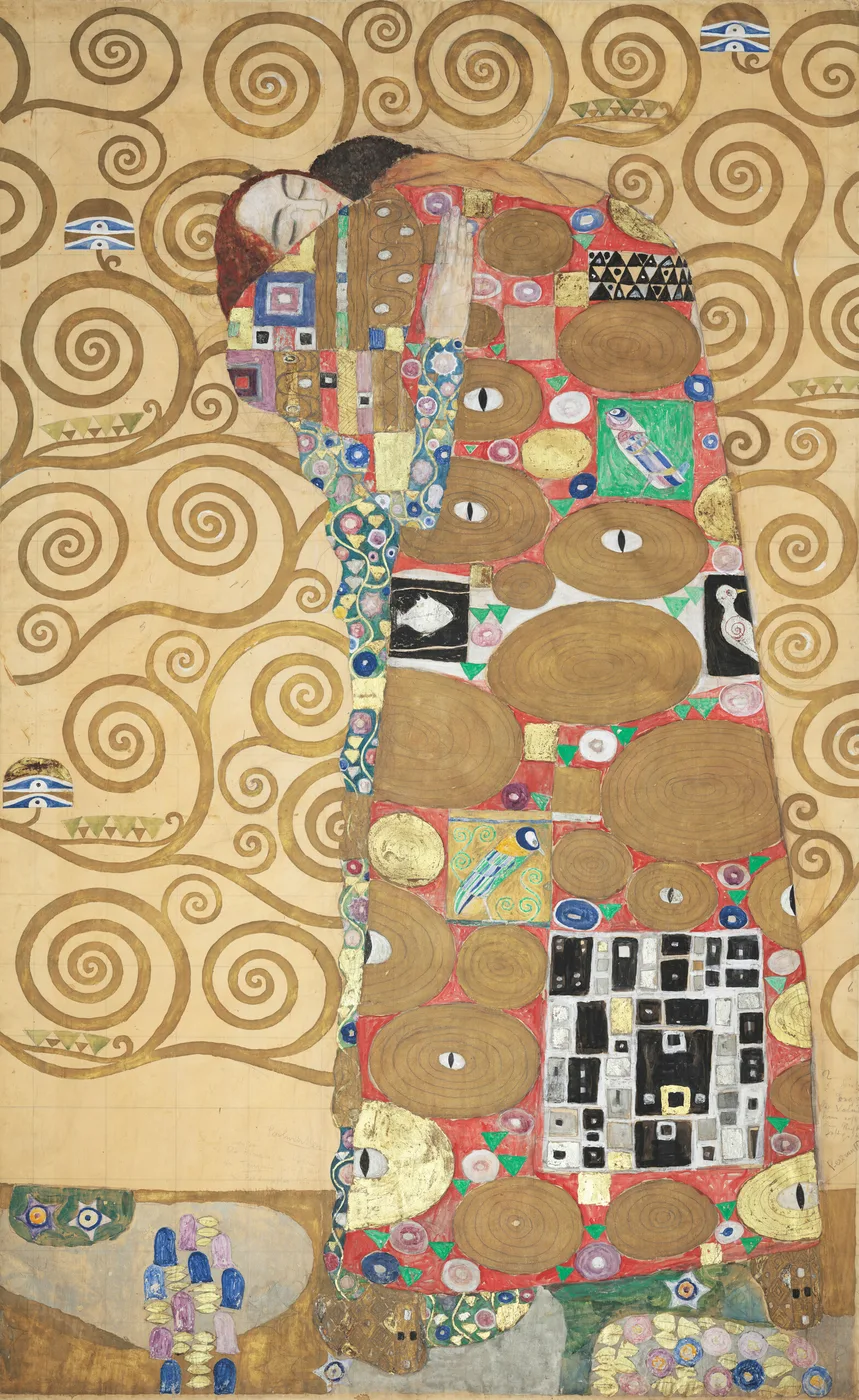
This mix, a softly modelled face set inside a hard-edged decorative field, runs through other work from the same years, including the mosaic-like panels of the Stoclet Frieze: Tree of Life. Here the same method appears again, turned on a starker subject: a flat, ornamental crowd pressed against one bare, modelled skeleton.
What the Gap Between Death and the Crowd Might Mean
Read as an allegory, the picture sets two forces face to face without letting them touch yet. Death stands near the edge of the canvas, club raised but not swung, while Life carries on inside its own crowded space, eyes closed or turned away, unaware of the figure watching it.
Every age appears inside the Life group at once: an infant at the centre, young faces pressed in around it, a bent adult man, an older woman with grey hair at the side. Read this way, the group is not one family but a whole span of life, folded into a single mass of bodies and cloth.
A bare strip of ground separates the two halves, and it can be read as the distance still left between them. Klimt paints Death’s arm raised, the club not yet brought down.
The painting also reads through its own contrast of surface: a cold, close-patterned robe set against a crowd dense with warmer colour and ornament. On that reading, the canvas balances temperature and density across the two halves, cold against warm, bare against crowded.
Hope II (Vision) is the other late painting where Klimt sets a pregnant figure over bowed, lowered heads inside a similarly dense and patterned field. Neither canvas carries a surviving note from Klimt that explains the subject beyond what is visible on it.
Seeing the Original at the Leopold Museum
The original hangs in the Leopold Museum, measuring 180.8 × 200.6 cm. At that scale, the figures inside the Life group sit close to life-size.
Seen in the room, the canvas rewards a short viewing distance, since the pattern only separates into its individual shapes once you are close enough to see them one at a time. From further back in the gallery, the two halves read first as two blocks of colour and temperature, cold grey-blue against dense warm pattern.
A reproduction cannot put you in that room, but it can keep the same proportions and the same reading distance at a smaller scale. The product page for Death and Life lists the sizes available, each one keeping the original’s near-square format.
Choosing a Hand-Painted Oil or Print of This Canvas
Two editions are available for this painting, a hand-painted oil reproduction and an archival canvas print, both made from the same museum photograph of the original. The oil is painted by hand on canvas; the print reproduces that same image on canvas with pigment inks.
The hand-painted oil is built up in oil on canvas, large colour fields first, then pattern, then the faces and hands last. That order suits this picture, since the patterned drapery around the Life group and the patterned robe of Death both depend on a steady, repeated hand, while the faces need the softer modelling described above. Painting the oil by hand takes 2 to 4 weeks.
An archival canvas print uses the same source image, printed on canvas with pigment inks, and gives a closer match from one print to the next if you want more than one piece to match. Printing takes 2 to 4 business days.
Because the painting is close to square, every size keeps that near-square shape. None of the sizes crop the composition into a standard rectangle. The format works best with some wall space left around it on each side, since the picture needs room for the eye to move from the narrow, cold Death panel to the wide, warm Life mass. A dark frame close to the tone of Death’s robe keeps that contrast sharp; a plain pale frame lets the orange and pink of the drapery carry the wall instead. Frame and stretcher options, along with the full range of sizes, sit on the Death and Life page.
Before a hand-painted piece ships, the studio photographs the finished canvas so you can check the colour and the pattern against the original before it leaves. Delivery then takes 5 to 7 business days. If you are weighing the oil against the print for this particular painting, the hand-painted version keeps real brushwork across both the smooth faces and the patterned fabric, visible up close on the Death and Life page.
Quick Answers on This Painting and Its Reproductions
What does Death and Life show, exactly?
A skeletal figure of Death, robed and marked with crosses, stands at the left edge of the canvas, club raised, facing a tall, crowded mass of sleeping and embracing figures of every age on the right.
Where can I see the original?
The original hangs in the Leopold Museum, where the near-life-size figures and dense pattern reward standing close to the canvas.
What is the difference between the hand-painted oil and the print?
The oil is painted by hand in oil on canvas from the museum photograph; the print is a giclee print of the same image on canvas. Both keep the original’s near-square proportions at every size.
How long does a hand-painted order take?
Painting the oil by hand takes 2 to 4 weeks. Delivery then takes 5 to 7 business days.
Does the print need a particular frame?
Not one in particular. A dark frame close to the tone of Death’s robe keeps the cold-and-warm contrast sharp, and a plain pale frame lets the orange and pink drapery lead instead.
More from this collection
Bring this painting home
Choose a hand-painted oil reproduction for real brushwork, or an archival canvas print for a crisp museum-image edition. Every size preserves the original proportions.
View this work & options
Further reading
Verify the original in the Leopold Museum collection record and continue through related works in the catalogue.