
Stoclet Frieze: Tree of Life, drawn as the plan for a Brussels dining room
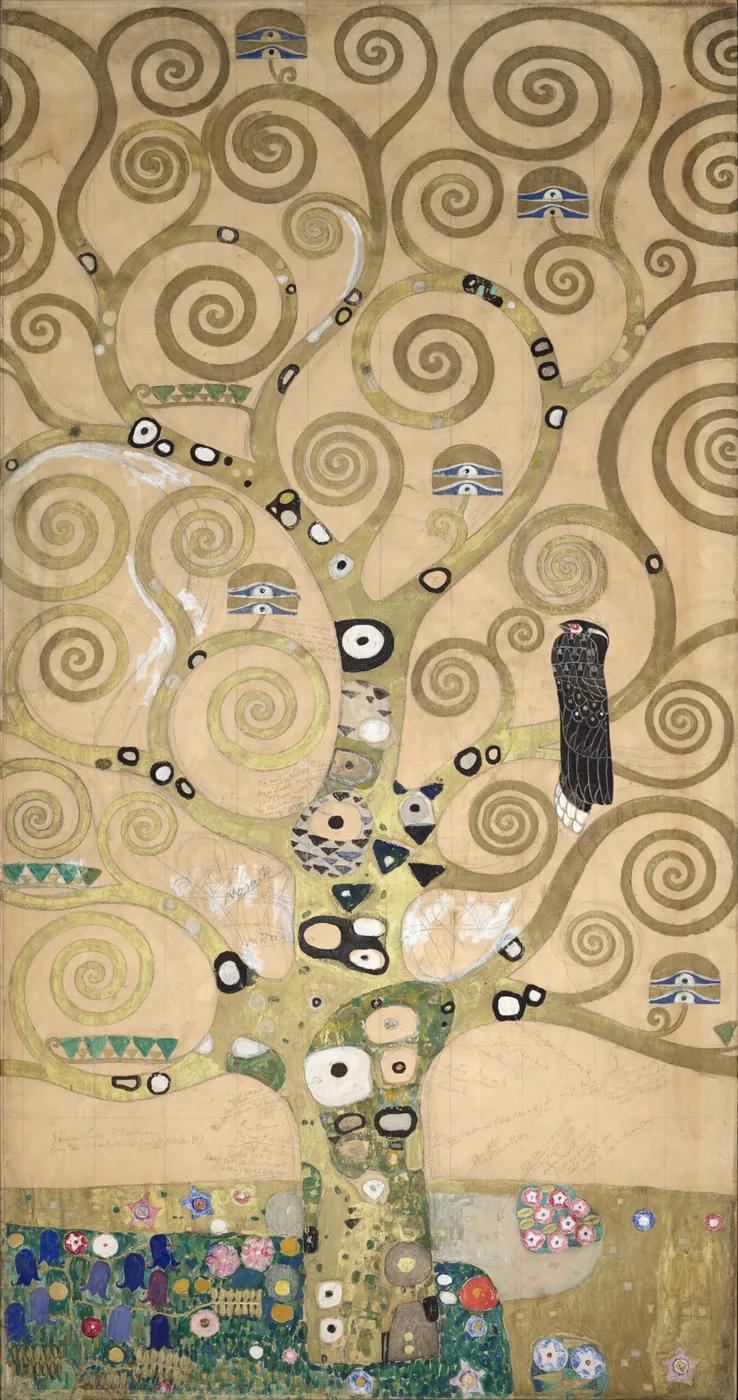
A design drawn for one dining room, 1910 and 1911
Klimt drew Stoclet Frieze: Tree of Life in 1910 and 1911 as part of a larger scheme made for a single room, a design now held at the MAK, Museum of Applied Arts, and measuring 195.3 × 102.2 cm.
Klimt was born in 1862 and worked until he died in 1918. By the time he took on the Stoclet commission he had already built his reputation on gold-ground portraits of Viennese women and on the group exhibitions of the Vienna Secession, the circle of painters, architects and designers who argued that a building and everything inside it should form one connected scheme, with painting, furniture and wall decoration designed together.
The scheme in question was the dining room of the Stoclet House in Brussels, a residence the architect Josef Hoffmann built for the Belgian banker and art collector Adolphe Stoclet. Hoffmann asked Klimt to design the room’s long walls instead of supplying a painting to hang on them, so the frieze had to answer to the proportions of the room and the furniture standing against it, as well as to its own composition.
Hoffmann set craftsmen of the Wiener Werkstätte, the design workshop he had helped found, to carry the frieze out in mosaic, using marble, enamel, gold and silver leaf, coral and semi-precious stone set directly into the wall. Klimt supplied the working plan those craftsmen needed on paper first, a full-scale guide they could follow section by section as the mosaic went up.
Tree of Life is one of those working sheets. Klimt drew it as a working sheet, not as an oil painting, which is why this shop lists it among Drawings and not among his oil paintings: the mosaic it guided was carried out in stone and metal, never in paint.
Further panels from the same scheme showed standing figures facing one another across the dining room, with the tree filling the space between them. Klimt gave the tree the widest field of the panels, letting its branches run from one end of the room toward the other and link the two figures across the space where guests would sit to eat.
Klimt also painted The Kiss (Lovers) in the same gold-ground manner. The Stoclet design carried that same manner off the canvas and onto a wall a dinner guest would sit beside for the length of a meal, not pass once on a gallery wall.
Spirals, eyes and a black bird across a cream ground
The sheet is tall and narrow, close to twice as high as it is wide, and the design fills it almost to the edges. Trunk and branches reach from the bottom edge to the top on both sides, with no border left empty.
A single trunk rises from the centre of the lower edge and splits into two main branches that climb either side of the sheet. Each branch curls outward and loops back on itself, coiling into circles of different sizes that repeat up the full height of the panel, larger near the top and smaller lower down, close to the trunk, so the tree reads as a pattern built from repeating spirals, more diagram than growing plant.
The ground is a pale cream colour. Against it, the branches sit in a flat olive gold, outlined instead of shaded, so each coil reads first as a line and only second as a shape. No light falls from one side the way it would in a landscape; the whole field stays even.
Small motifs sit along the branches like fruit or buds. Some take the form of almond-shaped eyes in blue and white, each centred on a dark lozenge. Others are black ovals ringed in white, a few holding a scatter of turquoise triangles or a single coloured dot.
A black bird stands in profile on a branch to the right of centre, framed by two of the larger spirals. Its eye is a small spot of red, its wings solid black, and a row of white feathers marks its breast.
A horizontal band near the bottom separates the coiling branches from a planted strip of ground. Blue flowers sit among magenta blooms in a dark bed on the left side of the trunk. Pink flowers and pale grey rounded forms sit in a gold ground on the right side. At the foot of the trunk itself, pale ovals in white, blue, pink and green cluster together like a handful of stones set into the soil. Klimt returned to a planted bed close to the ground in several of his garden paintings, among them Cottage Garden with Sunflowers.
Faint pencil lines show through the cream background in places, loose and cursive.
A tree read as one continuous cycle, root to flower bed
The subject is a tree whose branches never stop curling, filling the sheet without reaching toward any particular sky. Read in the simplest terms, it is a tree of life: one growing form holding within it the eyes, the buds and the bird that would usually sit around a tree instead of inside it.
Klimt set this trunk between panels of standing figures, which invites a reading of the whole wall as a passage from one state of life to another, the tree acting as the link that carries the eye from one figure to the other. He painted a single tree as a subject elsewhere too, in Apple Tree II (Green Apple Tree), where the branches stay low, against a green ground.
The black bird perched among the coils can read as a messenger moving between the roots and the furthest branch. The design never names the bird, so this is only a suggestion.
The planted band at the foot of the trunk ties the tree to a garden, not to a wild landscape, and it can be seen as the ground from which the more ornamental upper branches grow. Seen this way, the eye moves from soil and flower at the bottom of the sheet to pure pattern at the top as it climbs past spiral after spiral.
Klimt left no written explanation of what the tree meant for the Stoclet house, so every reading above stays a suggestion.
At the MAK, among Vienna’s collection of design and craft
The original Tree of Life drawing is held by the MAK, Museum of Applied Arts, which keeps it among its collection of Viennese design and craft, alongside other work connected to the Wiener Werkstätte and the architecture of the same period.
At 195.3 × 102.2 cm, the sheet needs distance to take in the full run of coiled branches from the trunk to the topmost spirals, while the small eye motifs and the black bird ask for a closer look.
Seeing the sheet in the museum also means seeing its olive-gold tone and white highlights at full scale, close enough to follow each coiled branch by eye. A photograph of the drawing, including the one used for the reproductions sold here, holds the composition and the colours steady but cannot reproduce that scale.
Sizing the Tree of Life for a tall, narrow wall
Every reproduction of Tree of Life sold here starts from the museum image of the original drawing, the same image behind both editions shown on the Stoclet Frieze: Tree of Life page. Choosing between them is a question of method and feel.
A hand-painted oil reproduction is built up stroke by stroke by an artist working from that image, in oil on canvas, with nothing printed underneath it. That suits a design built from flat colour and fine line, since brushwork keeps the small eye motifs and the bird distinct from the broad gold coils as light crosses the canvas, and no painted copies come out quite the same. Painting the oil by hand takes 2 to 4 weeks.
An archival canvas print is a high-resolution giclee print of the same image, printed on canvas with pigment inks, giving a steady, repeatable result across copies. It suits a tighter budget or a pair of pieces that need to match closely. Printing takes 2 to 4 business days.
Every size on the product page keeps the tall, narrow proportions of the original, so the trunk is never cropped to fit a squarer frame and the spirals are never stretched wider to fill one. The format suits a hallway, a stairway wall, or a narrow space beside a window, where the coiling branches can run the full height of the wall; the available sizes are listed on the Stoclet Frieze: Tree of Life page. A slim gold or dark frame suits the olive-gold line work better than a wide ornate moulding would.
Before a hand-painted piece leaves the studio, it is photographed so you can check the colour and the detail against the design and approve it before it ships. Delivery then takes 5 to 7 business days. Stretcher and framing options for this piece are set out on the Stoclet Frieze: Tree of Life page alongside the sizes.
Questions readers ask about this Tree of Life
What does the Tree of Life design actually show?
A trunk that splits into spiralling, coiling branches across almost the whole sheet, with small eye and bud motifs along them, a black bird perched to the right of centre, and a bed of flowers at the foot of the trunk.
Is this a painting or a drawing?
It is a drawing, made as the working plan for a mosaic wall rather than as an oil painting.
Where can I see the original today?
The original is held by the MAK, Museum of Applied Arts, among its collection of Viennese design and craft.
What is the difference between the hand-painted oil and the print?
The oil is painted by hand on canvas with real brushwork and some natural variation between copies, while the archival print is a consistent giclee print on canvas from the same image, a practical, budget-friendly option.
Which size and frame suit this design?
Tall, narrow spaces such as a hallway or a stairway wall suit it best, since every size keeps the original’s upright proportions, and a slim gold or dark frame suits the olive-gold line work.
More from this collection
Bring this painting home
Choose a hand-painted oil reproduction for real brushwork, or an archival canvas print for a crisp museum-image edition. Every size preserves the original proportions.
View this work & options
Further reading
Verify the original in the MAK – Museum of Applied Arts collection record and continue through related works in the catalogue.