
Portrait of Adele Bloch-Bauer II: A Standing Portrait Wrapped in Fur and Pattern
Why Klimt Painted Adele Bloch-Bauer a Second Time
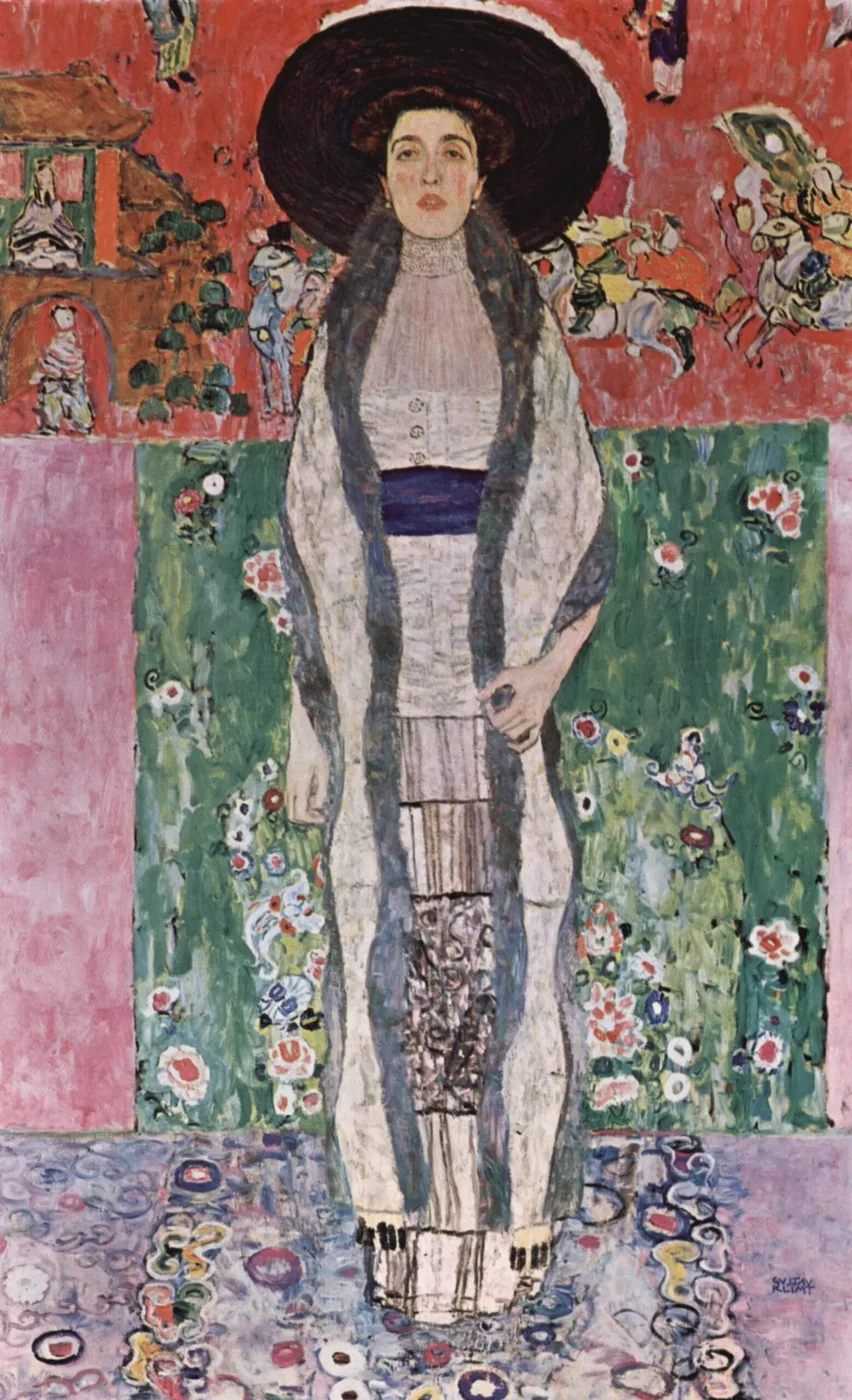
Portrait of Adele Bloch-Bauer II is a tall standing portrait Gustav Klimt painted in 1912, measuring 190 × 120 cm. It is the second picture he made of this sitter, the only woman he painted twice in his portrait work. The pictures, made some years apart, show how far his approach to portraiture had moved in that time.
By 1912 Klimt had spent more than two decades as one of Vienna’s most sought-after portraitists, with a client list drawn from the city’s industrial and banking families. He had helped found the city’s Secession movement earlier in his career and later led an independent group of painters who shared his interest in ornament, colour and decorative pattern. The Secession’s own exhibition hall carried the motto that each age deserves its own art, and that idea ran through this generation of Viennese painters.
Adele Bloch-Bauer, wife of the industrialist Ferdinand Bloch-Bauer, belonged to that circle of patrons who commissioned Klimt through these years. She had sat for him once before, in the picture now known as Portrait of Adele Bloch-Bauer I, a work built almost entirely from gold leaf and fine ornament, with the sitter shown seated against a dense, flattened field of pattern.
This second portrait sets that gold ground aside. Klimt collected East Asian screens, prints and textiles through these years, and the small painted scenes and flat colour fields set behind Adele Bloch-Bauer here carry something of that interest, closer to a decorative wall hanging than a believable room.
The same years gave Klimt his dense flower-field paintings, canvases filled edge to edge with small blossoms and no horizon, among them Flowering Poppies. The green, flower-scattered panel behind the sitter in this portrait grows from that same habit of covering a surface with small repeated marks.
Like his other portraits from this decade, the picture was a private commission rather than a work made for public exhibition.
Klimt was born in 1862 and continued painting portraits of Vienna’s wealthy women for the rest of the decade. He died in 1918, six years after finishing this canvas.
How This Tall Canvas Is Built, Band by Band
The canvas stands far taller than it is wide, and Klimt centres the standing figure of Adele Bloch-Bauer inside that narrow shape. She fills nearly the whole height of the picture, from the brim of her hat close to the top edge to her feet a short distance above the bottom edge, with almost no space to either side of her. The palette moves from warm coral red at the top to cool green and lavender further down, with her pale dress the one light note running through all three zones.
Above her head a band of deep coral red runs the full width of the canvas. Small painted scenes sit inside it: a gold-roofed pavilion with seated figures at the left, and riders on horseback picked out in orange and gold at the right, painted in the flat, miniature style of a decorative screen, gold outlining the horses and the pavilion roof.
Below that band the background splits into two fields. On the left it turns to a flat plane of pale pink. On the right a dense field of deep green carries blossoms in white, red and pink, laid down as separate dabs of paint.
At her feet the floor becomes a mottled ground of lavender and grey, flecked with small patches of colour, reading as a patterned carpet underfoot.
Her hat is wide-brimmed and almost black, tilted back from her face and set against the red band behind her. Her hair is dark auburn, drawn back under the brim, and her face is pale, with deep red lips and a direct, level gaze meeting the viewer.
A long, blue-grey fur stole with white highlights hangs from her shoulders in two strips reaching close to her ankles, worn over a high-necked ivory dress buttoned down the front and gathered at the waist by a dark navy sash. Fine grey stripes mark the upper part of the skirt, giving way lower down to a mottled, dotted texture. One hand rests visible at her side, a ring on one finger, while the other stays hidden beneath the fur. Her feet, in pale stockings and dark shoes, show just beneath the hem.
Klimt keeps the face and hands smoothly modelled, with soft shifts of tone across the skin. Everywhere else the paint breaks into flat fields and small repeated marks: tight, controlled strokes down the dress, loose overlapping strokes through the fur, dabbed touches of pigment in the flowers.
What the Picture Suggests About Its Sitter
The bands behind her are a patterned screen, or a length of fabric hung behind a sitter in a studio. There is no sense of a real room, a window or a piece of furniture, only pattern arranged in horizontal zones around the figure. The pink field to one side and the green, flower-scattered field to the other form two halves of one decorative backdrop.
Her costume is fashion of the day. The wide hat, the fur stole and the narrow waist belong to the wardrobe of a wealthy Viennese woman dressed to be seen in public.
The small scenes in the upper band, the pavilion and the riders, nod to the Asian art Klimt collected and admired, set behind his sitter the way a collector might hang a favourite screen on the wall behind a chair.
Against all that pattern, her face stays the calmest part of the painting. The directness of her gaze, set against so much colour and ornament, makes this a portrait of a specific woman holding her own amid the decoration built around her. The ring on her visible hand is a small, quiet marker of status next to the weight of pattern around her.
Where This Portrait Sits Among Klimt’s Other Women
This is the only canvas in which Klimt returned to a sitter he had already painted. The earlier work, Portrait of Adele Bloch-Bauer I, shows the same woman seated against a dense ground of gold leaf and spiralling ornament, a different surface from the colour and pattern built up here.
The green, flower-scattered field behind her belongs to the same strand of Klimt’s garden paintings as Flowering Poppies, where small blossoms cover the canvas with no horizon or sky to anchor them.
The tall, standing format also carries into his later portraits of young women from the same circle of patrons, including the full-length Portrait of Mäda Primavesi, where the figure again fills most of the canvas against a backdrop built from flat pattern.
Choosing a Reproduction of This Standing Portrait
Both editions sold for this portrait, the hand-painted oil and the archival print, start from a photograph of the painting. The choice between them is a matter of method and finish; both show the same image. You can see both editions and every available size on the Portrait of Adele Bloch-Bauer II page.
The hand-painted oil is built by an artist working in oil on canvas, laying in the coral band and the floral field first, then the finer passages of the face and hands. The fur and the dress keep real brushwork, so the surface changes a little as you move past the canvas, which suits the contrast between the smooth face and the patterned background in this picture. Painting the oil by hand takes 2 to 4 weeks.
The archival print is a high-resolution giclee print of the same image, printed with pigment inks on canvas, consistent in colour and detail from one print to the next. It suits a dependable result or several pieces that need to match. A side-by-side guide, Hand-Painted Klimt Reproduction or Canvas Print?, sets out these differences in more detail if you want to compare further before choosing.
Every size keeps the same tall proportions as the original canvas, so a smaller version stays as narrow and upright as the full-size one. That shape suits a hallway, a stairwell or the wall beside a tall doorway, spaces that are already tall and narrow. The available sizes are listed on the Portrait of Adele Bloch-Bauer II page.
A hand-painted order is photographed on completion so you can check the colour and the brushwork before it leaves the studio. For framing, a slim black or dark frame echoes the hat, while a plain pale frame sets off the pink and green fields without adding another colour, and both frame options sit alongside the sizes on the Portrait of Adele Bloch-Bauer II page. Delivery then takes 5 to 7 business days.
Questions Buyers Ask About This Portrait
What does Portrait of Adele Bloch-Bauer II show?
A full-length standing portrait of Adele Bloch-Bauer painted in 1912, wearing a wide dark hat and a long fur stole over an ivory dress, set against bands of red, pink, green and pattern rather than a plain room.
How is this different from the first portrait of the same sitter?
The first portrait sets Adele Bloch-Bauer against a dense ground of gold leaf. This second portrait replaces that gold with colour and pattern, and shows her standing rather than seated.
Which room suits this portrait?
Its tall, narrow proportions, 190 × 120 cm at full size, suit a hallway, a stairwell or a narrow wall better than a wide living-room space.
What is the difference between the hand-painted oil and the print?
The oil is painted by hand with visible brushwork and natural variation between canvases. The print is a consistent, high-resolution reproduction on canvas, printed from the same image.
Will I see the painting before it ships?
Yes, for the hand-painted oil. The studio photographs the finished canvas so you can check it before it leaves.
More from this collection
Bring this painting home
Choose a hand-painted oil reproduction for real brushwork, or an archival canvas print for a crisp museum-image edition. Every size preserves the original proportions.
View this work & options
Further reading
Verify the original in the collection record and continue through related works in the catalogue.