
Portrait of Adele Bloch-Bauer I: A Face Set Inside a Field of Gold
How Klimt Came to Paint Adele Bloch-Bauer in Gold
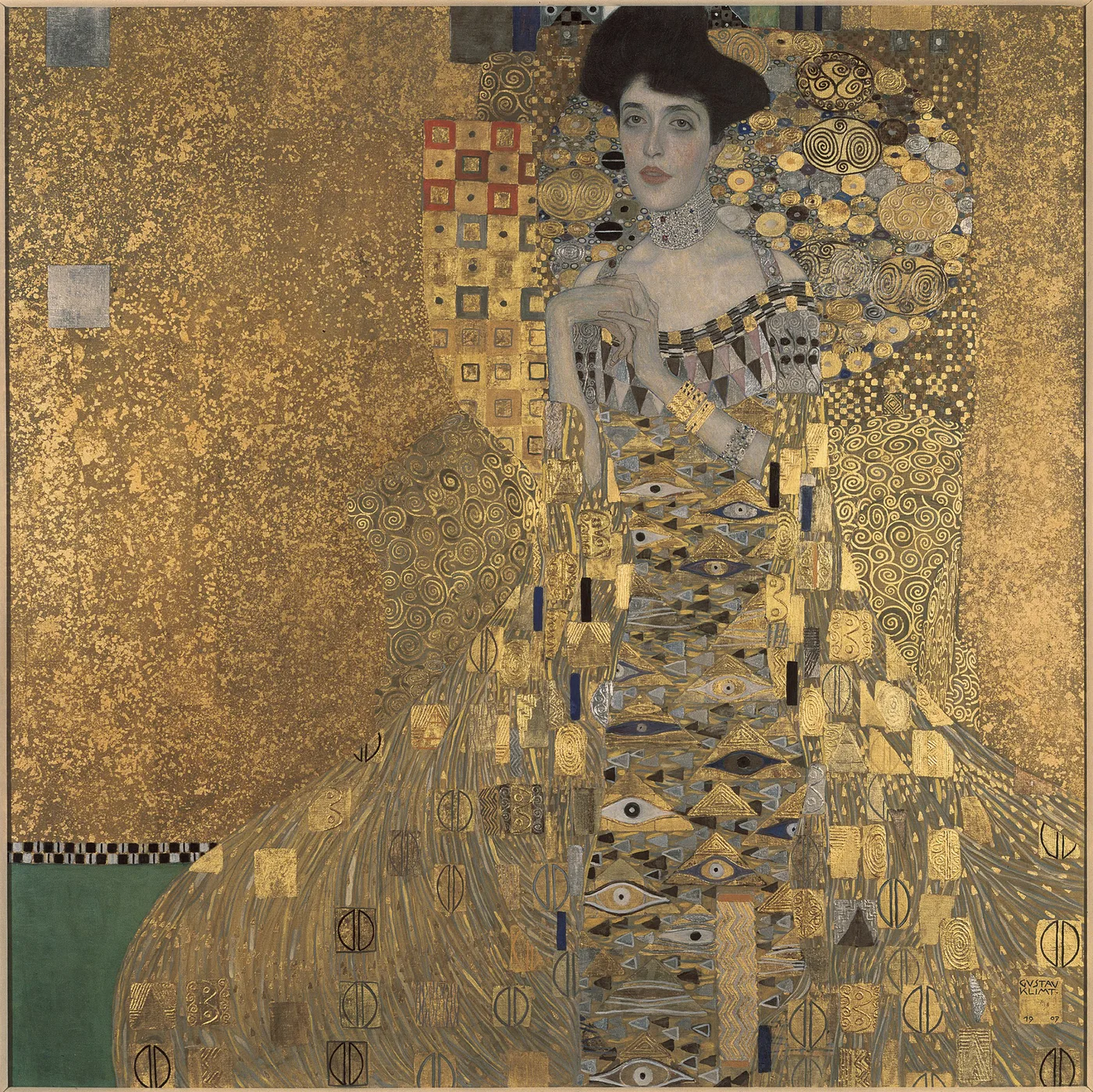
Gustav Klimt painted Portrait of Adele Bloch-Bauer I in 1907, a seated portrait built from gold leaf and oil on canvas, now held by the Neue Galerie. Adele Bloch-Bauer, the woman seated at its centre, belonged to one of Vienna’s wealthiest families.
Klimt was born in 1862 near Vienna, the son of a gold and silver engraver, and trained first in decorative and architectural painting rather than easel painting. He studied at Vienna’s school of applied arts before moving fully into painting, a path that put craft and ornament at the centre of his training from the start. The handling of metal and ornament never left him, and it resurfaces directly in the gold grounds of this portrait, made decades later.
Klimt had already resigned from the Vienna Secession, the group of painters, architects and designers who had broken from the official academy to push Viennese art toward a freer, more decorative style, two years before this portrait. The group built its own exhibition hall in Vienna and used it to show work the official Academy would not, including Klimt’s increasingly decorative portraits. Portraits of society women in Vienna made up a large part of his output through these years, commissioned by the families who could afford him.
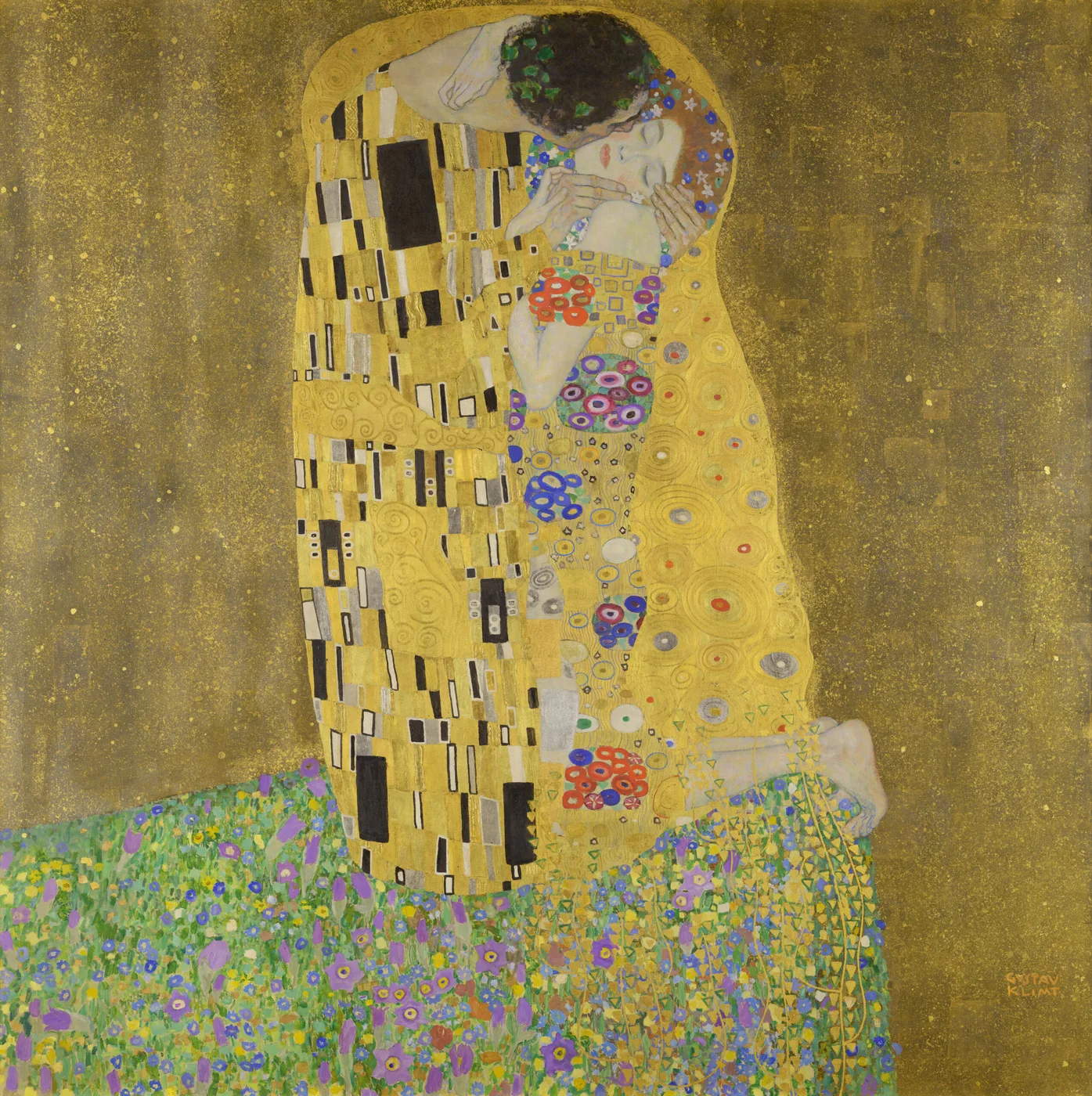
A trip to Italy, where Klimt saw the Byzantine mosaics at Ravenna, pushed his painting toward flat gold grounds and pattern instead of illusionistic depth. This stretch of his career is known today as his Golden Phase, which also produced The Kiss (Lovers) and Danaë, gold-ground paintings built on the same principle as this portrait.
Adele Bloch-Bauer’s husband, Ferdinand Bloch-Bauer, made his fortune in the sugar industry and was one of Klimt’s patrons. Ferdinand Bloch-Bauer commissioned the portrait for their home in Vienna.
Before starting the canvas, Klimt made drawings of Adele Bloch-Bauer. Those studies set the composition that the finished portrait keeps, a seated figure turned slightly toward the viewer with her hands brought together in front of her.
Adele Bloch-Bauer is the only sitter Klimt painted twice in a formal portrait, and a second, later portrait of her carries a related title in his catalogue. Portrait of Adele Bloch-Bauer I, the 1907 canvas, stays the more heavily gilded of the two. Klimt continued painting in Vienna until his death in 1918.
Gold Leaf, Pattern and the One Painted Face
The canvas is nearly square, and Adele Bloch-Bauer fills almost the whole height of it, seated close to the picture plane with her head reaching near the top edge. Gold covers most of the surface, so the eye has nowhere to rest except on her pale face, lit evenly with no single light source or cast shadow behind her.
Her face and throat carry the only passage of ordinary modelling in the picture: pale skin shaded with grey and rose around the eyes and jaw, dark hair swept up and back, and a mouth closed in a thin line of red. She looks straight out of the canvas, neither smiling nor stern.
A choker of pale stones sits tight around her neck, and wide gold cuffs circle her wrists. Her hands meet at chest height, fingers interlaced, one wrist resting over the other, painted with the same careful modelling as her face, a small island of flesh inside the gold.
Below her collarbone a band of silver-grey triangles crosses the dress like a belt of its own pattern, broken by small black rectangles, separate from the gold around it. From there down, the dress dissolves into a dense field of stylised eyes, triangles and small rectangles in gold, silver and black, with no fold or seam drawn to show where the fabric falls.
The background repeats the same vocabulary at a larger scale. To the left the gold is stippled and uneven, broken by pale silver squares set like windows into the surface, with a grid of small red and gold checks at shoulder height. To the right, spirals, circles and discs in gold, grey and black crowd together. Small eyes, in silver with a black pupil, recur among the circles on the right, the same motif that covers her dress below.
Toward the hem, the pattern changes again: the eyes and triangles of the bodice give way to looser, wave-like stripes in grey and gold that fan out as the dress widens into a train at the lower left, almost merging with the gold behind it. A narrow panel of green appears in that same corner, the only passage in the whole painting without gold or pattern, reading as a floor or a strip of ground beneath the train.
Klimt signed and dated the canvas in a small inscribed panel at the lower right, his name followed by the year 1907. He built the picture from gold leaf and silver leaf laid onto the canvas and worked with oil paint, so some passages catch light as metal while others sit flat as pigment. The brushwork changes with the job, smooth and blended on the skin, short and graphic in the pattern, where each eye or triangle reads as a separate, repeated mark.
Likeness Wrapped in Gold Ornament
The portrait sits at the point where a likeness turns into an object of status. Adele Bloch-Bauer is recognisable as a particular woman, with a particular face and hands, yet most of her body disappears into an ornament that bears no relation to any dress she could have worn. A viewer can hold the two at once only for a moment before the gold pulls attention away from the face and back into the pattern.
One reading takes the gold as part of the subject: wealth and standing made visible, with the sitter’s face set like a small window onto an otherwise abstract field of pattern. Klimt used the same device, a modelled face inside a flat gold ground, for several portraits of Vienna’s wealthiest women in these years, so by 1907 it already read as a kind of shorthand for status.
The small eyes scattered through the dress and the background support another reading. Repeated so many times, they turn into a field of watching, as if the sitter sits inside a pattern that looks back at the viewer as much as she does.
Reading the portrait through its genre gives a third view. Klimt takes the society portrait, built for recognition and flattery, and lets it edge toward decoration, until the pattern threatens to take over the canvas and leaves only the face and hands as ordinary likeness. Little in the result still resembles the restrained, academic portraits Klimt had painted earlier in his career.
Even inside so much pattern, Klimt keeps the face and hands outside it, painted with ordinary light and shadow rather than drawn as flat shapes. That choice keeps Adele Bloch-Bauer a specific woman rather than one more motif among the triangles and circles around her.
Seeing Portrait of Adele Bloch-Bauer I at the Neue Galerie
The original Portrait of Adele Bloch-Bauer I is held by the Neue Galerie. The museum’s collection centres on Austrian and German art from the early twentieth century, and its holdings of Klimt and Egon Schiele are among the reasons visitors travel specifically to see it.
Seeing the original means watching the gold leaf itself move as you walk past it, something no photograph or screen reproduces. Light across the room shifts over the mottled, tooled surface and flattens again the moment you stand still and look straight on.
From across the room the painting reads as a glowing block of gold with a pale face set into it. Only up close does the pattern separate into individual triangles, eyes and circles, so a visit rewards both the first impression from the doorway and the detail found standing close to the canvas.
Choosing a Hand-Painted Oil or Print of This Portrait
Every reproduction of this painting starts from the museum’s photograph of the original, which keeps the proportions, the colour and the placement of each motif close to the canvas Klimt signed in 1907. From that image, the Portrait of Adele Bloch-Bauer I page offers two editions, a hand-painted oil and an archival canvas print, made from the same source and differing only in method.
The hand-painted oil reproduction is painted by hand in oil on canvas, using that photograph as reference. The artist paints each passage by hand, so the surface carries real brushwork and a little natural variation, visible in the detail photos on the product page. Painting the oil by hand takes 2 to 4 weeks.
An archival canvas print is a giclee made with pigment inks from the same photograph, which keeps the colour and the fine eye-and-triangle pattern consistent from one print to the next. It suits a tighter budget, or a pair of Klimt pieces that need to match exactly. Printing takes 2 to 4 business days.
Before a hand-painted piece leaves the studio, it is photographed so you can see and approve the gold tones and the pattern before it ships. Delivery then takes 5 to 7 business days.
The composition is close to square, and the gold reads strongest at a distance, so a larger size suits this portrait better than a small one. Every size on the Portrait of Adele Bloch-Bauer I page keeps the same proportions as the original. A plain, narrow frame in black or dark wood keeps the attention on the pattern, while a wide, bright gold frame tends to compete with the gold already in the painting.
Questions Buyers Ask About This Portrait
What does Portrait of Adele Bloch-Bauer I show?
A seated woman, Adele Bloch-Bauer, painted with an ordinary, modelled face, throat and hands, while her dress and the whole background dissolve into gold leaf covered with triangles, circles and small stylised eyes.
Where is the original painting kept today?
The original is held by the Neue Galerie. Reproductions sold here are painted or printed from the museum’s own photograph of the canvas Klimt signed in 1907.
What is the real difference between the hand-painted oil and the print?
The oil is painted by hand on canvas, so the gold passages carry real brushwork and a little natural variation. The print is a giclee made with pigment inks, consistent from one copy to the next.
How long does a hand-painted reproduction take to arrive?
Painting the oil by hand takes 2 to 4 weeks. Delivery then takes 5 to 7 business days.
Which frame suits this portrait best?
A plain, dark or black frame, since a bright gold frame tends to compete with the gold already in the painting. The composition is close to square, so it reads well at a larger size.
More from this collection
Bring this painting home
Choose a hand-painted oil reproduction for real brushwork, or an archival canvas print for a crisp museum-image edition. Every size preserves the original proportions.
View this work & options
Further reading
Verify the original in the Neue Galerie collection record and continue through related works in the catalogue.