
1902: Klimt’s tall nude Goldfish, now at the Kunstmuseum Solothurn
How a university scandal led to Goldfish in 1902
Gustav Klimt, born in 1862 near Vienna, painted Goldfish in 1902, years after stepping down as the Vienna Secession’s first president. That year the Secession staged its fourteenth exhibition, built around Max Klinger’s painted statue of Beethoven, and Klimt contributed his own Beethoven Frieze to the rooms around it. Klimt painted Goldfish, on a narrow upright canvas, during that same stretch of work.
A few years before, Klimt had broken away from the Künstlerhaus, Vienna’s established artists’ association, to found the Secession with a group of painters and designers who wanted a more international and more modern Austrian art. Its new exhibition hall, finished with a dome of gilded laurel leaves, became the public face of a style built on flat pattern and gold surface, and the group ran its own journal, Ver Sacrum, to carry the message further.
Around the same period, Klimt had delivered ceiling paintings for the Great Hall of the University of Vienna: Philosophy, Medicine and Jurisprudence. The professors who had commissioned them objected to the nudity and the dark view of reason and the body the paintings offered, and the newspapers took up the attack. Klimt eventually bought the paintings back rather than let the university hang them, and turned more of his energy towards independent exhibitions with the Secession instead of state commissions.
Goldfish carries a trace of that fight. Klimt first wanted to call the painting To My Critics, and the red-haired nude at the foot of the canvas turns her bare back to the room and looks over her shoulder at the viewer, an expression closer to defiance than invitation.
Through these years, Klimt’s closest companion was Emilie Flöge, who ran a fashion house with her sisters in Vienna; the two stayed close until his death in 1918, though they never married. His mother and sisters remained part of his household throughout his career.
The gold scattered through the dark central panel anticipates the gold surfaces Klimt painted in the years that followed, when he filled entire canvases with gold leaf and flattened pattern, the body of work now known as his Golden Phase, and the small gold squares here read like an early sketch for that later style.
Goldfish sits at the start of a run of nudes that put the female body at the centre of myth and allegory rather than portrait sittings, a direction Klimt kept exploring for the rest of his career.
Three bodies, a fish and a field of gold squares
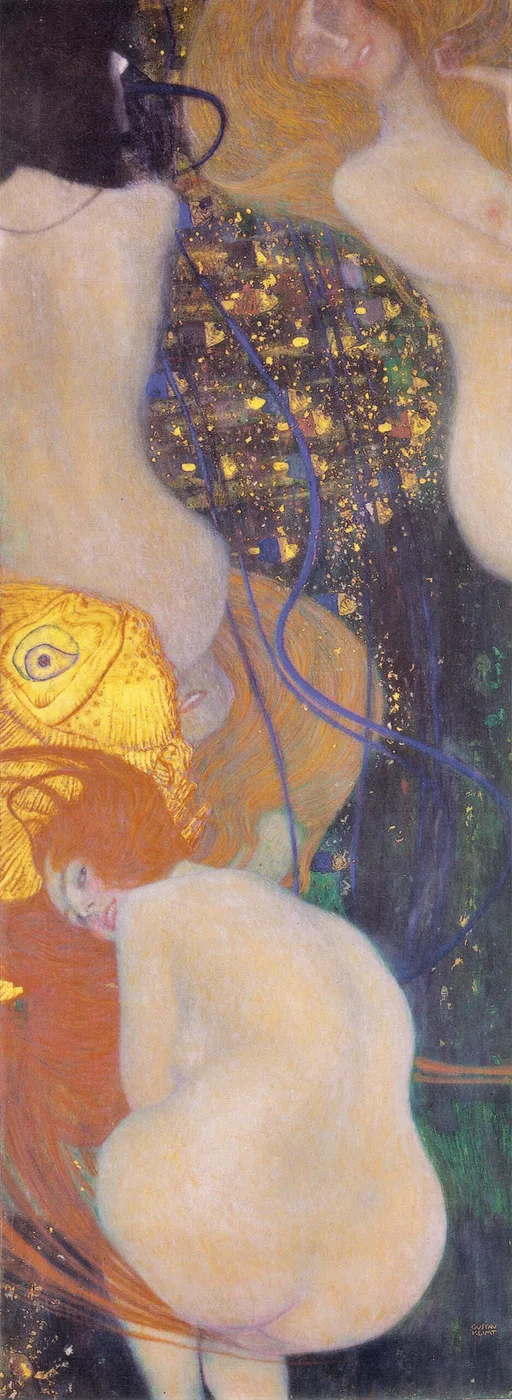
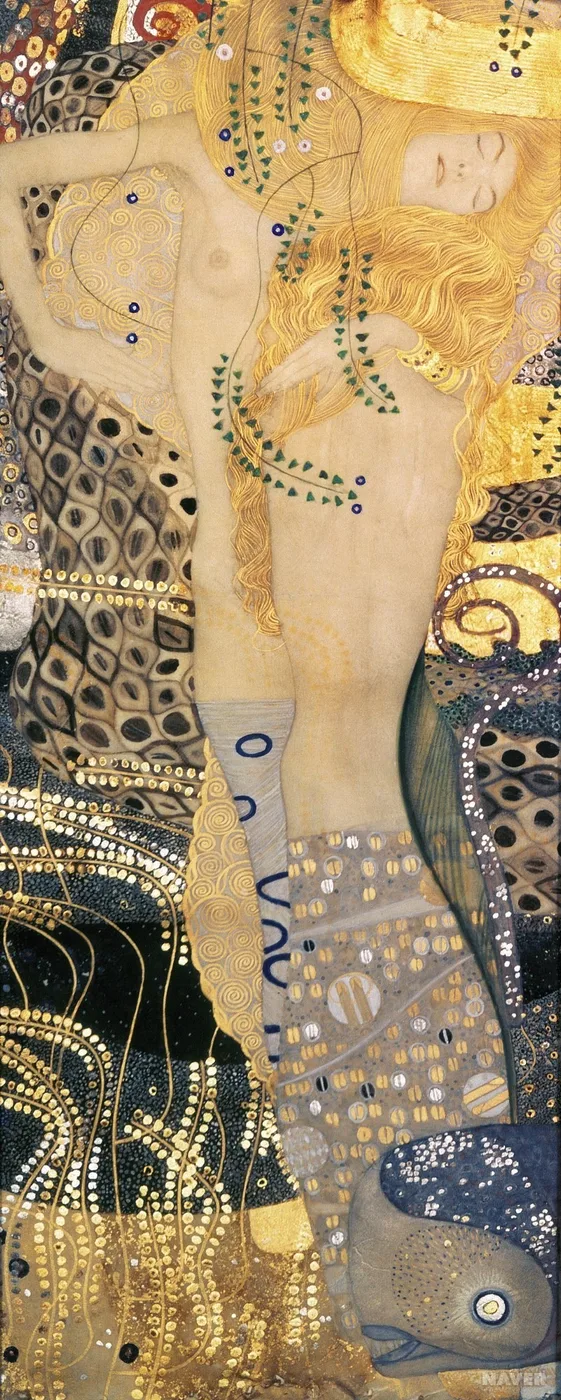
Goldfish is built as a single vertical column of bodies and pattern, far taller than it is wide, so the eye travels down the canvas rather than across it. Three female figures overlap from top to bottom, pressed close to the picture plane with almost no background space left around them. None of the three is shown in full, which denies the viewer the usual distance of a posed figure study.
At the top, a dark-haired figure is seen from behind, her head and shoulder filling the upper left corner in pale cream flesh against black hair. To her right, a second figure, her hair a wavy strawberry-blonde, turns her bare back and shoulder toward the viewer in the same close framing.
Between and below these two, a dark panel of pattern fills the centre of the canvas: small squares of gold, wine red, dark green and navy sit scattered across it like tesserae, and three or four pale blue ribbons curl down through it in long undulating lines, closer to a current of water than to drawn hair. The panel reads as part fabric and part mosaic, the kind of flat gold surface Klimt was using at the time in other paintings and in decorative schemes beyond his canvases.
Lower in the canvas, a large golden fish head gives the painting its title. Its scales are laid out in overlapping scalloped rows of yellow and gold, catching the light the way real fish scales do, and one dark eye looks out from among them.
Beneath the fish, a third figure, her hair a deep auburn, bends forward with her back and buttocks turned to the viewer and her face tilted up and back over her shoulder. Her skin is painted in the same pale cream as the figures above her, modelled with soft pink shading at the hip and spine.
The ground around her splits into a dark bottle green on the left and a warm rust orange on the right, the only strong colour contrast in the lower half of the canvas, and it throws her pale body forward from the surface. A thin band of the same rust orange reappears at the very bottom edge, tying the colour of the background to the warm tone of her hair.
Klimt keeps the drawing of each face and body smooth and closely observed, with soft outlines and gentle shading, while the gold panel and the blue ribbons around them are handled as flat, repeated pattern rather than modelled form. Brushwork on the skin stays smooth and almost invisible, while the gold squares sit as small distinct dabs of paint, each one a separate decision rather than a blended surface.
A mocking glance through water
Goldfish can be read, first, as a plain fantasy of life underwater. Three women and a large fish share one close, airless space, and the pale blue ribbons that thread between them read as currents rather than as hair or ribbon on dry land. That closeness removes any sense of open air or dry ground from the scene.
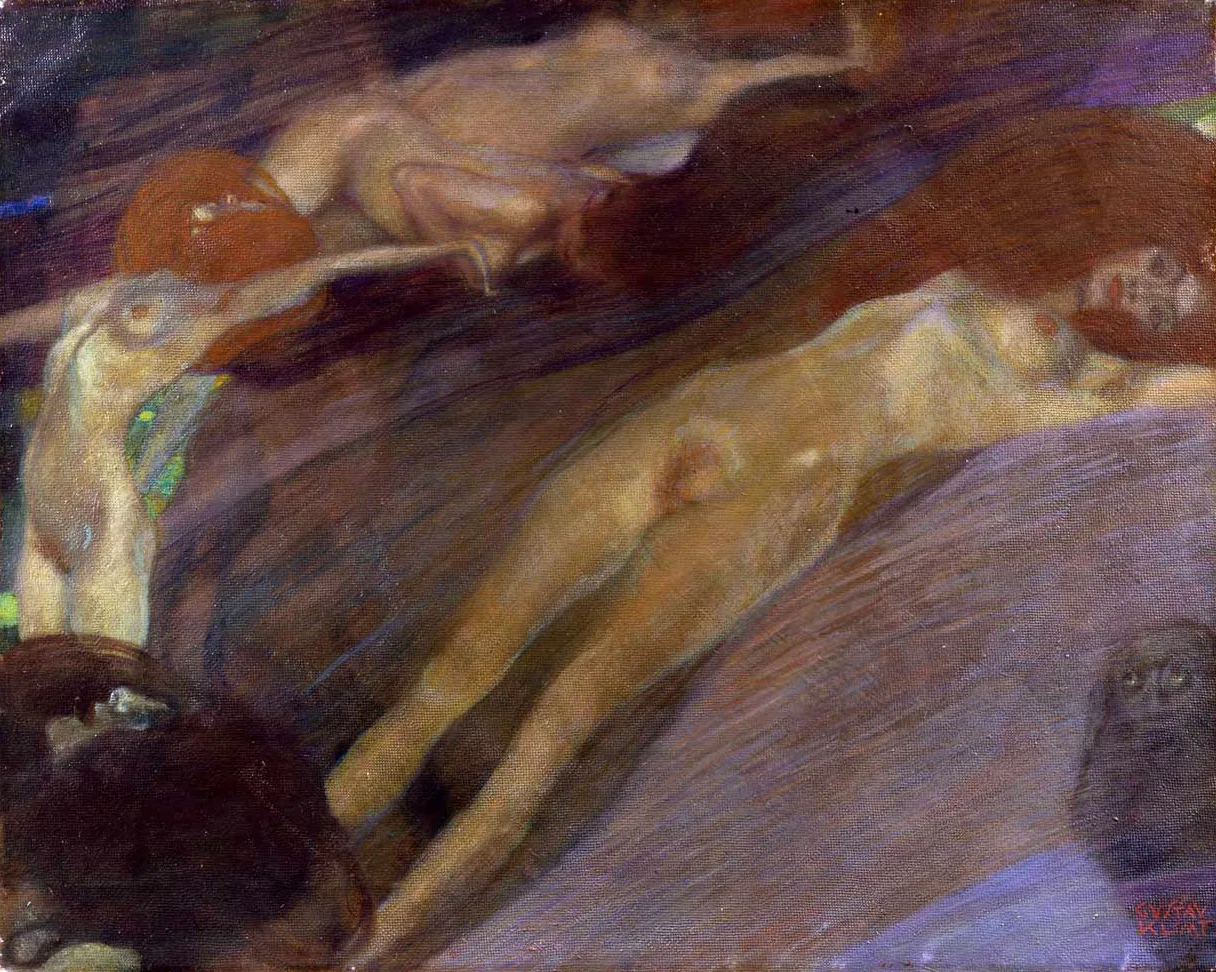
The painting names no myth and no saint, unlike Danaë, a painting from later in Klimt’s career that does carry a story. Even so, its pairing of nude women with fish and water puts Goldfish in the same loose register as Girlfriends (Water Serpents I), closer to a sea nymph or an undine than to an everyday figure study.
Read against the title To My Critics, which Klimt considered before Goldfish, the scene also works as an answer to the men who had attacked his university ceilings. Seen this way, the bending figure’s glance back over her shoulder turns from invitation into something closer to a dare, aimed past the frame at whoever is standing in front of the canvas. Nothing on the canvas itself confirms the story, but the fit between the pose and that early title is hard to miss.
The three bodies can also be taken as one woman shown at different moments: upright and turned away at the top of the canvas, then fully bent at the bottom, as though the viewer were following her down through the water rather than looking at three separate women side by side.
One thing stays fixed across every reading: the gold fish itself. It does not move or react, and its flat scales and single visible eye sit at the centre of the canvas like an anchor for the bodies curling around it.
Goldfish today, at the Kunstmuseum Solothurn
The original Goldfish, painted in 1902, hangs today in the Kunstmuseum Solothurn, in Switzerland. The canvas measures 181 × 67 cm, a narrow upright format roughly two and a half times as tall as it is wide, which keeps the eye moving down its length rather than across it.
Kunstmuseum Solothurn holds Goldfish as part of its permanent collection. A visit to the museum is the only way to see the original brushwork and the texture of the gold up close, and anyone planning a reproduction for home can check sizes against the original’s proportions on the Goldfish product page.
Choosing a size and frame for a tall, narrow canvas
A reproduction of Goldfish starts from the museum’s own photograph of the painting, the same image used for both editions offered on the Goldfish product page. Choosing between a hand-painted oil and an archival print there is a matter of method and feel, not a different version of the picture.
An artist paints each hand-painted oil by hand in oil on canvas from that photograph, laying in the large fields of colour first, then the gold panel’s pattern, then the fine detail of the faces. Painting the oil by hand takes 2 to 4 weeks. No two canvases come out quite identical, and that variation is part of what a hand-painted piece offers rather than a flaw in it.
The archival canvas print is a high-resolution giclee of the same image, printed with pigment inks for a consistent result from one print to the next. Printing takes 2 to 4 business days. It suits a dependable, lower-cost choice or a set of prints that need to match each other.
Because Goldfish is a narrow upright composition, every size keeps that same proportion rather than being stretched to fit a square or landscape frame. The format suits a slim stretch of wall, such as beside a doorway, in a stairwell or between two windows, where a wide canvas would not fit. A simple dark or narrow gold frame keeps the attention on the gold panel and the fish scales rather than competing with them.
Before a hand-painted order ships, the finished canvas is photographed so you can check the colour and the gold detail against the original. Delivery then takes 5 to 7 business days. Full size options, frame choices and the hand-painted version of Goldfish are all set out on its product page.
Common questions about Goldfish and its reproductions
What does Goldfish show?
Three female nudes and a large fish, stacked down a tall narrow canvas, with a central panel of gold, wine red and green squares and pale blue ribbons running through the middle of the composition. The fish and the ribbons give the scene the feel of an underwater view rather than a conventional portrait.
Why is the painting called Goldfish when it shows more than a fish?
Goldfish is named after the large gold-scaled fish at the centre of the canvas. Klimt first wanted to call it To My Critics, as an answer to the attacks on his university ceiling paintings, before it was shown under its present title.
Where is the original Goldfish painting?
The original, painted in 1902, is held by the Kunstmuseum Solothurn in Switzerland, where it remains part of the permanent collection.
What is the difference between the hand-painted oil and the print version sold here?
The hand-painted oil is painted by hand in oil on canvas from the museum photograph, with real brushwork and natural variation between canvases. The archival print is a giclee print of the same image on canvas, built for a consistent, repeatable result. Both start from the same museum photograph, so the choice is about method and feel rather than a different picture.
How long does a hand-painted order of Goldfish take?
Painting the oil by hand takes 2 to 4 weeks. Delivery then takes 5 to 7 business days. A photograph of the finished canvas is sent for approval before it ships.
More from this collection
Bring this painting home
Choose a hand-painted oil reproduction for real brushwork, or an archival canvas print for a crisp museum-image edition. Every size preserves the original proportions.
View this work & options
Further reading
Verify the original in the Kunstmuseum Solothurn collection record and continue through related works in the catalogue.