
Avenue to Schloss Kammer: Klimt’s 1912 Tree Tunnel at the Attersee
Painted in 1912, during Klimt’s summers at the Attersee
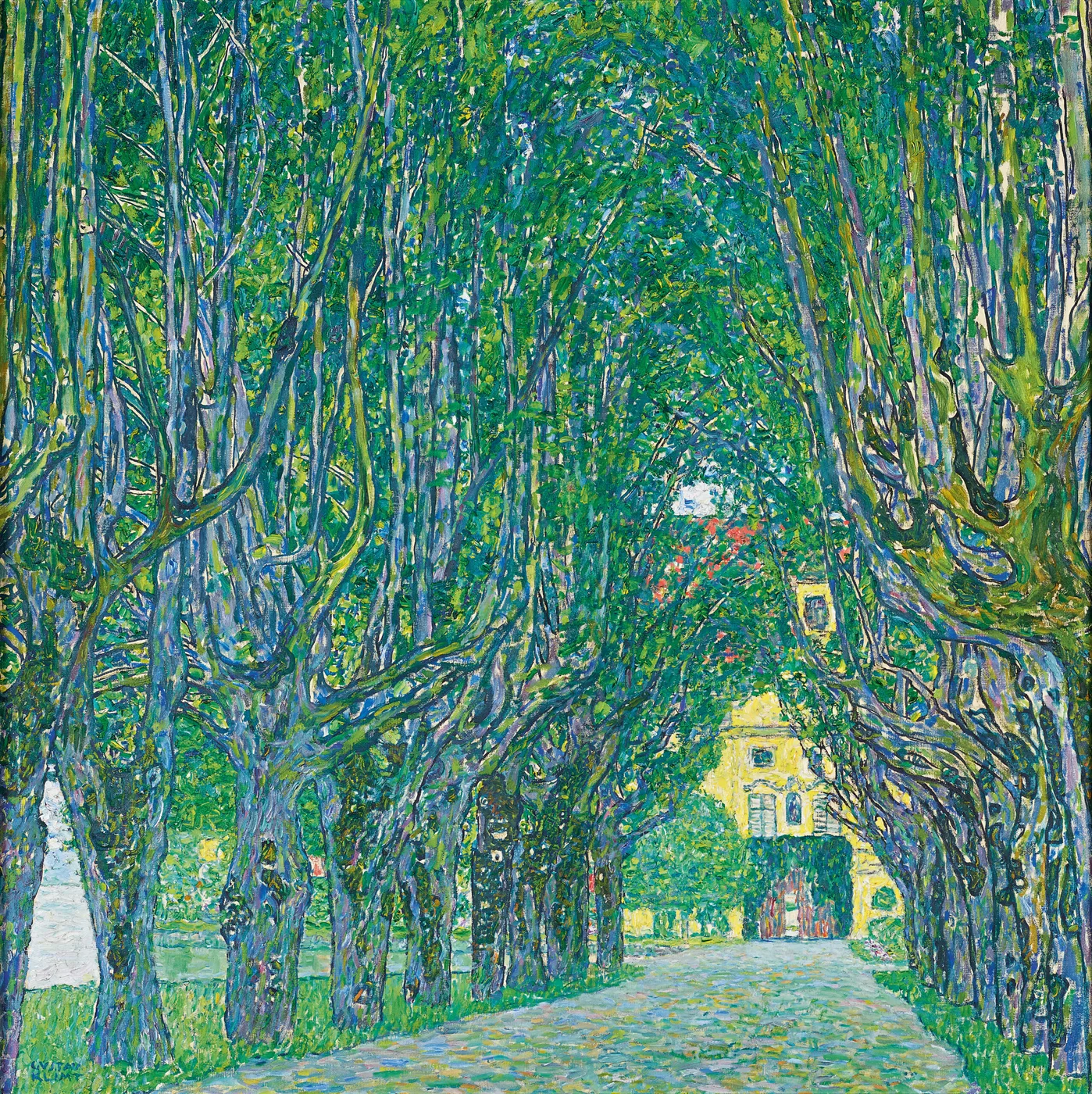
Gustav Klimt (1862-1918) worked away from his Vienna portrait commissions each summer at the Attersee, then painted Avenue to Schloss Kammer there in 1912. The canvas is square, 110 × 110 cm, and shows the private road that led up to the manor house after which the painting is named.
Klimt had been returning to the Attersee for years by then, usually travelling with Emilie Flöge and her family, who kept a house on the lake. Once away from the city he set aside the gold grounds and formal sitters that filled his Vienna studio and turned instead to the gardens, orchards and shoreline around the water.
Schloss Kammer am Attersee, the manor at the end of this avenue, stands close to where the Flöges spent their summers. Klimt painted its grounds more than once during these years, looking at the house and its park from different distances and through different screens of trees, so the building itself is rarely the main subject.
By 1912 Klimt was fifty, a founding member of the Vienna Secession and the portrait painter most in demand among Vienna’s wealthy families. Society women sat for him through the winter and into spring, their portraits built up slowly in his Vienna studio with gold leaf and ornament; the lake months gave him a different kind of work once those commissions were delivered.
On the water he painted without a sitter to please or a likeness to get right. Square canvases filled with flowers, water or foliage, close to the picture surface and with no horizon line, became his habit for these holidays, the same format he used for Roses beneath Trees and Flowering Poppies.
Avenue to Schloss Kammer, 110 × 110 cm, belongs to that same group of lake paintings. Its subject is the private road leading up to the house, a double row of trees whose branches had grown together overhead into a long, arched corridor above the stone paving below.
He kept painting these lake and garden pictures, square in format and empty of any figure, through the years that followed. They stayed a private, quieter practice, set apart from the winter portrait commissions that filled his Vienna studio.
How Klimt built the tunnel of trees in paint
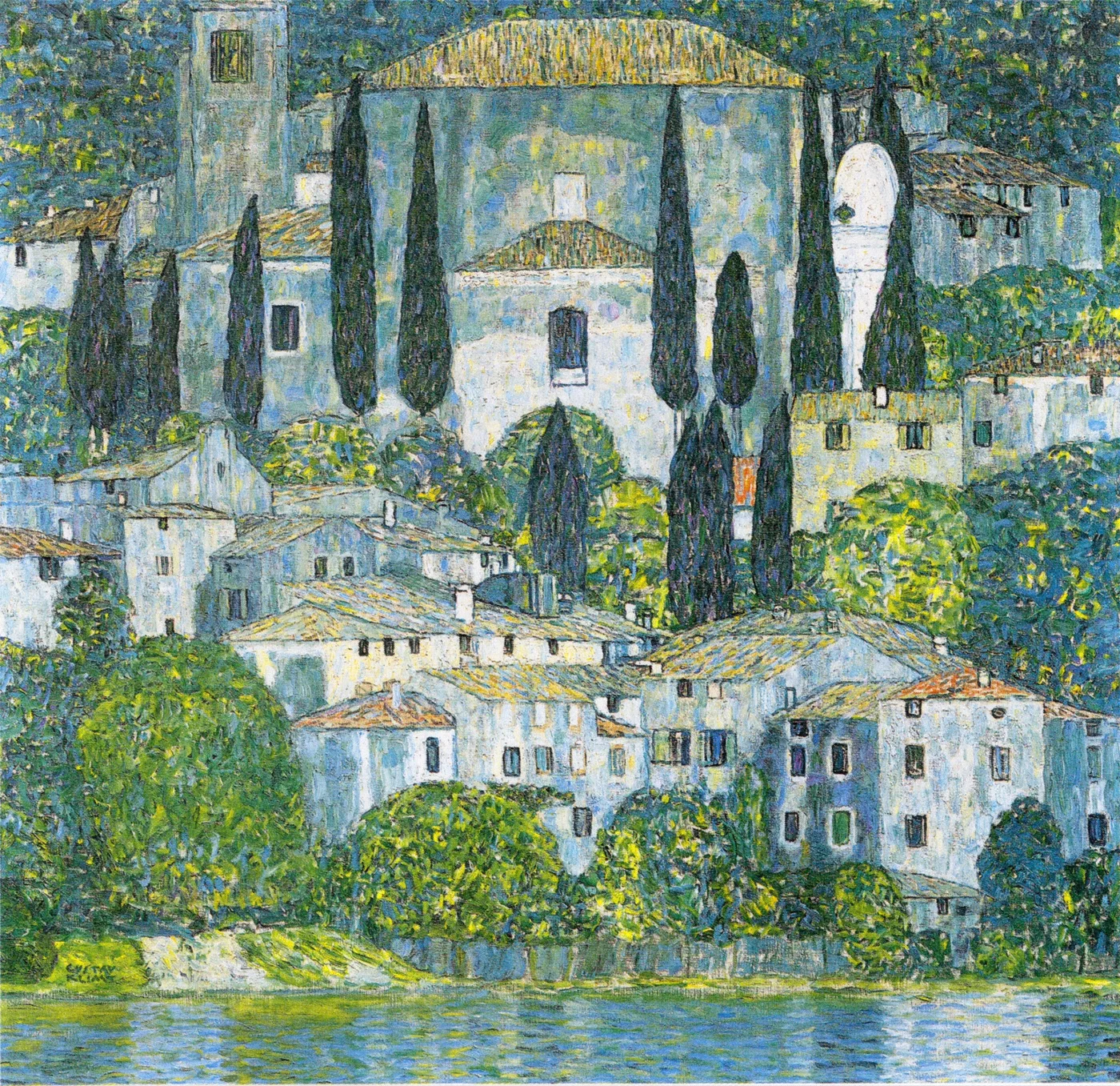
The canvas is square, 110 × 110 cm, and Klimt uses that shape to shut out the sky. There is no horizon anywhere in the picture: the avenue runs straight back from the bottom edge to a small building in the far distance, and the trees close over the top of the view like a roof, so the eye has nowhere to go but down the path.
Trunks and low branches are built in bands of blue-violet, grey and olive green, each one outlined in a darker line that curves and forks the way real bark splits around a knot or an old branch stub. The trunks lean slightly as they rise, which keeps the tall avenue from looking like a row of straight posts.
Above the trunks, the canopy is made of thousands of small, separate touches of paint rather than blended colour: dabs of olive green, yellow-green and a darker blue-green sit side by side and read, from a short distance, as leaves catching different amounts of light. Close up, the same passage breaks down into a dense field of individual marks.
Light in the painting is soft and filtered rather than direct. Near the centre of the canopy a patch of pale sky shows through a gap in the leaves, the brightest note in the upper half of the picture, and the paving below picks up a cooler version of the same light in streaks of grey and lilac.
The path is built from flat, pale grey-blue stones that narrow as they recede, with a thin strip of green grass along each edge. On the left, close to the frame, a pale triangular passage of white and blue breaks through the trees at ground level, the one place in the picture where the avenue opens instead of closing.
At the far end of the path, small against the height of the trees, sits Schloss Kammer: a pale yellow facade with white window frames and dark shutters, an arched opening at ground level, and a touch of warm red-orange foliage near the entrance. The building occupies a small part of the square, boxed in on both sides by the trees.
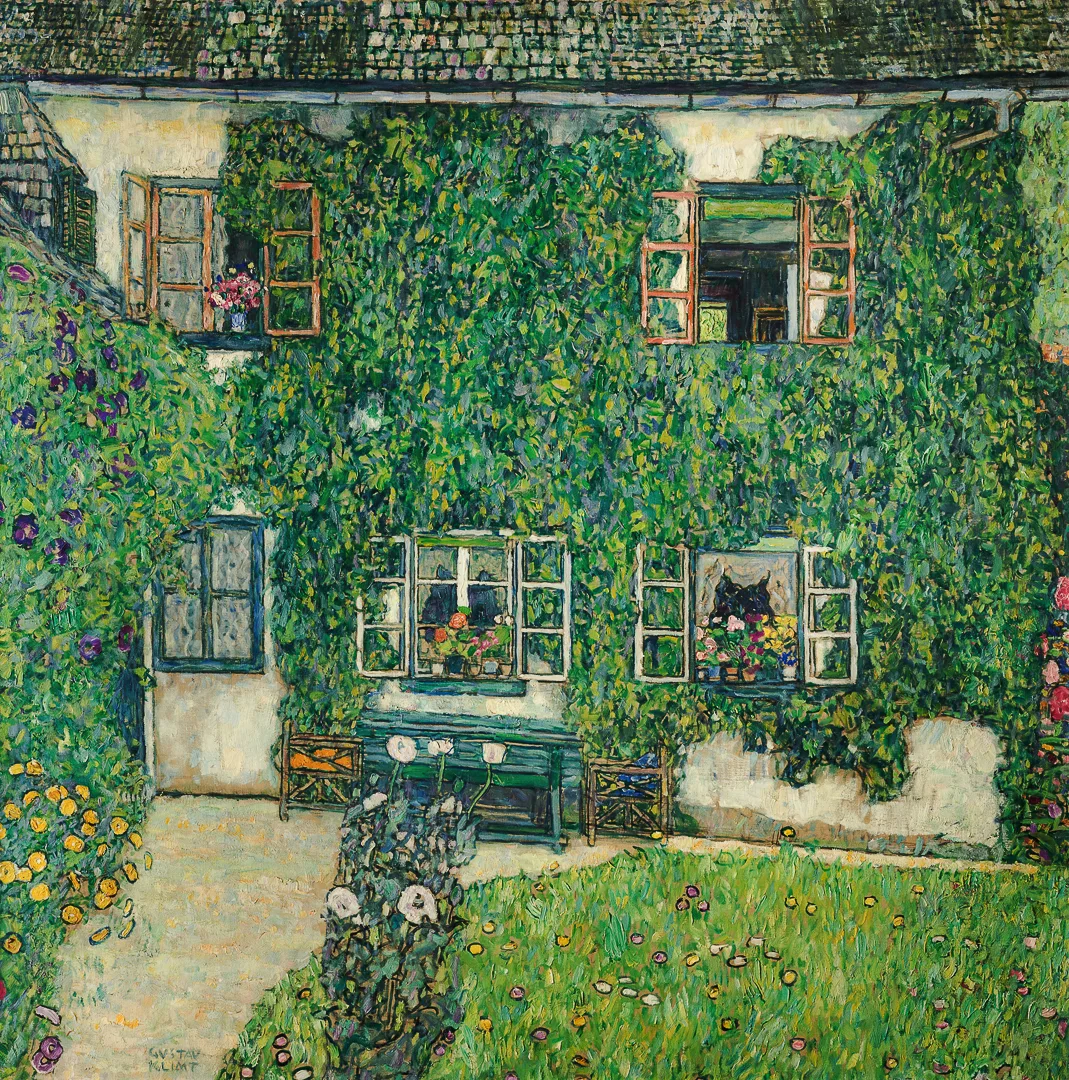
Across the whole canvas, Klimt keeps the same dense, patterned handling that marks his portraits from these years, even though there is no gold leaf here and no figure. Paint is laid on thickly in short, dry strokes, and the surface reads as a single mass of green from across a room, while individual strokes only separate out on close inspection, as they also do in Cottage Garden with Sunflowers.
A path to a house that stays half hidden
Avenue to Schloss Kammer has no figure anywhere in it, unusual for a painter known chiefly for faces and bodies. The subject is a stretch of ground: trees, stone paving and, at the far end, a house that the trees are already half hiding from the road that leads to it.
Read as a simple view, the painting records a private approach, a road built for people arriving at a house, with the house kept at a distance, its pale yellow facade lit while the avenue itself stays in shadow under the canopy. The emphasis falls on the walk itself rather than on the place it leads to.
The arch of trees can also work, more loosely, as a kind of enclosure, an outdoor room with walls of trunks and a green ceiling instead of a sky. The square format removes any horizon or open ground, so nothing in the picture offers an escape from the avenue itself.
The small gap of pale sky at the centre and the brief red near the house are the only breaks in an otherwise continuous field of green and blue-violet, which keeps the eye moving along the path rather than settling on any single detail.
Klimt leaves the path, the screen of trees and the half-seen house to carry the scene, with no figure anywhere in the painting to settle what it means.
The original, at full scale, in the Belvedere
The original of Avenue to Schloss Kammer hangs in the Belvedere, in Vienna, alongside other landscapes Klimt brought back from his Attersee summers. Its collection of his paintings is one of the largest held by a single museum, shown in rooms that also hold his better-known portraits and allegories.
At 110 × 110 cm, the canvas is large enough to stand in front of rather than hold at arm’s length. From across the room the avenue reads as a single mass of green and blue-violet; walking closer brings the separate dabs of the canopy and the grain of the stone paving into focus.
Seeing the painting at that scale is the only way to get both views at once, the overall shape of the avenue and the texture of the brushwork, in the same glance. A reproduction on a screen keeps the first and loses the second.
Choosing a reproduction of this avenue for your wall
Every reproduction in this shop starts from the museum’s own record of the original, the same reference used for both editions on offer. The sizes and formats for this picture are listed on the Avenue to Schloss Kammer page, where the hand-painted oil and the archival print sit side by side.
A hand-painted oil reproduction is painted by hand, in oil on canvas, from that reference: the large green and blue-violet areas first, then the paving, then the fine lines of the trunks and the small red note near the house. No two canvases come out quite identical, which suits a picture built from thousands of individual brushstrokes to begin with, and the product page shows examples of the finished surface.
The archival canvas art print is a giclee print of the same image on canvas, with consistent colour from one print to the next, a practical choice for a dependable result or for more than one piece that needs to match. Painting the oil by hand takes 2 to 4 weeks. Printing takes 2 to 4 business days. Delivery then takes 5 to 7 business days.
Because the canvas is square, a reproduction keeps that square shape at every size, with no cropping and no stretching into a rectangle. This composition suits a stairwell or a hallway, where the tall trunks read well in a narrow space, or a living room wall where the greens can sit against white or pale grey paint; a dark frame holds the blue-violet shadows in the trees without competing with the warm yellow of the house.
Before a hand-painted piece ships, the finished canvas is photographed so you can approve the colour and detail yourself. For current sizes, frame options and the two editions of this particular avenue, the Avenue to Schloss Kammer page is the place to check.
Questions readers ask about Avenue to Schloss Kammer
What does Avenue to Schloss Kammer show?
A tree-lined private road leading up to Schloss Kammer, a manor on the Attersee, painted by Gustav Klimt in 1912. Thick foliage arches over the path, and the house sits small at the far end.
Why is there no sky or horizon in the painting?
Klimt painted it on a square canvas, 110 × 110 cm, and let the canopy close over the top of the path, a composition he used for several of his Attersee landscapes.
Should I choose a hand-painted oil or a print?
A hand-painted oil keeps the texture of the brushstrokes that build the canopy. An archival print gives even, consistent colour at a lower cost and suits matching pieces. Both start from the same museum record.
How long does a hand-painted reproduction take?
A hand-painted oil is painted to order, with the painting, printing and delivery times for each edition set out in the reproduction section above.
Where can I see the original painting?
The original is held by the Belvedere, in Vienna, as part of its collection of Klimt’s work.
More from this collection
Bring this painting home
Choose a hand-painted oil reproduction for real brushwork, or an archival canvas print for a crisp museum-image edition. Every size preserves the original proportions.
View this work & options
Further reading
Verify the original in the Belvedere collection record and continue through related works in the catalogue.