
The Dense, Fruit-Heavy Crown of Klimt’s Apple Tree II
A Lakeside Summer in the Middle of the War, 1916
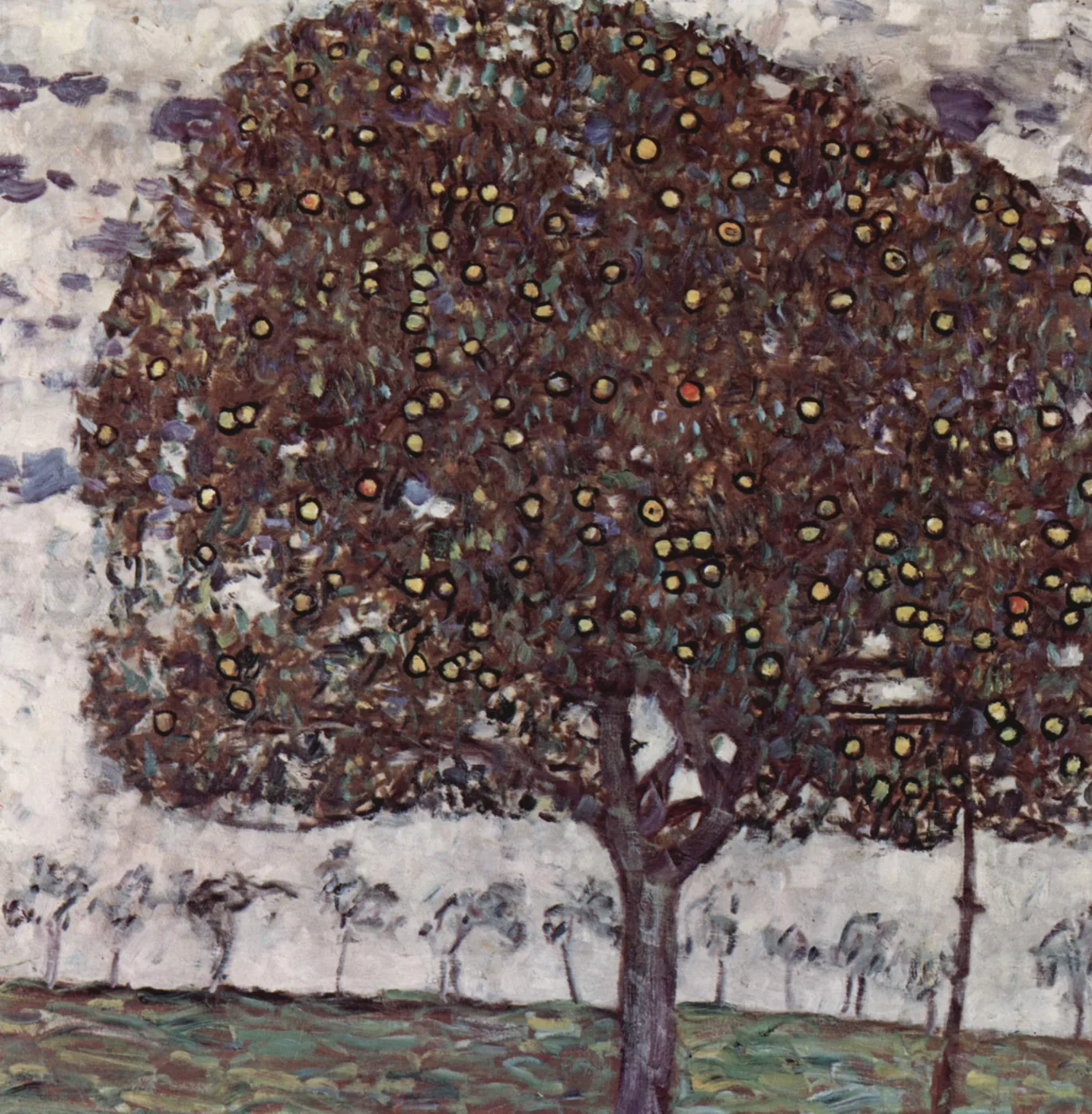
Gustav Klimt painted Apple Tree II (Green Apple Tree) in 1916, a square canvas of 80 × 80 cm built almost entirely from the crown of a single fruit tree. He was fifty-four that year, long established as Austria’s leading painter, and spending his summers away from Vienna’s portrait commissions.
Klimt was born in 1862, the son of a gold engraver, and spent three decades building the reputation that made him Vienna’s most sought-after painter of portraits and allegories. He had led the city’s Secession movement and filled his large figure paintings with gold leaf and ornament. By 1916 that period of scandal and spectacle, including the disputes over his university ceiling paintings, lay well behind him, and he worked in a quieter, more private register.
Each summer Klimt left Vienna for the Attersee, the lake region west of the city, where he stayed with Emilie Flöge and her family at rented villas and farmhouses. Away from sitters and commissions, he turned his attention to gardens, orchards and lake shores, almost always on a square canvas rather than the tall or wide formats he used for portraits. The square format became something close to a private habit of his later summers.
By 1916 Austria had been at war for two years, and the conflict shaped daily life in Vienna even for an artist of Klimt’s standing. He continued to paint and exhibit through the war years, and the orchard he painted that summer carries no sign of the war around it.
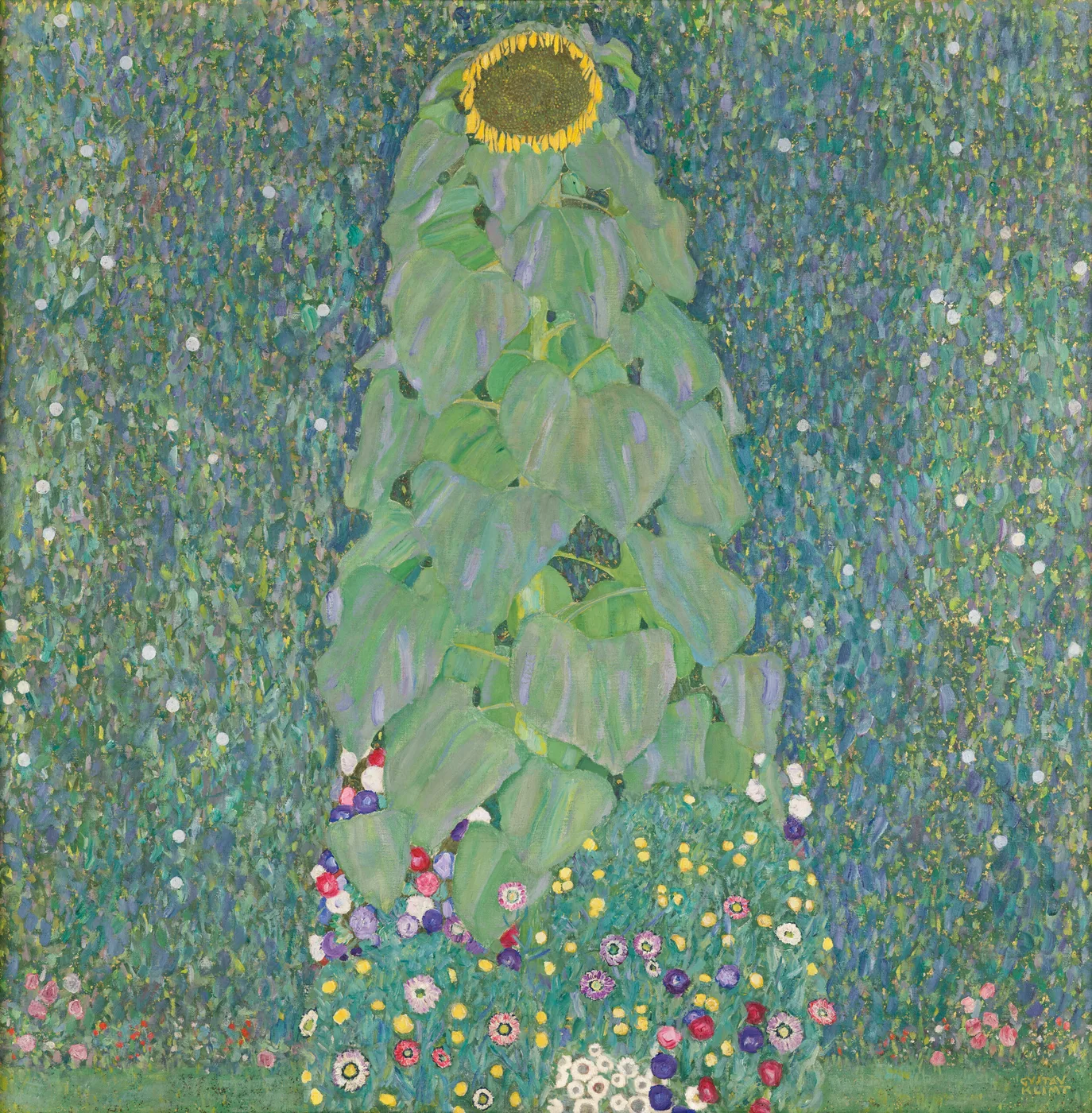
The apple tree was one subject among several Klimt returned to across his later summers, filling square canvas after square canvas with dense planting: a pear tree in full leaf, and a cottage garden thick with sunflowers. Each picture isolates its plant from any wider view, with no path, building or figure to place it.
He had covered figures and interiors with flattened, patterned surfaces for years before this, drawing partly on Byzantine mosaic and Japanese prints, and in these lake pictures he turned that same instinct toward leaves, bark and fruit instead of fabric and gold leaf.
Klimt died in 1918, two years after he painted this tree, following a stroke that left him unable to work for weeks before pneumonia set in. Apple Tree II belongs to the last stretch of a career spent mostly on portraits, painted instead in a summer given over to a single orchard.
A Square Crown Built from Brown, Grey and Pale-Yellow Dabs
The canvas is square, 80 × 80 cm, and Klimt fills nearly the whole of it with the rounded crown of one apple tree. The canopy rises from the lower third of the picture to touch the top edge, and spreads to the right edge, while a wide strip of pale sky runs down most of the left side. There is no horizon in the usual sense: the eye meets foliage first, sky second, and ground only in a thin strip along the bottom.
A slender trunk enters the canvas just right of centre, deep plum brown, and splits into two main limbs well below the middle of the square, in the lower part of the picture. A pale patch of bare wood sits in the fork, where the darker bark has worn away, and a second, thinner pole stands just to the right of the trunk, bare of leaves near its base.
The crown itself is built from a mass of short, separate brushstrokes in reddish brown and rust, the colour of autumn rather than high summer, broken up by cooler touches of grey-blue and sage green. No single leaf is drawn; the colour accumulates, stroke beside stroke, until it reads as foliage from a normal viewing distance.
Dozens of apples sit inside that mass of colour, each picked out as a small circle outlined in black or dark brown. Most are pale yellow or cream at the centre, a handful are a deeper orange, and one near the middle of the canopy is a clear red. The outlines give the fruit a flat, graphic quality against the textured brown of the leaves around them.
Behind the canopy, the sky is a pale lavender-white, laid in with short, loose strokes that run in several directions. A row of slender, leafless saplings is sketched thinly in grey low in the picture, directly above the grass strip at the bottom edge, the only hint of a wider orchard beyond the single tree in front.
A narrow strip of green grass, dabbed in darker and lighter tones, runs along the very bottom of the canvas and grounds the composition. There is no cast shadow and no single light source to speak of: the light is even across the whole square, closer to an overcast afternoon than bright sun, which keeps every colour close in value.
Seen from across a room, the separate strokes merge into a single textured mass, brown and warm, with the pale apples reading as small points of light. Seen closer, the brushwork breaks apart into hundreds of individual marks, none blended into its neighbour, the same mosaic-like handling Klimt used for drapery and ornament in his figure paintings.
A Tree Read as Pattern, Ripening Fruit or Plain Record
Apple Tree II shows a fruit tree with its apples ripening among dense leaves. Klimt gives no figure, building or path to anchor the view in a particular place, so the picture reads as a close study of a plant on its own terms. The title states the subject plainly and adds nothing beyond it.
One way to read the picture is as an exercise in pattern. The dense, repeated marks of leaf and fruit cover the canvas edge to edge the way gold leaf and spirals cover the surfaces of Klimt’s portraits, so a living tree is treated with the same decorative instinct he applied to fabric and skin elsewhere in his work. Nothing here is labelled a portrait or an allegory, so the pattern carries no obvious meaning beyond the tree it describes.
A second reading sits in the apples themselves. Scattered through the canopy in yellow, cream, orange and a single red, they read as fruit still ripening, their small size against the mass of leaves keeping the picture close to observation rather than symbol. Their fairly even spacing across the canopy gives the fruit a regularity the leaves themselves do not have.
The square format itself supports a quieter reading. Without a horizon to organise sky above and ground below, the canvas has no obvious top or bottom beyond what the tree provides, and the composition holds together as a single dense shape more than as a landscape with depth. The picture sits closer to a dense, decorative surface than to a window onto a place.
No caption settles the question here. The picture records a tree in leaf and fruit with the same density of brushwork Klimt gave his portraits, and the choice of subject, an ordinary tree instead of a person, is itself part of how the picture reads.
Where Apple Tree II Sits Among Klimt’s Lake Pictures
Apple Tree II takes its place among the dense, close-cropped plant studies Klimt painted at the Attersee in his later summers, pictures that stand apart from the gold-ground portraits of his Vienna Secession years. Roses crowding beneath a stand of trees, a pear tree in full leaf, a cottage garden thick with sunflowers: each follows the square format and the same refusal to show any wider view beyond the plant itself. The orchard setting ties it to his garden paintings as much as to his tree studies, even though no garden wall or path appears in this one.
The numeral in the title suggests Klimt returned to the same tree, or the same kind of picture, more than once, in the way he returned to other garden subjects across his later summers. The habit points to a painter working through one motif across several canvases instead of planning a single picture in isolation.
Within that body of work, Apple Tree II sits at the plainer end: only the tree and the thin line of young trees behind it fill the square.
Hand-Painted Oil or Print: Choosing Your Apple Tree II
Every reproduction in this shop starts from a photograph of the original painting. Both editions on offer, the hand-painted oil and the archival canvas print, are made from that same image, so choosing between them is a question of method and feel rather than a different picture of the tree.
A hand-painted oil reproduction of Apple Tree II is painted from scratch by an artist, in oil on canvas, using that photograph as the reference. The artist builds the image by brush, laying in the large masses of colour first, then the patterned foliage, then the small detail of the apples. Because the canopy here is built from hundreds of separate dabs, a hand-painted copy suits it well: the brush can rebuild that same broken touch without flattening it into a printed surface.
The archival canvas print is a high-resolution giclee print of the same image, printed on canvas with pigment inks, and it gives photographic consistency from one print to the next. It is the practical choice for a dependable result, a friendlier budget, or several Klimt pieces on one wall that need to match. Both editions are shown on the page for Apple Tree II (Green Apple Tree), alongside their sizes.
Every size keeps the proportions of the original, so the reproduction stays square at every size: never cropped into a rectangle, never stretched to fit one. A square, leafy picture of this kind works well where a tall or wide painting would feel wrong, above a kitchen counter, beside a window, or in a dining nook with a run of similar-sized frames, and the available sizes are listed on the product page for Apple Tree II. Painting the oil by hand takes 2 to 4 weeks. Printing the canvas takes 2 to 4 business days. Delivery then takes 5 to 7 business days.
Before a hand-painted piece ships, the finished painting is photographed so you can check the colour and detail against the source image and approve it. Stretcher and frame options for this square composition, including a plain stretched canvas or a framed finish, are set out on its own product page.
Common Questions About This Painting
What does Apple Tree II show?
A single apple tree fills almost the whole square canvas, its crown dense with reddish-brown leaves and small yellow, cream, orange and red apples, standing above a strip of grass with a thin row of young trees sketched behind it.
Why is the canvas square rather than rectangular?
Klimt painted most of his Attersee landscapes, this tree among them, on square canvases during his later summers, a format that removes any single direction for the eye and lets the tree read as a dense, even pattern.
What is the difference between the hand-painted oil and the print?
The oil is painted by hand on canvas from the same photograph the print is made from, so it carries real brushwork and small variation. The print is a consistent giclee reproduction on canvas, useful when colours need to match exactly across several pieces.
Which size suits a kitchen or dining wall?
Because the composition stays square at every size, a mid-sized square oil or print sits comfortably above a counter, console or dining table, without the gap a tall or wide picture would leave in that kind of space.
How long will my order take?
Painting and printing times, along with delivery, are set out in the section above on choosing a reproduction, and a hand-painted piece is photographed for your approval before it ships.
More from this collection
Bring this painting home
Choose a hand-painted oil reproduction for real brushwork, or an archival canvas print for a crisp museum-image edition. Every size preserves the original proportions.
View this work & options
Further reading
Verify the original in the collection record and continue through related works in the catalogue.