
Landscapes Collection: Gustav Klimt Oil Painting Reproductions
Showing 33–33 of 33 results
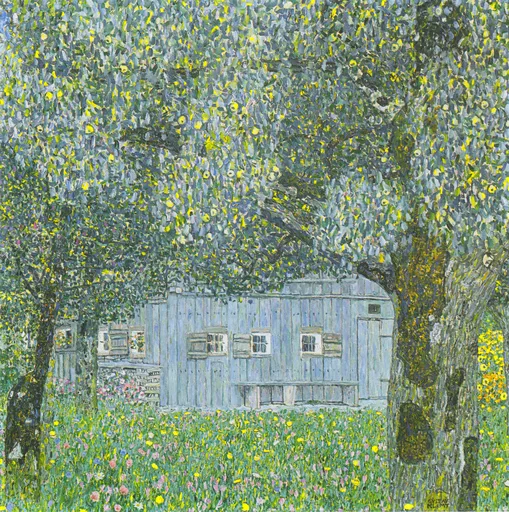
Klimt painted landscapes without commissions, for himself, and most of them in the summer months he spent with the Flöge family on the Attersee, a lake in the Salzkammergut of Upper Austria. This collection gathers all of them, from an early pond and a farmhouse among birches to the gardens and lakeside villages of his last years. Each is available as a hand-painted oil reproduction or an archival canvas print.
What landscape means in Klimt's work
The early pictures, such as A Morning by the Pond (1899) and On Lake Attersee (1900), are quiet and tonal, close to the mood painting then in favour in Vienna. Within a few years Klimt settled on the square format of almost all his later landscapes. In Beech Forest I (c. 1902) and Birch Forest (Beech Forest) (1903) the trunks stand in rows and the sky is shut out. In Cottage Garden with Sunflowers (1906) and Flowering Poppies (1907) leaves and petals fill the canvas to its edges, each laid down as a separate touch, so the picture reads like a mosaic.
From 1908 he turned to buildings seen across water: Kammer Castle on the Attersee I (1908-1909) and the views of the castle that followed, Litzlberg on the Attersee, and in 1913 the Italian shore in Malcesine on Lake Garda and Church in Cassone on Lake Garda. The late gardens, Garden Landscape with Rounded Mountaintop (Parsonage Garden) (1916) and Garden Path with Chickens (1916), are looser and brighter. The horizon sits high or disappears, depth gives way to pattern, and that is why these pictures hang so well beside his portraits.
Several groups have pages of their own: The Attersee, Gardens & Parks and Trees & Forests.
How each reproduction is made to order
Nothing is printed in advance. For the hand-painted oil reproduction, an artist paints the picture from scratch in oil on canvas, working from the museum's open-access photograph of the original; the dense, broken touches of these landscapes are where a brush shows its difference. The archival canvas print is a giclée of the same photograph in pigment inks on canvas. Every size keeps the proportions of the original, square for most of these landscapes, so nothing is cropped.
You can order the canvas rolled, stretched ready to hang, or in a thin or thick frame; the framing guide explains the difference. A hand-painted canvas is photographed before it ships so you can approve it.
Frequently asked questions
Why are Klimt's landscapes square?
Klimt chose the square for almost every landscape from 1900 on. It cancels the sense of a wide view and turns the scene into an even surface of colour, closer to a textile than to a window.
Where did Klimt paint these landscapes?
Mostly on the Attersee in Upper Austria, at Litzlberg, Kammer and Weissenbach, where he spent his summers. A smaller group comes from a stay on Lake Garda in 1913, and Schönbrunn Landscape shows the park of Schönbrunn Palace in Vienna.
Which landscape suits a large wall?
The garden and forest pictures, such as Flowering Poppies or Beech Forest I, hold up well at large sizes because their pattern covers the whole surface. For a calmer wall, choose one of the lake views, where water fills most of the canvas.
Should I choose the oil or the print for a landscape?
The oil shows real brushwork, which suits the thousands of small marks Klimt used for leaves and water. The print reproduces the photograph exactly and is the more affordable edition. Our guide to the hand-painted oil and the canvas print compares them side by side.