
Judith II (Salome): A Narrow Gold Canvas Built Around a Severed Head
Painted in 1909, After a Trip That Changed Klimt’s Brush
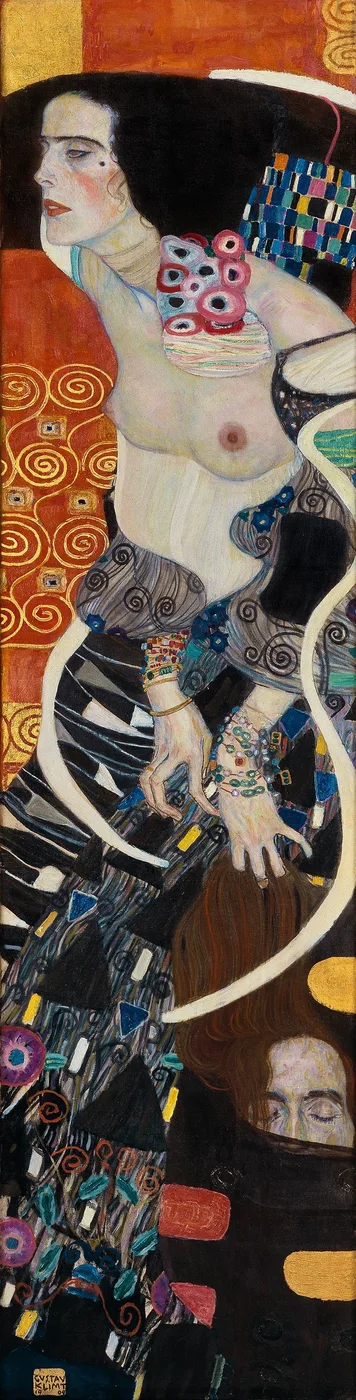
Gustav Klimt painted Judith II (Salome) in 1909, a tall narrow canvas that carries two biblical names at once. A single woman fills nearly the whole height of the picture, one hand clenched above a man’s head that rests near the bottom edge of the canvas.
Klimt was born in 1862 near Vienna and trained as a decorative painter, working for years alongside his brother on murals and ceiling paintings for the city’s grand public buildings. By his mid-career he had moved past that history-painting training, into portraits, allegorical female figures and landscapes built from flat pattern and gold leaf, with little painted depth.
He had also helped lead, then left, the Vienna Secession. That group had pushed for an art built on ornament and flat gold surfaces instead of the brown academic paint around them, and Klimt kept using that visual language well after he left the group.
In 1909, the year he painted Judith II (Salome), Klimt travelled to Paris and to Madrid, where he saw paintings by Toulouse-Lautrec and El Greco. The paintings he made that year show a looser, more broken way of applying paint, and that change is visible across the surface of this canvas.
The title joins two women from separate biblical traditions. Judith is the widow of Jewish scripture who beheads the general Holofernes to save her besieged city. Salome is the stepdaughter of Herod in the New Testament, who asks for the head of John the Baptist as a reward for her dance before him.
Klimt had painted Judith once before this canvas. By the time he returned to the subject, the new picture carried both names, and it is still shown under both today.
Klimt kept painting portraits of Vienna’s wealthiest women alongside subjects such as this one until he died in 1918, after a stroke left him partly paralysed. Judith II (Salome) is one of several single-figure paintings from those final years, each built close around one woman with almost no space left around her.
Inside the Narrow Canvas: Gold, Pattern and a Clenched Hand
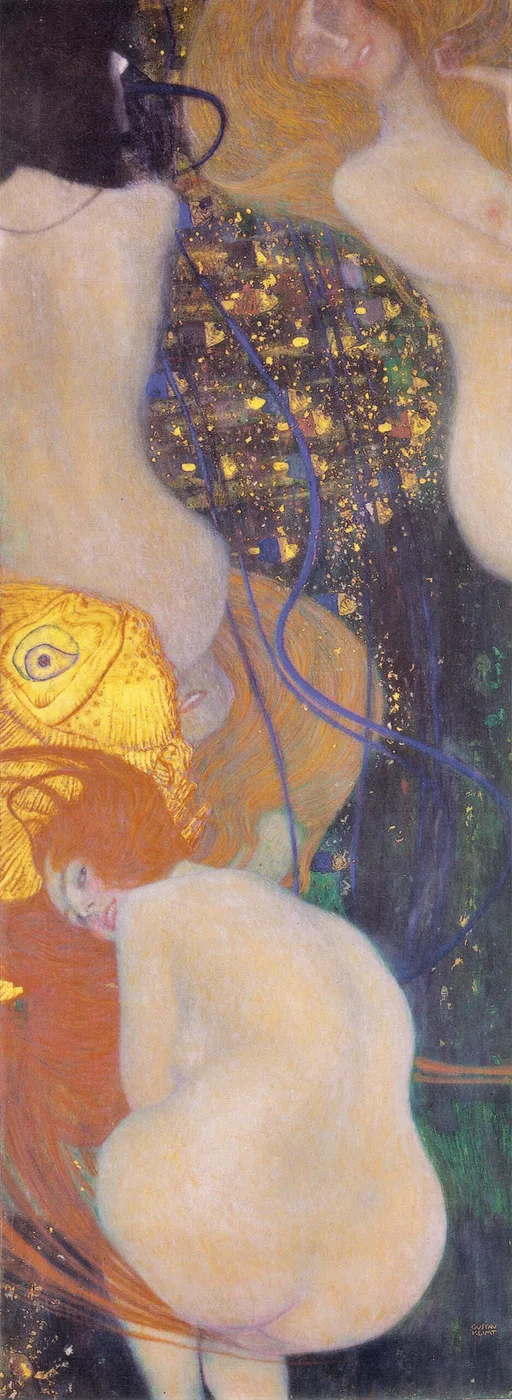
The canvas is far taller than it is wide, closer to a doorway than to a conventional picture. Klimt had used that elongated, narrow shape before, in paintings such as Goldfish, and a wide gilded wooden frame surrounds this canvas too, its vertical bands of worn, streaky gold leaf echoing the gold inside the picture itself.
The woman fills nearly the whole height of the canvas, cropped at the hip by the patterned skirt that closes off the bottom of the picture. There is no floor, no horizon and no room around her, only flat ornament behind her shoulders and the gold frame at the outer edges.
Her head turns to one side and tilts back slightly. Her eyes are heavy-lidded, her lips are parted and painted a deep red, and a small dark mark sits on her cheek. Her black hair falls loose past her shoulders and down her back.
Across her collarbone lies a wrap of white cloth dotted with pink roundels, each centred with a dark red mark, like stylised flowers or eyes stitched onto a bandage. Below it, one breast is bare, the skin painted in soft, even ivory tones against the pattern around it.
Behind her shoulders the ground turns a deep rust orange, broken near her shoulder by a patch of small enamel-coloured squares, turquoise, magenta, navy and white, set in a loose checkerboard. Lower down, gold spirals coil over the same orange ground, a motif Klimt also used at full scale in the Stoclet Frieze: Tree of Life, while a swirl of grey and black paisley spirals covers her hip and a thin white ribbon winds from her shoulder down through the patterned skirt toward the bottom of the canvas.
Her near hand hangs low, bent into a claw, fingers curled and ringed, with bracelets of turquoise and red beads stacked up the wrist. It hovers just above a man’s head wedged into the lower right corner, eyes shut, mouth slightly open, hair and beard a dull red-brown against the dark ground behind it.
The skin stays smooth and softly shaded, while the robe below is handled as flat, hard-edged shapes: black and white triangles, small teal and red rectangles laid in sharp geometric rows. The gold here carries visible, broken brushstrokes, rougher than the flat, burnished sheen of Klimt’s earlier gold paintings, a change that lines up with the looser handling he brought back from Paris and Madrid that year.
Judith’s Triumph or Salome’s Prize: Two Ways to Read the Gesture
The picture shows the moment after a killing. Her hand stays closed over the head, and her own face turns away from it, eyes shut, mouth open, with no sword and no gesture of display to settle what the viewer is looking at.
Read as Judith, the picture shows the widow who saved her city by killing an enemy general in his own tent. Her closed hand can be read as grip rather than release, the instant just after the act rather than a staged moment of victory.
Read as Salome, the same gesture turns from duty into appetite. In that story, a dance earns her the head of a prophet as a reward, and the bare chest, parted lips and half-closed eyes fit a story about desire more than one about rescue.
Both readings put a woman in control of a man’s fate, a theme Klimt had already painted once, in Judith I.
The gallery that catalogues this canvas keeps both names attached to it, Judith and Salome together, rather than settling on one.
Seeing the Original at the Galleria Internazionale d’Arte Moderna
The Galleria Internazionale d’Arte Moderna holds the original, a canvas measuring 178 x 46 cm, a shape that reads much closer to a panel than to a square picture, and the gilded frame around it adds width without adding height.
Standing in front of it means looking at a narrow, close-up figure rather than a wide scene. For a closer look at the surface before choosing a size, the Judith II (Salome) page carries enlarged photographs of the face, the hand and the severed head.
Choosing an Oil or a Print of Judith II (Salome)
This shop sells Judith II (Salome) in two versions, both made from the museum’s own photograph of the painting: a hand-painted oil and an archival canvas print. The choice between the two comes down to method and feel, since both start from the same image, and the full range of sizes sits on the Judith II (Salome) product page.
In the hand-painted oil, an artist builds the image with a brush, laying in the large fields of colour first, then the patterned passages, then the fine detail of the face and the hands. That suits this canvas: the soft, shaded skin and the flat, hard-edged ornament of the robe come through with real texture, and no two canvases come out quite identical.
The archival print is a high-resolution giclee on canvas, printed from the same source image. It gives a close, consistent match to the museum photograph on every print, a practical choice on a tighter budget or when several pieces need to match.
Every size keeps the original’s narrow proportions; none stretch the figure into a standard rectangle. That shape suits a slim stretch of wall, beside a door, in a hallway, or between two windows, and a wall that catches both daylight and lamplight through the day shows the gold better than one lit only one way.
Before a hand-painted order ships, the studio photographs the finished canvas so you can check the colour and detail against the original and approve it. Painting the oil by hand takes 2 to 4 weeks. Printing takes 2 to 4 business days. Delivery then takes 5 to 7 business days. Framing and stretcher choices work the same way across sizes, whichever edition you pick from the Judith II (Salome) page.
Questions Buyers Ask About Judith II (Salome)
What does Judith II (Salome) show?
A woman fills most of the tall canvas, one hand closed above a man’s severed head resting near the bottom edge, in a picture shown under both the names Judith and Salome.
Why does the same painting carry two names?
Judith and Salome are separate women from different biblical stories, each linked to a severed male head, and the painting is still shown under both names today.
What is the difference between the hand-painted oil and the print?
The oil is painted by hand with real brushwork and texture, slightly different canvas to canvas, while the print is a consistent giclee copy, a practical choice on a tighter budget.
Which size and frame suit this composition?
Because the original is a narrow vertical panel, every reproduction keeps those same proportions, which suits a slim wall, a hallway or the space beside a door better than a wide room wall.
Can I see the piece before it ships?
Yes. For the hand-painted oil, the studio photographs the finished canvas so you can check it and approve it before it leaves the studio.
More from this collection
Bring this painting home
Choose a hand-painted oil reproduction for real brushwork, or an archival canvas print for a crisp museum-image edition. Every size preserves the original proportions.
View this work & options
Further reading
Verify the original in the Galleria Internazionale d'Arte Moderna collection record and continue through related works in the catalogue.